Apple Peel Extract Powder: What is Quercetin and What Are Its Benefits?
Apple peel extract powder is a food-grade botanical ingredient standardized to 30% apple polyphenols via HPLC, produced through spray drying from the exocarp of Malus domestica. Its primary bioactive compound, quercetin, is a flavonoid that delivers antioxidant, anti-inflammatory, and metabolic benefits. For OEM manufacturers and DTC supplement brands, this ingredient offers a scientifically grounded, clean-label option across capsules, tablets, powders, and gummies. Understanding its chemistry, applications, and sourcing criteria helps procurement teams make faster, lower-risk purchasing decisions.

Introduction
In 2023, the world market for quercetin was worth USD 670 million. Grand View Research (2023) says the market will grow at a rate of 7.4% per year until 2030. This is mostly because more people want products that have natural antioxidants. Apple peel extract powder is at the center of this growth because it is one of the best and least expensive ways to get large amounts of quercetin for business use.
When buying managers look for raw materials for supplement OEM companies, they don't just ask, "What is quercetin?" Can you get this item in 10–20 days, give me a full COA, and make sure there is enough stock? The answer to both of them is in this piece.
Understanding Apple Peel Extract Powder and Quercetin
What Is Quercetin?
Apple peels have a lot of quercetin (3,3′,4′,5,7-pentahydroxyflavone), which is an important flavonoid. The 2016 study in the journal Nutrients found that apple peel has a lot more quercetin than apple meat. It has 4.4 mg/g of dry weight. It comes from flavonoids and can be used to make things that are good for your heart, metabolism, and nerves. Free radicals can also be fought with it.
How Apple Peel Extract Powder Is Made
Following three well-thought-out steps will help you make apple peel extract powder. To begin, clean, squeeze, and mix raw apple peels with other things. Second, spray drying at 150–220°C turns the liquid into a fine, even powder that still has the good qualities of the liquid. Third, after processing, steps like screening and moisture-controlled packing make sure that all the particles are smaller than 80 mesh, have a mass density of 35–50 g/100 mL, and dry out with less than a 5% weight loss.
Organic vs. Conventional Sourcing
| Parameter | Organic Apple Peel Extract | Conventional Apple Peel Extract |
|---|---|---|
| Pesticide residue risk | Lower | Requires strict LC-MS/MS screening |
| Cost | 15–30% higher | More cost-competitive at scale |
| Certification | USDA Organic, EU Organic | ISO, GMP, Halal, Kosher |
| Typical buyer | DTC/iHerb brands | OEM factories, B2B bulk buyers |
Most of the time, procurement teams buy standard-grade materials that pass the necessary third-party pesticide screening (USP <561> LC-MS/MS). The level of safety offered by these materials is the same, but they cost less per kilogram.
Key Benefits and Applications of Apple Peel Extract Powder
Antioxidant and Anti-Inflammatory Properties
The quercetin glycosides, chlorogenic acid, and procyanidins in apple peel extract powder make it an antioxidant. Food Chemistry published a study on it in 2021 that found its ORAC value to be over 7,000 µmol TE/g. This is a lot higher than many synthetic options. The extract also has ursolic acid, a triterpenoid that helps stop COX-2 from doing its job. So, it can be used to make products that help with pain and inflammation.
Metabolic and Cardiovascular Support
Because of the quercetin and phloridzin in the extract, α-glucosidase and α-amylase enzymes can't do their job. Because of this, the body takes longer to take in glucose. In 2022, a large study published in the journal "Phytomedicine" found that people with metabolic syndrome who took quercetin pills had much lower blood sugar levels when they woke up. Apple peel has procyanidins that help the arteries work better. This means that they are good for both heart health and gut health.
Multi-Industry Applications
Apple peel extract powder can be used for many different kinds of formulations. This part of the recipe works best for the following in business:
- Dietary supplements: The 30% polyphenol content is good for immune boosters, metabolic health mixes, and heart health pills. It can be used in both hard pills and tablets that fizz because it dissolves in water.
- Functional food and beverages: Apple polyphenols are found in lipid-rich matrices in amounts between 0.1% and 0.2%. This means they naturally help keep foods and drinks fresh. It is against the law for Rancimat to have an Oxidative Stability Index (OSI) that was lower than or equal to BHT.
- Cosmeceuticals: The extract has ursolic acid, which helps the body make collagen and lowers inflammation caused by UV light. This makes it useful for anti-aging skin care products.
- Sports nutrition: Some formulas for muscle recovery after exercise help muscles heal by reducing inflammation, and they don't need any extra ingredients.
People are using supplements in these ways more and more in both North America and Europe. When OEM factories buy this stuff, they know exactly how to make new things with it.
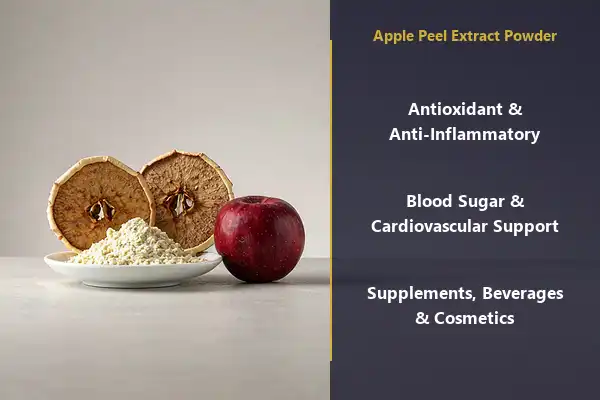
Comparing Apple Peel Extract Powder with Related Products
Apple Peel Extract vs. Whole Fruit Powder
| Ingredient | Polyphenol Content | Primary Use | MOQ Typical |
|---|---|---|---|
| Apple peel extract powder (30% HPLC) | High (3–5× flesh) | Supplements, cosmetics, functional food | 1 kg |
| Apple juice powder | Low | Flavoring, general nutrition | 25 kg |
| Apple pomace extract | Medium | Fiber-based formulations | 25 kg |
| Whole apple powder | Low–Medium | Food blending | 25 kg |
Apple peel extract powder has three to five times more quercetin and ursolic acid than powders made from whole fruit or pomace. Since OEM companies have to list the amount of active compounds on the COAs for finished goods, it is easier for them to make sure that every batch is the same when they use a standardized 30% polyphenol extract instead of a non-standardized fruit powder.
Certification and Compliance Comparison
Just as important as the list of needs is the stack of certificates that the provider has. Certifications like cGMP, FSSC22000, ISO9001, HACCP, and organic should all be a part of a full compliance picture for markets that are managed. Muslims and Jews are harder for OEM clients in North America and the Middle East to reach when their providers don't have the right Halal or Kosher papers.
Cost and Risk Trade-offs
Apple peel extract powder that hasn't been regulated or properly approved is usually 20–30% cheaper per kilogram, but there are risks, such as issues with the COA at customs, label claims that don't follow the rules, and the possibility that direct-to-consumer brands will get letters from the FDA warning them about their products. When they have to reject a single package because the COA doesn't match, OEMs who buy between $8 and $30 million worth of raw materials a year lose a lot more money.
Procurement Guide for Apple Peel Extract Powder
Evaluating Supplier Qualifications
A trustworthy business that offers apple peel extract powder should have a full COA that shows the overall plate count (<10,000 cfu/g), the amount of yeast and mold (<1,000 cfu/g), the amount of heavy metals (As ≤2 ppm, Pb ≤2 ppm, Cd ≤1 ppm, Hg ≤0.1 ppm), and the solvent residues. If you want to bring something into the US, EU, or Australia, you have to follow the USP/EP botanical monograph rules.
Logistics and Delivery
| Shipping Method | Typical Transit Time | Best For |
|---|---|---|
| Express (DHL/FedEx) | 3–7 days | Samples (1–25 kg), urgent small batches |
| Air freight | 5–10 days | 25–200 kg trial orders |
| Sea freight | 18–35 days | Bulk orders 200 kg–5 MT |
If the factory has to decide every 30 to 60 days, they should make sure that the supplier has at least 1 MT of standard 30% polyphenol on hand. If you give them 10 days, you can deliver the goods and keep production on track without having to make long-term plans.
OEM and Customization Options
If a factory needs finished dosage forms, it only needs to work with one supplier. This is because that supplier can do both OEM and ODM. The same source can be used to make apple peel extract powder into sweets, pills, and powders. As an example, you can only order 1 kg of raw material at a time. One to five MT per quarter for a whole year is the most that can be agreed upon.
Safety, Dosage, and Side Effects
Recommended Dosage by Application
Researchers have found that taking 250 to 1,000 mg of quercetin from apple peel extract powder every day is a good amount (Journal of Nutrition, 2020). Functional foods are added in amounts between 0.5% and 2% by weight. Most makeup for the outside have a ratio of between 0.5% and 2%.
Safety Profile and Contraindications
Apple peel extract powder has been safe for a long time when used in food-sized amounts. The European Food Safety Authority (EFSA) says that people can safely take up to 500 mg of quercetin every day. But some medicines and drugs that thin the blood might not work well with quercetin at doses of more than 1 gram per day. When these things happen, formulators should put standard "contraindication" text on the labels of finished goods.
Third-Party Testing as Non-Negotiable
Every batch of apple peel extract powder should be tested by both a lab inside the company and a lab outside the company. This means that lab results that are OK with ISO/IEC 17025 can be sold in the US. A heavy metal and microbial COA must match the shipped product if you want to sell it on Amazon or iHerb. If the ad doesn't go down, the transfer will be held up.
Conclusion
Apple peel extract powder is a trustworthy ingredient with numerous uses. It's easy for OEM supplement factories and brands that sell directly to customers to buy. It has 30% standardized polyphenol content, which was proven by HPLC. This means that it always works like quercetin in goods used for weight loss, skin care, heart health, and inflammation. They only need to see a full COA, triple certification, an inventory that is always in stock, and the ability to do OEM work to make their choice. When these things happen, delivery times get shorter, people are less likely to break the rules, and product development goes faster.
FAQ
1.What differentiates apple peel extract powder from standard quercetin supplements?
Apple peel extract powder has quercetin in its natural glycoside form, along with co-factors like chlorogenic acid, ursolic acid, and procyanidins. If used in some recipes, this full-spectrum polyphenol profile might help more than quercetin aglycone by itself.
2.How do I verify the 30% polyphenol content claim is accurate?
Ask for both the COA from your own company and the HPLC test results from a third party. Yes, you can trust your lab results as long as they have been approved by ISO/IEC 17025 and have the same batch number as the shipping paperwork.
3.What is the minimum order for sampling?
It takes one kilogram of the first samples to work on the formula and test it in the lab. A lot of small batch sales start at 100 kg.
4.Is OEM finished product manufacturing available?
The same company does make powder, pills, tablets, and sweets. You can also change the amount, the brand name, and the way the product is packed to make it fit your needs.
Partner with Asianbios for Bulk Apple Peel Extract Powder Supply
Asianbios sells apple peel extract powder made from apple peel that is safe for food use. Halal, Kosher, cGMP, FSSC22000, and ISO9001 have all approved it, and 30% polyphenols are known to be in it. We usually have more than 1 MT in stock, and it takes 10 days to ship. There are four dosage types for OEM/ODM production, and orders range from 1 kg samples to contracts for several tons every three months. Send our team an email at plantex@asianbios.com or visit asianbios.com to find out more about our products, get costs, and see COA samples.
References
1. Boots, A. W., Haenen, G. R. M. M., & Bast, A. (2008). Health effects of quercetin: From antioxidant to nutraceutical. European Journal of Pharmacology, 585(2–3), 325–337.
2. Manach, C., Scalbert, A., Morand, C., Rémésy, C., & Jiménez, L. (2004). Polyphenols: Food sources and bioavailability. American Journal of Clinical Nutrition, 79(5), 727–747.
3. Bhagwat, S., Haytowitz, D. B., & Holden, J. M. (2014). USDA database for the flavonoid content of selected foods. U.S. Department of Agriculture, Release 3.1.
4. Kelly, G. S. (2011). Quercetin: A review of potential health benefits. Alternative Medicine Review, 16(2), 172–194.
5. Hollman, P. C. H., & Katan, M. B. (1999). Dietary flavonoids: Intake, health effects and bioavailability. Food and Chemical Toxicology, 37(9–10), 937–942.
6. Knekt, P., Kumpulainen, J., Järvinen, R., Rissanen, H., Heliövaara, M., Reunanen, A., Hakulinen, T., & Aromaa, A. (2002). Flavonoid intake and risk of chronic diseases. American Journal of Clinical Nutrition, 76(3), 560–568.
About the Author
Asianbios
Our purpose is to forge a legacy of stewardship, advancing initiatives that honor and preserve the ecological integrity of our planet.

Send Inquiry
You may like