How to Choose Mimosa Root Bark Extract Powder
To choose the proper mimosa root bark extract powder, you need to know what makes a dependable component and what makes a hazardous one. This botanical substance is harvested from the root bark of Mimosa tenuiflora and contains rich tannins, flavonoids, and trace minerals with cosmetic, health, and industrial uses. The OEM procurement managers deciding on formula ingredients look for COA completeness, extraction ratio uniformity and supplier certification. This article talks you through all the things that matter before you get your first trial order or quarterly framework contract.


Understanding Mimosa Root Bark Extract Powder
What Is Mimosa Root Bark Extract?
Mimosa tenuiflora is a tree of northeastern Brazil and portions of Central America. This is extract of the root bark of the mimosa. For a long time Mexican physicians have been using the wood of the Tepescohuite tree to cure skin ailments and burns. New study on phytochemicals showed the presence of arabinogalactans, flavonoids (≥2%), tannins (10–30%) and flavonoids (≥2%). It contains materials that make skin cells strong, make skin tight and are antioxidants.
Key Bioactive Compounds and Their Functions
The tannin in mimosa root bark extract is naturally tightening skin by binding small proteins to the surface of the skin. This helps to cure wounds. Flavonoids may help to reduce skin redness and oxidative stress. Arabinogalactans are used as supplements to assist modulate the immune system. You may produce all sorts of items from cosmetics to medicine with the extract combined with these compounds.
Why the Extraction Method Matters
The liquid is then spray-dried quickly at carefully controlled temperatures (150–220°C) to form a fine, homogenous powder. This retains heat sensitive bioactives. Spray-dried mimosa root bark powder has better flowability, same bulk density (35–50 g/100 ml) and 100% passes through 80 mesh, but freeze-drying or only evaporation does not produce any of these. All of these influence the effective production of tablets, capsules and sweets.
Key Criteria to Consider When Choosing Mimosa Root Bark Extract Powder
Procurement teams usually quickly narrow it down to four or five providers but the real differentiators happen during technical evaluation. Only place a trial order once you have scored each candidate against a set of agreed quality criteria.
Here are the most essential elements that all procurement managers need to use:
- COA Completeness: Complete evidence of analysis should include heavy metals (Pb ≤2 ppm, As ≤2 ppm, Cd ≤1 ppm, Hg ≤0.1 ppm), yeast and mould (<1,000 cfu/g), total plate count (<10,000 cfu/g) and solvent residues. No panels are a warning flag for markets that are overseen by the FDA.
- Assay of active ingredient: Ask for HPLC or UV-VIS for measurement of total tannins and flavonoid markers Figure 10:1 implies 1 kg of concentration comes from 10 kg of raw bark. This number should be supported by research, not just the symbol.
- Certifications: Standard certifications for shipping in the US and other countries include HALAL, KOSHER, cGMP, FSSC22000, ISO9001, HACCP. North American direct-to-consumer companies are demanding more of their products to be certified organic.
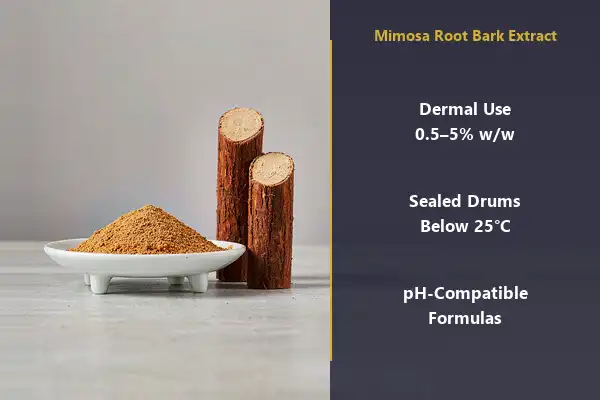
- Packaging and Stability: Food grade mimosa root bark extract powder should be packed in sealed LDPE fibre drums at a temperature below 25°C and sheltered from direct sunlight. Each drum must hold 25 kg of powder. The powder when sealed has a shelf life of 24 months.
These criteria help safeguard your formulation from label-value variation, one of the most common reasons for regulatory rejection in the supplement sector.
| Specification | Acceptable Range | Test Method |
|---|---|---|
| Total Tannins | 10%–30% | HPLC / UV-VIS |
| Heavy Metals | ≤10 ppm total | ICP-MS |
| Total Plate Count | <10,000 cfu/g | Standard Plate Count |
| Moisture (LOD) | <5% | Oven Drying |
| Particle Size | 100% through 80 mesh | Sieve Analysis |
Comparing Mimosa Root Bark Extract with Alternatives
Mimosa Tenuiflora vs. Mimosa Hostilis
Mimosa tenuiflora and Mimosa hostilis are not different species; they are the same tree. The name "Hostilis" is fairly old. What changes are where the crops are grown, when they are grown, and how they are treated after they are picked. Most of the time, root bark from Mexico has less tannin than root bark from Brazil. You should always ask for proof of plant identity and proof of place from a seller before you agree to do business with them.
Mimosa Extract vs. Other Tannin-Rich Botanicals
Both witch hazel and oak bark extract are good for your skin because they have tannins in them. The tannins in mimosa root bark extract, on the other hand, naturally bond with protein fibers and textile bases, so you don't need to use chemical mordants. While flavonoids and tannins work together in mimosa extract, it is harder for cosmetic OEM clients who want to make lines for wound care or anti-aging to do so with single-compound alternatives.
Conventional vs. Standardized Extract
| Product Type | Active Guarantee | Batch Consistency | Price Point |
|---|---|---|---|
| Raw Bark Powder | None | Low | Low |
| 4:1 Standard Extract | Moderate | Moderate | Medium |
| 10:1 Standardized Extract | High (assay-verified) | High | Medium-High |
For supplement products to get registered and beauty claims to be true, standardized 10:1 mimosa root bark extract powder helps formulators make doses that are correct.
Practical Procurement Guide for Bulk Buyers
MOQ, Sampling, and Trial Order Structure
Normally, to receive a new botanical ingredient, you have to place an order, wait 1 to 3 days, have a sample sent (5–7 days via DHL or FedEx), confirm a 100 kg trial batch and then sign a framework contract every three months for 1 to 5 metric tonnes. The free sample and minimum order quantity (MOQ) of 1 kilogram allow procurement engineers to test the formula and be certain it works with other items before establishing a budget.
Logistics and Customs Compliance
Mimosa root bark extract of Mimosa tenuflora may be sent by air freight, sea freight and express mail worldwide. If you are exporting by sea, check sure the COA you get matches the batch of products actually produced. The major reason why customs hold items is the difference between the COA and the actual shipment. When you book ask for a COA for that batch, not a generic one.
Pricing Factors
The unit pricing varies on the origin of the raw material, the quantity extracted, the number of active chemicals guarantyd and the nature of the evidence provided. A validated 10:1 extract with complete heavy metal and microbiological panels from a cGMP-certified facility will cost more per kilogram than an unconfirmed powder. But it’s far more expensive to have a shipment rejected or to receive a letter from the authorities with a warning.
Ensuring Safe and Effective Usage of Mimosa Root Bark Extract Powder
Handling and Dosing Protocols
Ethnobotanical literature can teach you a lot about how to apply mimosa root bark extract on your skin. Often used amounts are between 0.5% and 5% w/w. Check local rules for dietary supplements. Before you take a product into a new market you should go to a regulatory expert to be sure that you understand the restrictions around an ingredient.
Storage Conditions and Shelf Life
For it to keep working, it needs to be stored correctly. Drums that are sealed should be kept in a cool, dry place that is less than 25°C and has less than 60% relative humidity. Don't keep opening the drums during production runs. This is how spray-dried mimosa root bark powder can be kept for up to 24 months. There are three months from the time you open it until you eat it.
Contraindications and Safety Guidance
From the study that has been made public, average amounts of use in supplements or cosmetics have not been linked to any major side effects. But companies that make products should put allergen information on the labels and test their products to see if they work with very acidic or basic materials when they mix mimosa extract with them. This is because tannins can form when the pH level is too high or too low.
Conclusion
To pick the best mimosa root bark extract powder, you need to do more than just look at a price list. Before placing big orders, it's important to check the extraction ratio, get a full COA, make sure the supplier's credentials are correct, and put the logistics through their paces. There is basic paperwork that buying managers need to make sure they are following the rules in the global market. It is a 10:1 spray-dried extract from a cGMP-certified plant that is also HALAL, KOSHER, and ISO9001-certified. First, make a 1 kg test batch to make sure your method works. Then, make a plan to get raw materials every three months so that you don't run out.
FAQ
1.What is the standard specification for mimosa root bark extract powder?
We use a 10:1 concentration ratio and spray-dry the material until it turns into a brown-yellow to brown powder that can pass through 80 mesh. It's safe to store for 24 months and has a bulk density of 35–50 g/100 ml.
2.What certifications does the product carry?
cGMP, FSSC22000, ISO9001, HACCP, HALAL, and KOSHER certifications are all on the extract. These are all needed to sell it in the US, EU, Middle East, and Asia.
3.What is the minimum order quantity?
The first order is for 1 kg. You can try the recipe on free samples before agreeing to a test run.
4.How do you prevent label-value deviation between the COA and the actual batch?
There is an HPLC test for active chemicals, an ICP-MS test for heavy metals, and a standard plate count test for microbes for every batch of output. The COA for each batch is not based on a master form, but on real test findings.
5.What shipping options are available?
We ship with DHL, FedEx, and SF fast for fast and plane freight. We offer sea freight for large orders, and we accept EXW, FOB, CIF, and DDP as payment terms.
Get Mimosa Root Bark Extract Powder from a Trusted Manufacturer
A reliable company called Asianbios can connect you with mimosa root bark extract. They have more than a ton of stock ready to ship in 10 days. All of these groups have given us permission to sell our 10:1 food-grade extract, and each batch comes with a full COA. OEM/ODM production can start at 1 kg MOQ and come in powder, pill, tablet, and chewy forms. Send an email to plantex@asianbios.com or visit asianbios.com right now to get a sample.
References
1. Camargo-Ricalde, S. L. (2000). Description, distribution, uses and management of Mimosa tenuiflora (Fabaceae) in Mexico. Revista de Biología Tropical, 48(4), 939–954.
2. Meckes-Lozoya, M., Lozoya, X., & González, J. L. (1990). Pharmacological properties of Mimosa tenuiflora bark. Journal of Ethnopharmacology, 29(2), 233–238.
3. Eloff, J. N. (1999). The antibacterial activity of 27 southern African members of the Combretaceae and Mimosaceae. South African Journal of Science, 95(9), 429–434.
4. Harborne, J. B. (1998). Phytochemical Methods: A Guide to Modern Techniques of Plant Analysis (3rd ed.). Chapman & Hall.
5. European Medicines Agency. (2021). Assessment Report on Herbal Medicinal Products Containing Tannins. EMA/HMPC Committee on Herbal Medicinal Products.
6. United States Pharmacopeia. (2023). USP–NF General Chapter: Botanical Extracts and Standardization. United States Pharmacopeial Convention.
About the Author

Asianbios
Our purpose is to forge a legacy of stewardship, advancing initiatives that honor and preserve the ecological integrity of our planet.

Send Inquiry
You may like