Key Features to Look for in a Modern Flash Dryer Device
When procurement engineers evaluate industrial drying equipment, the flash dryer device consistently stands out for its speed, thermal efficiency, and versatility. Unlike rotary or spray dryers, a flash dryer device completes moisture removal in under three seconds by combining high-speed hot airflow with mechanical dispersion. This makes it the preferred choice for processing fermentation filter cakes, starch, herbal residues, and paste-like wet materials across chemical, food, and biological fermentation industries. Understanding what separates a well-built flash dryer device from a mediocre one helps you avoid costly commissioning failures.
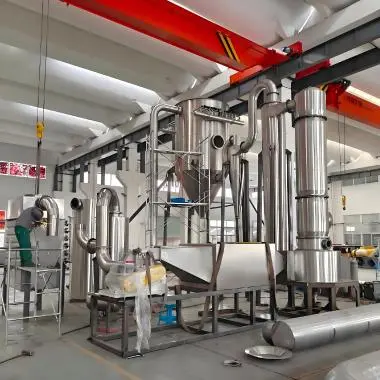
Understanding the Core Principles and Operation of Flash Dryer Devices
How the Drying Mechanism Works
Wet things are moved into a cylinder-shaped drying chamber by a flash dryer. Hot air is blown out at high speed. The fan at the base swirls rough air around, which breaks up the material that comes in and dries it. The name "flash" comes from the fact that the gas phase stays in place for less than three seconds. The touch of hot air with spread-out particles almost instantly drains water without making any spots too hot.
Operating Temperature and Capacity Range
This is how a normal flash dryer works: the temperature at the input can be between 160°C and 350°C, and the temperature at the exit can stay between 80°C and 120°C. To work with inorganic materials, the temperature at the entry can reach up to 650°C. Process speeds on industrial-scale units range from 100 kg/h to 5,000 kg/h, and the rate at which moisture is removed ranges from 50 kg/h to 15,000 kg/h. If you match your output flow to the right amount of capacity, you can avoid waste and bottlenecks that come from having too many requirements.
Automation and Control Architecture
Modern flash dryers have PLC automatic control, which checks the temperatures at the feed and exhaust points, the fan speed, and the amount of air moving through it all in real time. With frequency-conversion fans, engineers can change the flow of air without having to stop work. The feeding screw will stop if the temperature at the opening goes above a certain amount set by the control software. This keeps things that can't handle heat from getting burned.
| Parameter | Standard Range | High-Performance Range |
|---|---|---|
| Inlet Temperature | 160–350°C | Up to 650°C |
| Outlet Temperature | 80–120°C | Application-dependent |
| Processing Capacity | 100–1,000 kg/h | Up to 5,000 kg/h |
| Moisture Evaporation | 50–500 kg/h | Up to 15,000 kg/h |
Essential Performance Features That Affect Efficiency and Output
Thermal Efficiency Comparison
If the flash dryer is well-made, it can reach up to 90% thermal efficiency, which is a lot higher than tray dryers and other systems with rotating drums. Spray dryers work well for liquid food, but they need a lot more power to remove one kilogram of water. The agitated fluidization idea in a flash dryer makes it possible for hot air and wet particles to hit more surfaces. This makes each drying cycle use less energy.
Continuous Production and Anti-Clogging Performance
One thing engineers like about rotating flash dryers is that they don't get clogged up very often. The system that stirs and crushes the lumps breaks them up all the time so they don't stick to the walls of the chamber. This means that the flash dryer can work with filter cakes and pastes that a static-bed dryer would get stuck on. When you use spiral or pump mechanisms for continuous feeding, there is no batch-start downtime, so the overall cost per ton goes down.
Safety Features and Compliance Standards
Before they buy something, procurement teams need to make sure of these core compliance factors:
- Negative pressure operation: The system runs under slight vacuum, which prevents dust from escaping the chamber and supports ATEX/NFPA compliance for organic powder handling.
- GMP-grade surface finish: Pharmaceutical and food-grade units use SUS316L stainless steel with Ra < 0.4 µm finishes, satisfying GMP and HACCP hygiene requirements.
- Pressure vessel certification: Units intended for regulated markets must meet ASME VIII Div. 1 or CE/PED standards; verify mill certificates and weld inspection records before acceptance.
You can avoid government checks and work accidents during the factory acceptance test (FAT) by making sure that these three things are met.
Comparing Flash Dryer Device Types and Their Applications
Spin Flash vs. Pneumatic Conveying Flash Dryers
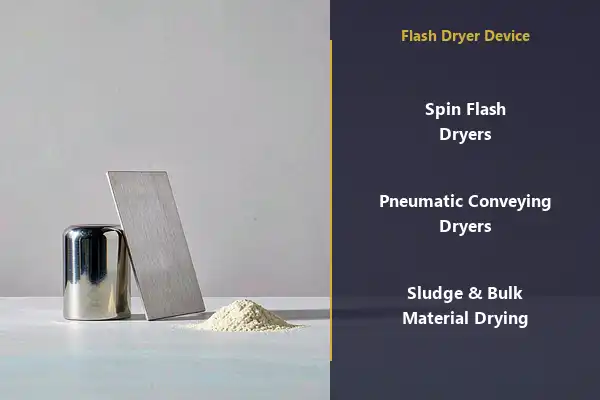
The bottom of the spin flash dryer device has a rotor that sets the particle cut-point to d50 values between 5 and 100 microns so that they don't need to be milled later. This is good for pigments and medicine powders where the particles need to be the same size all the time. On the other hand, pneumatic conveying flash dryers move lighter materials that are already spread out through a straight stack of dryers. In lines that prepare starch or feed additives, where grain size is not as important, they work better.
Application Scenarios by Industry
| Industry | Typical Material | Key Performance Requirement |
|---|---|---|
| Biological Fermentation | Fermentation filter cake | Low outlet temperature, anti-clogging |
| Chemical Processing | Iron oxide, titanium dioxide | Wear-resistant liner, color consistency |
| Food & Agro | Vital wheat gluten, starch | Controlled outlet ≤60°C, moisture accuracy |
| Environmental | Industrial sludge | High moisture reduction, sterilization |
| Chinese Herbal Medicine | Herbal residues | Gentle thermal profile, GMP compliance |
Real-World Case: Sludge Drying
Any flash dryer that has to deal with industrial sewage sludge will have a hard time. It's possible for the feed to have up to 80% water in it, and when the material is stressed mechanically, it changes how thick it is. This adjustable feed works well with a flash dryer that has a bottom-entry stirrer. In one pass, this dryer can lower the moisture level to less than 10%. All germs in the product are killed by the heat shock, so it can be burned or used in gardening. Plus, more than 70% less trash needs to be thrown away.
Buying Guide: Selecting the Right Flash Dryer Device for Your Business
Defining Your Technical Requirements
Before you call a flash dryer device provider, write down a list of your material's moisture level, particle size distribution, heat sensitivity, and output needs. If the materials come in with more than 50% water, check to see if they need to go through a pre-dewatering step. Setting a highest exit temperature for organics that can't handle high temps is important. Also, make sure that the control system can keep that temperature even if the feed rate changes.
Evaluating Suppliers and Lead Times
You can order standard flash dryer setups from well-known companies and get them in 20 to 30 days. Customized designs, like chamber sizes that aren't standard, special alloy liners, or automation packages that are built in, usually take 30 to 90 days to make. When you look at different sources, these are the things you should ask for:
- Full material traceability certificates (mill sheets) for all product-contact components
- Non-destructive testing (NDT) reports covering critical chamber welds
- PLC loop check records showing interlock verification results
- Vibration analysis data confirming rotor balance at maximum RPM (velocity RMS < 2.5 mm/s)
OEM and Customization Options
You can change the shape of the room, how it warms (electricity, steam, or gas), and how it gets rid of dust so that it fits your utility lines and the space you have. Through OEM partnerships, you can also get control panels with your own brand on them, safety labels that are made just for you, and the ability to connect to your current SCADA infrastructure.
Installation, Automation, and Future Trends in Flash Dryer Technology
Site Preparation and Utility Connections
The steam, power, and cooling water lines need to be checked before the flash dryer unit arrives. Make sure that the motor can get the power it needs and that the PLC container can get the compressed air it needs. The stack for getting rid of dust has to follow the rules for emissions in the area. Sometimes it has a cyclone and bags to filter the air. These catch small particles before the exhaust fan blows out clean air.
Industry 4.0 Integration
Using OPC-UA or Modbus TCP protocols, newer flash dryer device systems can be watched over from a central control room. In this way, engineers can keep an eye on changes in temperature, fan load, and output. Algorithms for predictive maintenance find odd vibrations or changes in temperature before they cause unplanned stops. It's easier to log data for GMP batch records and there is less downtime each year when you can join at this level.
Energy-Saving and Eco-Friendly Designs
When these units are always on, they can cut fuel use by 15–25% because they use waste gas to warm up the air coming in. All of the moving parts in some types of flash dryers now have drives that let you change the speed. They use even less energy during shifts when they don't have to do as much work.
Conclusion
To make sure you can buy the flash dryer device you want, you need to check that it meets all of the necessary requirements for temperature, material, and safety. During the factory acceptance stage, check the ranges of inlet temperatures, the certifications for rotor balance, the GMP surface finishes, and the PLC interlock logic. Your launch risk goes down a lot when sources give you all the information you need, like mill sheets, NDT reports, and loop check records. A well-made flash dryer can process between 100 kg/h and 5,000 kg/h, and it can be heated by gas, electricity, or steam. It can get the same amount of work done in lines that make chemicals, food, alcohol, and medicines.
FAQ
1.What inlet temperature range does a flash dryer device support?
The temperatures that standard units take in range from 160°C to 350°C. To work with solid minerals, you can heat them up to 650°C. A PLC controls the flow of air so that temperatures at the outlets stay between 80°C and 120°C.
2.How does a flash dryer device compare to a spray dryer?
Spray dryers can't dry things that are paste-like or cake-like without first slurrying them. It can be a flash dryer. Also, flash units take up less space and use less energy per kilogram of water that evaporates. They do the same amount of work.
3.What maintenance routines keep downtime low?
After 500 hours of use, check the rotor and covers that won't wear down. Instead of following a set plan, read the pressure difference and change the bag filter parts based on what you find. To keep the bearings in good shape, follow the maker's guidelines and check the PLC interlock features every three months.
4.Can the flash dryer device process heat-sensitive pharmaceutical materials?
It's okay for drugs to be dried as long as the equipment has a GMP-compliant surface finish (Ra < 0.4 µm), SUS316L touch surfaces, and an outlet temperature that stays below 60°C. Make sure you get a material test report before you sign off on the final specs.
5.What certifications should I require from a supplier?
Need to be certified by at least ISO9001, CE, and HACCP. If the parts are going somewhere, make sure they meet the requirements of either ASME VIII Div. 1 or PED.
Partner with Asianbios for Your Next Flash Dryer Device Project
You can buy process technology kits and industrial drying tools at Asianbios. These are made to meet CE, ISO9001, HACCP, and GMP standards. Our flash dryer device setups are made of SUS304/316L and can handle 100–5,000 kg/h. They are also fully automatic with PLCs and come with full help for setting them up. People trust our company to make flash dryers, and we ship them all over the world with DHL, FedEx, and SF Express. Most of the time, lead times are 20 days. Please email our engineering team at plantex@asianbios.com or visit our website at asianbios.com to get mechanical help and a personalized price.
References
1. Mujumdar, A. S. (Ed.). Handbook of Industrial Drying. CRC Press, 2014.
2. Perry, R. H., & Green, D. W. Perry's Chemical Engineers' Handbook. McGraw-Hill, 2018.
3. Keey, R. B. Drying of Loose and Particulate Materials. Hemisphere Publishing, 1992.
4. Bahu, R. E., Baker, C. G. J., & Reay, D. Industrial Drying Technology. Institution of Chemical Engineers, 1986.
5. Grabowski, S., & Mujumdar, A. S. "Solar-Assisted Drying Systems: Applications in Food Processing." Drying Technology, 2009.
6. GEA Group. Flash Drying Technology: Engineering Reference Manual. GEA Process Engineering, 2020.
About the Author

Asianbios
Our purpose is to forge a legacy of stewardship, advancing initiatives that honor and preserve the ecological integrity of our planet.

Send Inquiry
You may like