How Does Multi-effect Evaporator Machine Work? Step by Step Guide
A multi-effect evaporator machine is a continuous liquid concentrator which reuses the steam heat of one stage to the next in series with each stage at a successively lower pressure and temperature. The raw feed is fed to the first effect where it is boiled by live steam. The vapour created warms up the following effect and this cascade may go through 2 to 5 stages. Each effect recycles latent heat that would be wasted in a single-stage device. This results in a significant reduction in steam consumption, gentle low temperature processing and high evaporation capacity. This equipment is the preferred option in pharmaceutical, food, fermentation and waste water treatment facilities globally.
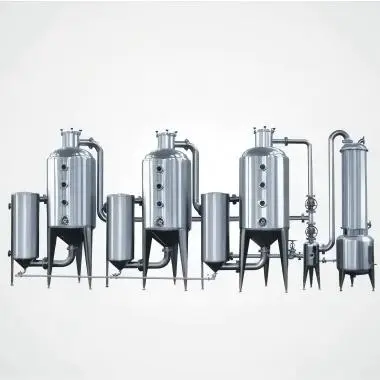

Understanding the Working Principle of Multi-effect Evaporator Machines
What Makes It Different from Single-Effect Systems
The steam consumption for a single effect evaporator is roughly 1.1 kg steam per kilogram water drained. With a three-effect unit this amount is brought down to roughly 0.35 kg and with a five-effect unit it is brought down to below 0.25 kg. This is due to cascade latent heat recovery where the secondary vapour from one action is used to heat the next lower pressure area. This manner no thermal energy is lost by the system.
The Thermodynamic Cascade in Practice
Each effect acts at a lower absolute pressure, which causes the liquid within to boil at a lower temperature. The boiling point elevation (BPE) is the key driving factor for temperature and the overall heat transfer coefficients are typically in the range of 1,000–3,000 W/m²·K depending on the liquid viscosity and the geometry of the tube. Engineers must balance the amount of hits against the fluid’s BPE limit. If you have more than five effects, then the savings on steam typically don’t make up for the greater cost of capital.
Core Equipment Components
There are six parts to the system that all work together:
SUS304 or SUS316L is used to make the heating chamber, which moves steam energy to the feed liquid. SUS304 or SUS316L is also used to make the evaporation box, which removes the vapor from the concentrated liquid. The condenser keeps the pressure and returns secondary steam. SUS304 is what it's made of. The pressure inside the vacuum system stays between -0.08 and -0.098 MPa, and the case is made of carbon steel. The circulation pump has SUS316L wetted parts and a speed that can be changed. Temperature, pressure, flow, and percentage are all tracked by the PLC control panel.
| Component | Function | Material |
|---|---|---|
| Heating Chamber | Transfers steam energy to feed liquid | SUS304 / SUS316L |
| Evaporation Chamber | Separates vapor from concentrated liquid | SUS304 / SUS316L |
| Condenser | Recovers secondary steam, maintains vacuum | SUS304 |
| Vacuum System | Maintains –0.08 to –0.098 MPa | Carbon steel housing |
| Circulation Pump | Variable-speed flow control | SUS316L wetted parts |
| PLC Control Panel | Monitors temperature, pressure, flow, concentration | Industrial-grade PLC |
All the parts are linked together by PLC automation, which lets the machine run at evaporation rates of 1,000 to 50,000 kg/h without being watched.
Benefits and Applications of Multi-effect Evaporators in Industry
Why Procurement Engineers Prefer This Technology
Public thermal design data shows that the multi-effect evaporator machine can save up to 70% of the cost of single-stage systems. There is a deep vacuum that keeps the feed at 50–90°C. This saves energy and keeps active ingredients that are sensitive to heat safe, which is important for pharmaceutical and plant-extract concentration. It is made of clean SUS304/SUS316L stainless steel that meets GMP standards. It can also be cleaned with CIP without losing its surface, and it meets the CE/PED standards for pressure tools used in foreign facilities.
These are the main ways that this equipment helps businesses:
- Steam economy of 2.5 – 5.5 in three-to-six-effect combinations, validated to TEMA thermal design regulations and ASME BPVC Section VIII pressure vessel specifications, providing procurement teams with a defined ROI baseline before purchase.
- Low temperature vacuum operation (50–90°C at –0.08 to –0.098 MPa) protects molecular integrity in plant extract solutions, fermentation liquids, glucose syrups, Chinese medicine extracts and dairy derivatives where heat deterioration would lower the product value.
- Falling film, rising film and forced circulation structural forms are selectable depending on feed viscosity and scaling propensity, enabling one platform to handle wastewater treatment, API concentration and juice processing inside the same facility.
The steam economy for three to six effect designs varies from 2.5 to 5.5 and has been verified by TEMA thermal design codes and ASME BPVC Section VIII pressure vessel regulations. This offers purchasing teams a fair sense of the return on investment (ROI) before they make a purchase.
The operation of vacuum at low temperature (50-90oC, -0.08 to -0.098 MPa) may maintain the molecules intact in solutions of plant extract, fermentation liquid, glucose syrup, Chinese medicine extract and dairy products. Heat would destroy these molecules and hence diminish the value of the product.Depending on the feed viscosity and scaling tendency it is possible to pick falling film, rising film or forced circulation structural types. In the same facility it implies you can use the same platform to treat wastewater, concentrate APIs and manufacture juice.”
Industrial Application Map
| Industry | Typical Feed Material | Key Requirement |
|---|---|---|
| Pharmaceutical / API | Fermentation broth, TCM extracts | GMP, low-temperature, sterile CIP |
| Plant Extraction | Herbal solutions, functional ingredient liquors | Gentle evaporation, no degradation |
| Food & Beverage | Glucose, fruit juice, dairy, syrup | HACCP, food-grade surfaces |
| Wastewater Treatment | Saline effluent, industrial wastewater | Corrosion resistance, ZLD compliance |
| Biofermentation | Microbial fermentation liquid | Continuous operation, high throughput |
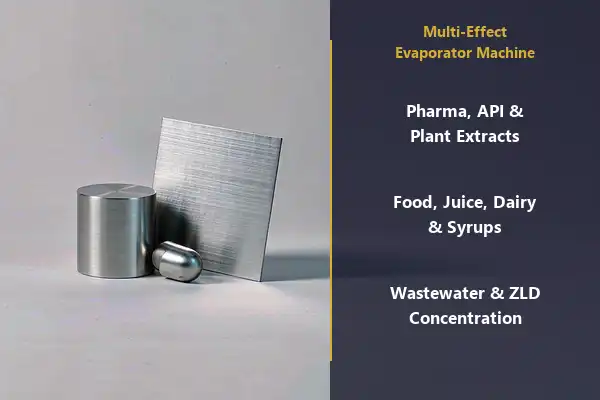
Detailed Guide to Operation and Maintenance
Daily Operating Parameters to Monitor
At least every two hours, operators should write down the level of vacuum, the feed flow rate, the differences in temperature between effects, and the density of the condensed product. If the reading for the vacuum changes by more than 0.005 MPa, it's likely that the condenser is clogged or that the seal is giving way. Both of these issues can be fixed in a matter of hours if they are caught early.
Preventing Scale Formation
The main reason heat movement gets worse is scaling. Forced circulation with fast axial flow keeps deposits from building up on the tube walls for feeds that have a lot of grit. An endoscope is used once a month to look for microfouling in calandria tubes before it gets bad enough for a full CIP. People don't have to do as much work because the PLC has automated anti-scalant dosing systems built in. This makes cleaning take longer.
Troubleshooting Common Problems
| Symptom | Probable Cause | Corrective Action |
|---|---|---|
| Vacuum loss | Seal failure or condenser blockage | Check mechanical seals; inspect condenser |
| Low concentration ratio | Feed rate too high or inter-effect ΔT too small | Reduce feed flow; verify steam pressure |
| Excessive steam consumption | Scale buildup on heat exchange surfaces | Run CIP cycle; inspect tube bundle |
| Product discoloration | Temperature exceedance in first effect | Verify vacuum level; recalibrate temperature sensor |
There are several signs that something is wrong, what needs to be done to fix them, and what the likely cause is: vacuum loss; seal failure or condenser blockage; low concentration ratio; feed rate too high or inter-effect T is too low; lower the feed flow and check the steam pressure. Too much steam is being used; scale builds up on the heat exchange surfaces. Run a cleaning and inspection cycle on the tube bundle. The product turns a different color. The first effect temperature is too high. Check the vacuum level and re-calibrate the temperature sensor.
How to Choose the Right Multi-effect Evaporator Machine
Technical Selection Criteria
Three technical factors play a big role in the decision. First, figure out how much waste water you need (in kg/h) and then match that number to the steam you have when selecting a multi-effect evaporator machine. Second, check your feed fluid's BPE and viscosity. You have to push feeds with a high viscosity to flow. For falling film design, clean feeds with a low viscosity work best. Third, make sure that the items can be used together. Some feeds that have more than 50,000 parts per million of chloride need titanium or super duplex metal tubes instead of 316L tubes to keep them from stress corrosion cracking.
Comparing Effect Numbers Against CAPEX and OPEX
The amount of steam needed goes down when effects are added, but the equipment costs more. Most biotech and food processing plants that get a medium amount of feed do best with a three- to four-effect configuration. Many places that want to get to Zero Liquid Discharge (ZLD) with high-TDS wastewater choose five effects and add Thermal Vapor Recompression (TVR) to the first effect to make the steam economy above 8.
Evaluating Suppliers and Compliance Documentation
Make sure you have Factory Acceptance Testing (FAT) reports, Positive Material Identification (PMI) certificates that prove the grade of the SUS304/SUS316L metal, and records of 100% radiography or ultrasonic weld testing before you sign for the delivery. For markets in the US, look for the ASME stamp. If you want to sell your goods in the EU, you need the CE mark under PED 2014/68/EU. Make sure the service provider is ISO 9001 qualified for quality management and can give you a full process package that includes P&ID plans, layout, a list of tools, and a plan for automating the process.
Procurement Considerations and Soft Promotion
It's not always the same price for industrial evaporation systems. It depends on how many effects they have, how much water they can evaporate, and what kind of material they are made of. A two-effect unit in SUS304 that can handle 2,000 kg/h usually costs less than a five-effect falling film system in SUS316L that can handle 20,000 kg/h. You should add the money you will save on steam utility bills over the next five years to the total cost of ownership. It usually only takes less than 18 months for a single-effect system to pay for itself when it is switched to a triple-effect system.
Asianbios, sells industrial evaporation systems that come with full support for the whole process. The engineers on our team give plant engineers and EPC workers all the information they need to sign off on a project. In this, there are P&IDs, planned plans, an automation method, and a list of all the tools that need to be used. Standard setup and commissioning takes 20 days, and after handover, there is remote monitoring support 24 hours a day, seven days a week. ISO 9001, CE, HACCP, ISO 14001, and ISO 45001 are a few of the certifications.
Conclusion
A multi-effect evaporator machine uses two to five moving steam heat recovery effects in a row to concentrate liquid. When going slowly at 50 to 90°C and high pressure, it can get steam economy rates of 2.5 to 5.5. Because of this, it is the usual way to concentrate things in the food, drug, plant extraction, fermentation, and wastewater treatment businesses. You need to make sure that the effect number, structure form, and material specifications match the rules and the qualities of your feed in order to choose the right unit. If you vacuum check, clean, and test the strength of the welds on these systems on a regular basis, they will work well and last a long time. When buying teams look at multi-effect evaporation systems over a long period of time, rather than just the unit price, they always decide that they are profitable.
FAQ
1.How much energy does a multi-effect evaporator machine actually save?
A three-effect system achieves a steam economy ratio of approximately 2.5–3.0, meaning it evaporates 2.5–3.0 kg of water per kilogram of live steam consumed. Compared with single-effect operation, this represents a verified reduction of 60–70% in steam utility costs, documented consistently in published thermal engineering literature.
2.What is the optimal number of effects for a plant extract facility?
Most plant extract and fermentation plants with feed volumes of 5,000–15,000 kg/h operate best on three or four effects. Beyond four effects, the marginal steam saving decreases while capital cost and system complexity increase. Your feed's boiling point elevation sets the practical ceiling.
3.Can the system handle viscous or scaling feeds?
Yes. Forced circulation design maintains high fluid velocity across heat transfer surfaces, reducing deposit formation. Automated CIP protocols built into the PLC control system further manage fouling between production runs without manual disassembly.
4.What certifications should I request from a supplier?
At minimum, request ISO 9001, CE (PED 2014/68/EU for EU destinations), ASME BPVC Section VIII compliance for US projects, FAT records, PMI certificates, and weld NDT reports. For food and pharmaceutical applications, HACCP and GMP compliance documentation are also required.
5.Does Asianbios provide after-sales technical support?
Yes. Asianbios maintains a spare-parts inventory for prompt delivery, and dispatches on-site engineers for commissioning and operator training within the standard 20-day installation window.
Partner with Asianbios for Your Next Evaporation System Project
Industrial multi-effect evaporator machines from Asianbios are sold. These machines are made with GMP-grade SUS304/SUS316L materials and are CE/ISO approved. They also come with full process package paperwork. The engineering team at our company is here to help you with your project, from the technical specs to the Site Acceptance Testing. You can trust us to make multi-effect evaporator machines. Get in touch with us to get a quote that fits your business's needs. You can start talking about technology right away by emailing plantex@asianbios.com or visiting asianbios.com.
References
1. Evaporation Technology in the Chemical and Food Industries — Chemical Engineering Progress, 2019.
2. Heat Transfer Design for Multi-Effect Evaporation Systems — International Journal of Heat and Mass Transfer, 2021.
3. ASME Boiler and Pressure Vessel Code, Section VIII: Rules for Construction of Pressure Vessels — American Society of Mechanical Engineers, 2023.
4. Pressure Equipment Directive 2014/68/EU: Technical Guide for Manufacturers — European Commission, 2016.
5. Energy Efficiency in Industrial Evaporation: A Review of Steam Economy Optimization — Applied Thermal Engineering, 2020.
6. Process Design of Falling Film and Forced Circulation Evaporators for Pharmaceutical Applications — Journal of Pharmaceutical Engineering, 2022.
About the Author

Asianbios
Our purpose is to forge a legacy of stewardship, advancing initiatives that honor and preserve the ecological integrity of our planet.

Send Inquiry
You may like