What Is Hyaluronic Acid? A Guide To This Ingredient
A natural polysaccharide called a glycosaminoglycan, hyaluronic acid is found in the skin, joints, and eyes. Its major role is to retain the water within the cells, which keeps them wet, soft and pliable. It is widely used in cosmetic products as a salt, sodium hyaluronate . It maintains the skin surface wet and helps serums, creams and masks feel smooth. It affects the way it operates in a formula dependent on the length of its chain . That is that weight . This article is for buyers and formulators who want to know more about grades, specifications and how to acquire a lot of hyaluronic acid powder.
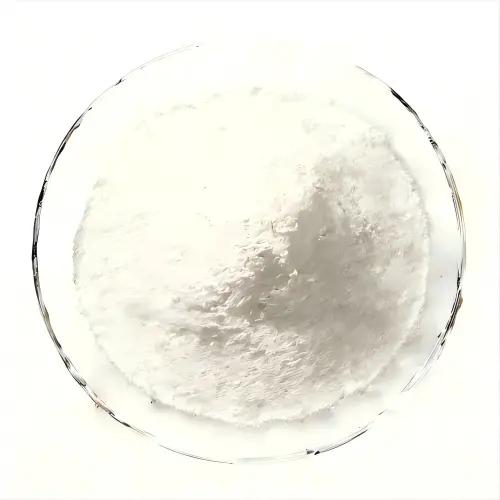
Understanding Hyaluronic Acid: Definition, Benefits, and Daily Use
What Is Hyaluronic Acid and Sodium Hyaluronate?
In 1934, researchers initially discovered hyaluronic acid in the vitreous humor of the eyes of cows. It gets its name from the Greek for glass and uronic acid. The molecule consists of numerous long straight chains of D-glucuronic acid and N-acetyl-D-glucosamine units. The renowned research by Fraser and colleagues states that an adult body has roughly 15 grams of water and loses nearly a third of it per day. You may notice hyaluronic acid, sodium hyaluronate, or hydrolyzed hyaluronic acid on the label. The sodium version of hyaluronate is simpler to handle and break down. These grades have chains, which are cut into shorter ones. Lysozymes ferment food to generate hyaluronic acid, which is largely utilized in cosmetics nowadays.
Hyaluronic Acid Benefits and Common Applications
Many publications claim that hyaluronic acid weighs 1000 times its weight in water. When you apply this on your skin it feels better and the surface becomes softer and smoother. It is in masks, eye creams, serums, creams, gels and formula for sensitive, dry or dehydrated skin after surgery. It is also utilized for medicinal purposes such as dermal fillers and to take care of your hair, eyes and joints. Also note that the advantages of an ingredient are not always the same as the benefits of any final product. The outcomes are dependent on the molecular weight and the concentration and the remainder of the formula and the laws of the market where you sell.
How to Use Hyaluronic Acid in a Skincare Routine
Most individuals use a hyaluronic acid serum shortly after washing their faces, while their skin is somewhat moist. Moisturizer is the next stage since skin loses water slowly. Apply SPF in the morning. The reason it works like that is because anything that seals the surface after a humectant helps it operate better. Hyaluronic acid is generally compatible with vitamin C, retinol, peptides and ceramides, however companies should test the final pH and preservative system. Serum, cream, gel, mask or ampoule – each variety feels different. Make sure the final product is stable, has the proper viscosity, will fit in the box and is safe for customers before you sell it.
Hyaluronic Acid Molecular Weight, Safety, and Common Myths
Hyaluronic Acid Molecular Weight Explained
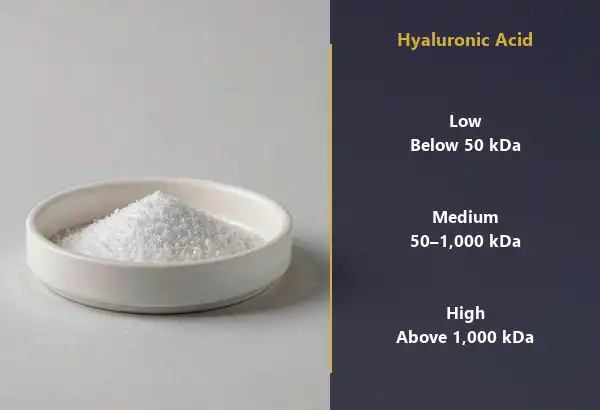
The number of kilodaltons (kDa) a molecule weighs tells us how big a chain is. Size affects how something flows, dissolves, forms a film, and feels on the skin. The ranges from Asianbios' product information are used in the table below because each supplier has their own way of drawing band lines.
| Band | Range | Typical role in a formula |
|---|---|---|
| Low | Below 50 kDa | Lighter feel, thinner solutions |
| Medium | 50–1,000 kDa | Balanced viscosity and skin feel |
| High | Above 1,000 kDa | Surface film, smooth conditioning, higher viscosity |
In 2011, creams that were tested in the Journal of Drugs in Dermatology used hyaluronic acid with different molecular weights. The study looked at changes in how moist, elastic, and deep wrinkles were in the skin. Between the two ends of the range, there is no clear winner. Ask how the test was done and how the results were broken down by lot.
Is Hyaluronic Acid Safe?
Hyaluronic acid has long been employed in the cosmetics. Cosmetic Ingredient Review evaluated hyaluronic acid and its salts and concluded that they are safe to use in cosmetics. But it may not be the hyaluronic acid itself that turns skin red. It’s the scent, it’s the preservatives, it’s the way the formula is made. Most people assume the substance doesn't cause acne but the oils and waxes in the composition tell us whether the product is beneficial for acne prone skin. Materials for medical equipment, spectacles and injections must meet more rigorous requirements, such as limitations of endotoxin and sterility. If the powder is for cosmetic purposes you should never use it for such a purpose.
Common Misconceptions About Hyaluronic Acid
Most of the time three myths stand in the way of producing new things. First, too much might make a solution thick, sticky or unstable, so more isn’t always better. Second, tiny molecules are not necessarily better. You can make the proper choice by considering the purpose of the product, the data, and the claims you’d want to make. 3. One powder will not substitute for another. Two hyaluronic acid powders might be from distinct sources and have different molecular weights They could also have varying moisture and microbial restrictions. And lastly, hyaluronic acid is largely a humectant so keep that in mind. It’s not a substitute for the emollients, occlusives and barrier supportive elements included in a complete moisturizer.
Choosing the Right Hyaluronic Acid Grade and Form
How to Choose the Best Hyaluronic Acid for Different Applications
Job and claim, the market and the market first. So be sure the ingredient is suited for the task. Glycerin is an inexpensive humectant, making things wetter and stickier. Niacinamide may also aid with barrier related aims. Hyaluronic acid holds water in situ and gives a filmy sensation in modest levels. Most times they operate together, rather than against each other. These are 2 separate types of goods that act in various ways. A serum for the skin and a supplement for the mouth. The European Food Safety Authority has rejected several skin claims for oral hyaluronic acid because of the less amount of research that has been conducted on this issue compared to topical usage. The specifications can't tell you how it will function in every basis therefore no matter what you chose you need to test the material in your own base.
Hyaluronic Acid Raw Material Grades and Product Forms
Hyaluronic acid has a wide range of applications, including in medical, eye care, food and supplements, and cosmetics. You can't change them out. This powder may be mixed with gels, serums, creams, masks, and serums. We need improved control over quality systems, endotoxins, bioburden and purity, to make items safer for medical and pharmaceutical usage. It costs cheaper to transport and keep powder than liquid , but you have to be cautious with distributing it . Add it in carefully . Add it slowly to water that is room temperature . And let it absorb the water entirely before adding anything else. This is why they don’t huddle together. “The cross-linked or viscosity-controlled materials have to be discussed differently for each use. Confirm molecular weight, purity technique, microbiological limitations, packaging, storage, shelf life and documentation are correct for your market before purchase.
Asianbios Hyaluronic Acid Powder Bulk Specifications
Asianbios says these things about their hyaluronic acid powder that has been spray-dried and is safe to use for cosmetics.
| Item | Listed value |
|---|---|
| Grade and appearance | Cosmetic grade, white powder |
| Purity | 98% HPLC |
| Particle size | 100% through 80 mesh |
| Bulk density | 35–50 g/100 ml |
| Heavy metals / Lead / Arsenic | ≤10 ppm / ≤2 ppm / ≤2 ppm |
| Total plate count / Yeast and mold | <10,000 cfu/g / <1,000 cfu/g |
| Moisture / Shelf life | ≤5% / 2 years |
| Package / Minimum order | 25 kg drum / 1 kg, samples available |
Most of the time, the amount of glucuronic acid or sodium hyaluronate in hyaluronic acid is used to show how pure it is. Ask to find out how the 98% HPLC number was found. On the standard sheet, there are measurements of molecular weight distribution and endotoxin that are not present. Please let us know what you need before we send the sample.
Sourcing Hyaluronic Acid Powder in Bulk
How to Source Hyaluronic Acid in Bulk
What is the quality ? Who do you want to purchase it ? How will it be packed ? How much do you need each year ? When do you need it ? Etc. Etc. Before you acquire bids you need know what you want to utilize the molecular weight for . Then ask each supplier to provide an analytical certificate, a technical data sheet, safety documentation, microbiological data, allergies, GMOs, BSE/TSE, heavy metals, residual solvents and traceability information for the product. The Modernization of Cosmetics Regulation Act, passed in December 2022, also includes facility registration, product listing and safety proof requirements. U.S. brands should sit up and take notice. Good records of what’s in the meal will save time over time. You can't only look at the price per kilogram. You should also consider the overall cost, including testing, minimum order quantity, lead time, packaging, freight, customs, purity, etc.
How to Evaluate a Hyaluronic Acid Manufacturer or Supplier
First, find out if the firm creates the material, modifies it, delivers it to other areas, or sells it again. Then verify that each certificate is for the appropriate location and the right object. Asianbios has certifications including cGMP, FSSC22000, ISO9001, HACCP, HALAL, KOSHER and organic. Here is how you should examine the extent of any supplier’s certifications. Look at capacity, scaling up potential, what can be changed, deviations, molecular weight control and batch release. OEM and private label customers may also need assistance with product manufacturing, product labeling, product packaging and stability testing. Finally, listen to how people speak. A excellent partner will give you the truth about how things are going. They will answer any technical queries you may have promptly.
From Ingredient Selection to Finished Product: A Practical Procurement Workflow
A lot of beauty teams are going in the same direction. The due dates for each lab and project are different, but this table shows the general order.
| Step | Action | Typical timing |
|---|---|---|
| 1. Specify | Set grade, molecular weight range, purity method, microbial and metal limits | Before sampling |
| 2. Request | Collect TDS, CoA, molecular weight report, and samples | First contact |
| 3. Lab trial | Test dissolving, viscosity, and skin feel in your base | Early lab work |
| 4. Stability | Check stability and compatibility | Often 2–4 months |
| 5. Pilot and small order | Validate a pilot batch and retain samples | After stability passes |
| 6. Supply agreement | Lock specifications, quality terms, and annual plan | Full onboarding often 4–8 months |
This order lowers risk in three areas: technology, rules, and business. Hold on to a few samples from each lot and compare each new batch to the specs that were agreed upon.
How Asianbios Supports Hyaluronic Acid Projects
Spray Drying and Quality Control
The hyaluronic acid that Asianbios sells is made through microbial fermentation. The liquid is then sprayed with water to dry it out and make a fine white powder. When you spray dry something, the liquid is broken up into tiny droplets that meet hot air that has been filtered. With this, the water leaves almost right away. The powder is collected by separating the gas and solids, the caking is stopped by cooling, and vibrating screens make the particle sizes more even. Each batch is checked for heavy metals, microbial limits, and active content before it is sealed to keep out water. You can get technical help from the people who work in our R&D lab and check samples.
Packaging, Storage, and Delivery
The standard way to package it is in a 25 kg fiber drum with an LDPE bag liner. Samples start at 1 kg. Keep the powder somewhere cool and dry, not in the sun or very hot weather. Close tightly any containers that have been opened, and within six months, use what's inside. If you don't open it, it will last for two years. When Asianbios gets paid, they have enough stock on hand to ship standard specifications within 10 days. If you need a small order delivered quickly in 7–10 days, you can use our Green Channel. It takes about 20 business days to make custom items. We ship by express, air, or sea with the help of friends like DHL, FedEx, and SF Express.
OEM/ODM and Technical Support
There are brands that want powder only and brands that want the whole thing. Asianbios can make gummies, capsules, tablets, and powders, among other things, based on the country, brand, and type of product. Our team of researchers and developers can make specs just for you. This means that small test runs are possible, and our technicians can help with lab checks and formula questions. For the first request, I suggest that you include your target molecular weight range, purity basis, microbial limits, and destination market. This is because formulators like answers that are full of details. So, we can start by putting the right sample with the right documents.
Conclusion
A polysaccharide called hyaluronic acid binds to water and helps skin stay moist. What it does is based on the rest of the formula. Because molecular weight changes how thick, thin, and rough something is, there isn't a single weight that works for everything. There are safety reviews that say it is okay to use on the skin in cosmetics, but other ingredients can still make the skin red. Things used in medicine, food, and cosmetics are not all the same, so grade is important. Users can tell if a powder is right for their project by looking at its clear specifications, molecular weight data, microbial and heavy metal limits, and how consistent it is from one lot to the next. It is safer to do lab tests, stability checks, sampling, and a pilot batch before placing large orders.
FAQ
1. What is hyaluronic acid used for?
Hyaluronic acid can be found in serums, creams, masks, eye drops, joint products, and medical devices. Being able to hold water together is what keeps skin moist, smooth, and lubricated.
2. How does it differ from sodium hyaluronate?
Sodium hyaluronate is the salt form of hyaluronic acid. It is used in a lot of cosmetic powders because it works better and dissolves better. Look at the label to find out which one it is.
3. Is there one best molecular weight?
Not at all. How the film looks, feels, and flows are all different for low, medium, and high weights. Be sure to choose a formula based on the goal of the product and check that the values you measure are correct.
4. What is the minimum order for hyaluronic acid powder?
Asianbios will take orders as small as 1 kg and offer test samples. The standard way to pack is in a 25 kg drum.
Request Hyaluronic Acid Samples from Asianbios
Are you prepared to test something? If you want to buy hyaluronic acid from Asianbios, you can start with 1 kg. You can get samples, and the business has enough stock to handle both OEM and ODM. Our team will get back to you with documents and a sample plan if you email plantex@asianbios.com with your molecular weight range, grade, and yearly volume. Asianbios.com is another place where you can find out more about the product.
References
1. Dermato-Endocrinology (2012). "Hyaluronic Acid: A Key Molecule in Skin Aging."
2. Journal of Internal Medicine (1997). "Hyaluronan: Its Nature, Distribution, Functions and Turnover."
3. Journal of Drugs in Dermatology (2011). "Efficacy of Cream-Based Novel Formulations of Hyaluronic Acid of Different Molecular Weights in Anti-Wrinkle Treatment."
4. Microbial Cell Factories (2011). "Microbial Production of Hyaluronic Acid: Current State, Challenges, and Perspectives."
5. Biotechnology Letters (2007). "Hyaluronic Acid: A Natural Biopolymer with a Broad Range of Biomedical and Industrial Applications."
6. U.S. Food and Drug Administration (2022). "Modernization of Cosmetics Regulation Act of 2022 (MoCRA)."
About the Author
Asianbios
Our purpose is to forge a legacy of stewardship, advancing initiatives that honor and preserve the ecological integrity of our planet.

Send Inquiry
Related Industry Knowledge
- Lysine Production Technology: Fermentation vs. Chemical Synthesis Costs
- Pure Artichoke Extract for Liver Health: What to Know
- Disc Centrifuge Machine Applications in Food and Beverage
- Eggshell Membrane Peptide: waht is it and how it works
- How Does Lip Plumping Peptide Improve Lip Volume Naturally?
- Freeze Dried Kale Best Recipes & Guides from Experts
- How Production Technology Of Ergothioneine Improves Purity
- Is Ergothioneine a Key Player in Promoting Skin Health and Radiance?
- Production Technology Of Hyaluronic Acid for Medical Grade Use
- Best Tart Cherry Powder: Benefits for Sleep, Inflammation, and Muscle Recovery