Amylase Production by Fermentation: A Step-by-Step Process Guide
Amylase production by fermentation is the process of taking selected microorganisms, carefully controlled cultivation and downstream processing to make an enzyme product that will help manufacturers convert starch. But the main concerns for buyers are not merely how an enzyme is made. Which kind is ideal for this application? Activity – what do you measure? Can a process be safely moved from the laboratory to the plant? The guide takes you through the workflow from enzyme selection, strain creation, fermentation, recovery, formulation to scale-up. And it informs you what to ask a technical partner before you buy amylase or invest in a production process.

Start With the Enzyme Your Application Needs
Step 1: Match Amylase Type to the Starch Process
Different occupations . Amylase is enzymes . So the process should be designed from the start with the intended aim in view. Alpha-amylase is typically used for liquefaction, when the decrease in viscosity enables further processing. It breaks internal connections in starch. Glucoamylase breaks apart glucose from the chains derived from starch. This is useful if a large output of glucose is wanted. The requirements for temperature, pH and performance vary in brewing, baking, starch syrup manufacturing, textile desizing and feed processing. In the fermentation synthesis of amylase, it is more relevant to select the suitable enzyme target than only to pursue the highest feasible activity number.
| Application | Common enzyme focus | Main processing goal |
|---|---|---|
| Starch liquefaction | Alpha-amylase | Reduce viscosity and break down starch |
| Glucose syrup | Glucoamylase | Increase glucose conversion |
| Baking | Application-specific amylase | Improve dough handling and product consistency |
| Textile desizing | Alpha-amylase | Remove starch-based sizing |
Step 2: Define Product Specifications Before Cultivation
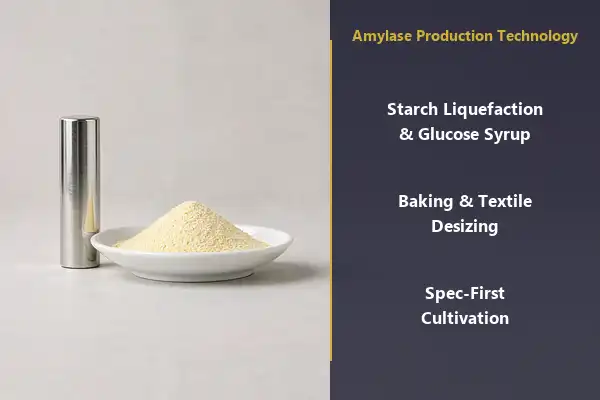
A good product specification links laboratory results to the conditions at the customer’s site. Buyers should agree on enzyme activity and its assay technique, operating pH and temperature, expected stability, microbiological limitations, and if the material is intended for food grade or industrial application. These details affect strain selection, processing controls, and final formulation. Asianbios Amylase is supplied in light yellow powder form, available in samples and orders from 1 kg, with 25 kg barrel packing. The amylase production technology can be seen as a technical solution, not only as a purchase of a finished product.
Build a Controlled Fermentation Process
Step 3: Select the Strain and Develop the Seed Culture
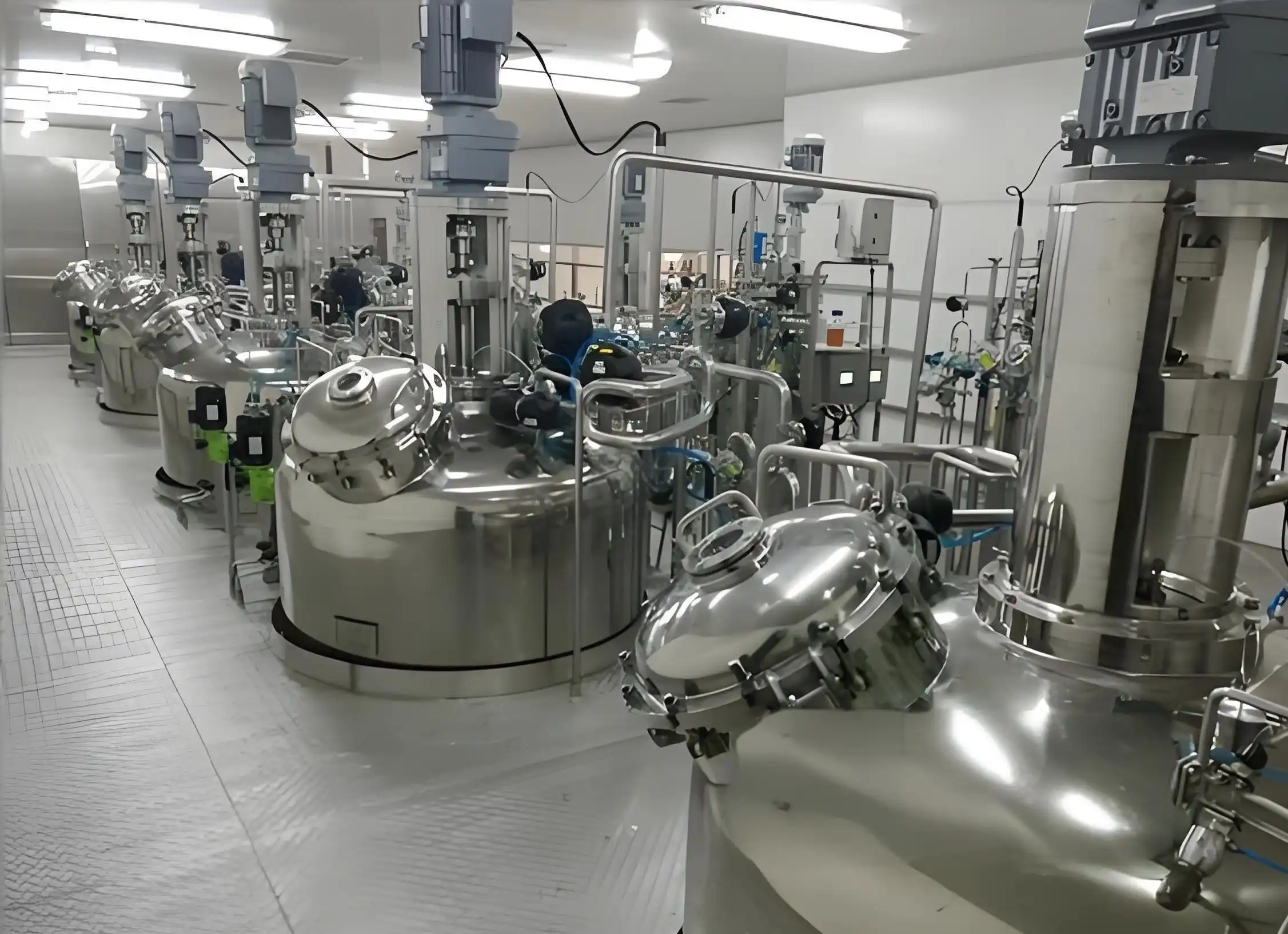
The manufacture of amylase in industry is mostly based on submerged microbial fermentation. One of the options for the creation of alpha-amylase is Bacillus subtilis, and glucoamylase can be produced with the help of Aspergillus niger. The chosen strain must be tested for its enzyme output, stability in repeated cultivation and appropriateness for the desired product category. Work then proceeds to a seed train where a maintained culture is expanded in stages until sufficient healthy biomass is available to inoculate the production vessel. Variations at this early stage might effect the whole batch of fermentation, so it is important to have a consistent quality of seed.
Step 4: Prepare the Medium and Run the Fermenter
Production medium supplies carbon, nitrogen, minerals and other nutrients required for growth and expression of enzymes. Selection should be based on strain and final enzyme and its performance and practical sources should be evaluated. In submerged fermentation the operators control elements like temperature, pH, aeration, agitation and feeding. As the ship gets bigger, so do problems with dissolved oxygen and foam. There is no standard for all strains. A good amylase manufacturing technology is based on the investigation of the interplay of several variables and the guarantee of reproducible outcomes.
| Fermentation stage | Key check | Why it matters |
|---|---|---|
| Seed preparation | Culture identity and growth | Supports a reliable start |
| Medium preparation | Composition and consistency | Reduces batch variation |
| Production run | pH, temperature, oxygen, and feeding | Supports enzyme expression |
| Harvest decision | Activity and batch records | Identifies the right time to process |
If you are thinking about a new plant or an upgrade of an existing line, this is a good time to consider your target enzyme and available equipment together. If you provide us a short description of your application, production capacity and quality requirements to plantex@asianbios.com we may initiate a more focused technical discussion.
Recover, Measure, and Formulate the Enzyme
Step 5: Separate the Broth and Concentrate the Enzyme
When the fermentation reaches target , the broth is subjected to downstream processing . Filtration or centrifugation removes microbial cells and other suspended debris. The clarified liquid may be concentrated by an appropriate process based on the stability of the enzyme and the desired product format. Each process should be tested for enzyme recovery and throughput. However, a high performance fermentation cycle has limited economic utility if there is a substantial loss of activity during separation or concentration. Thus, amylase production by fermentation should be seen as an integrated process rather than as an upstream yield objective with an afterthought.
Step 6: Standardize Activity and Prepare the Final Product
“The concentration of the enzyme alone won’t tell a customer how a batch is going to behave.” Amylase production technology relies on activity being quantified using a defined assay, results have to be expressed in a way that the method and units give meaning to the data. The recovered enzyme is then standardised and compounded to a uniform specification for storage and use. For a powder product this means attention to moisture, packing and shelf-life verification under certain conditions. A certificate of analysis shall conform to the specification established. Buyers need to request necessary papers for their market and product category while evaluating vendors and not assume one certificate covers all applications.
| Final-product check | What to confirm with the supplier |
|---|---|
| Enzyme activity | Assay method, units, and batch result |
| Intended use | Food-grade or industrial-grade specification |
| Powder quality | Appearance, moisture, and packaging |
| Documentation | Certificate of analysis and applicable quality records |
Turn a Working Process Into a Reliable Supply
Step 7: Validate Scale-Up and Local Implementation
A lab result may not necessarily indicate a good plant practice. Larger fermenters differ in oxygen transport, mixing, heat removal, and foam formation. Downstream equipment has its own capacity limits. Therefore scale-up requires pilot runs, operational ranges, sampling strategies, and clear deviation procedures. Asianbios describes success in using technology as “30% process + 70% localisation implementation”. Practicality counts. The most effective use of a technology package is when it is tailored to the equipment, utilities, raw-material supply, labour, regulatory tasks and sales plan of the location.
Step 8: Align Technical Support With Purchasing Plans
Customers may need a powder enzyme, a custom formulation or assistance on how to set up or optimise a production line. These are various endeavours that start with different questions. Confirm product procurement activities. Sample assessment. Minimum order quantity. Packing and shipping conditions. Line project. Talk about process design, lab verification, training of staff, quality controls and ongoing technical support. Asianbios can talk about your OEM/ODM requirements and technological solutions and practical procedures required to establish a process locally. Check lead times, documentation, logistics for that specific order, before scheduling production
Conclusion
The amylase production by fermentation process for amylase production is a series of interrelated decisions. Which enzyme is targeted depends on intended use. Choice of strain and seed culture determines the starting point. Controlled fermentation produces the enzyme, downstream processing results in a measurable useable output. A reliable supply also requires activity testing, good documentation and a scale-up plan indicative of the production site. If you are buying amylase or exploring amylase production technology for a new line, begin with a clear application and specification. These details add more significance to tech trials and make for more fruitful supplier discussions.
FAQ
1.What is the difference between alpha-amylase and glucoamylase?
A major goal in liquefaction is to reduce viscosity . Alpha-amylase breaks bonds in the starch chains and is typically used for liquefaction . Glucoamylase is an enzyme that breaks down starch-based material to produce glucose and is generally regarded for glucose syrup operations. Neither should be chosen by name alone. The proper decision is dependent on the starch feedstock, the processing circumstances, the intended conversion and how the enzyme performance is assessed in the customer’s process.
2.Can amylase production technology be adapted to an existing plant?
Yes, but adaptation is not simply a transfer of laboratory instructions, it needs a technical assessment. The process is affected by fermenter size, aeration, utilities, raw materials available, separation equipment and quality systems. The existing line is usefully reviewed against the proposed strain, fermentation conditions and product specification. Trial runs then determine operating ranges and show where equipment improvements or staff training may be needed.
3.What should I request when evaluating an amylase sample?
Begin with a sample specification and a certificate of analysis showing enzyme activity and the testing procedure. Ask whether the product is food-grade or industrial-grade and verify its suggested working parameters, storage and packing requirements, and any quality documentation. Most essential, test the sample in your method. A test result is helpful, but the stronger evidence for purchase is performance with your feedstock and equipment.
Ready to Plan Your Amylase Project? Let's Talk Next Steps
A useful inquiry will include some practical data; your application, target enzyme, projected volume, product format required and whether you need a finished powder or production line support for amylase production by fermentation. Please provide any activity specification, operational conditions or sample-test results you have. Asianbios can use that information to talk about potential product options, technical verification, customisation and next steps for a fermentation project. Email plantex@asianbios.com for a sample or to start a technical chat. The more precise your initial needs the easier it is to construct a fit-to-process solution.
References
1. Gupta, R., Gigras, P., Mohapatra, H., Goswami, V. K., & Chauhan, B. (2003). “Microbial α-amylases: A biotechnological perspective.” Process Biochemistry, 38(11), 1599–1616.
2. van der Maarel, M. J. E. C., van der Veen, B., Uitdehaag, J. C. M., Leemhuis, H., & Dijkhuizen, L. (2002). “Properties and applications of starch-converting enzymes of the α-amylase family.” Journal of Biotechnology, 94(2), 137–155.
3. Pandey, A., Nigam, P., Soccol, C. R., Soccol, V. T., Singh, D., & Mohan, R. (2000). “Advances in microbial amylases.” Biotechnology and Applied Biochemistry, 31(2), 135–152.
4. Sivaramakrishnan, S., Gangadharan, D., Nampoothiri, K. M., Soccol, C. R., & Pandey, A. (2006). “α-Amylases from microbial sources—An overview on recent developments.” Food Technology and Biotechnology, 44(2), 173–184.
5. de Souza, P. M., & de Oliveira Magalhães, P. (2010). “Application of microbial α-amylase in industry—A review.” Brazilian Journal of Microbiology, 41(4), 850–861.
6. Aiyer, P. V. D. (2005). “Amylases and their applications.” African Journal of Biotechnology, 4(13), 1525–1529.
About the Author

Asianbios
Our purpose is to forge a legacy of stewardship, advancing initiatives that honor and preserve the ecological integrity of our planet.

Send Inquiry
Related Industry Knowledge
- Marigold Extract Powder: A Potent Source of Lutein for Eye and Skin Health
- Recombinant Human Collagen in Clinical Medicine
- Elastic Peptide: How It Supports Skin Elasticity and Firmness
- What Makes Deep lifting peptide powder Essential in Firming Skincare?
- Trehalose Production Technology: exploiting novel approaches
- How to Choose the Best Sleep Aid Capsule for Adults
- Are Multi-effect eye peptides Effective for Under-Eye Bags?
- Freeze Dried Kiwi Powder Guide 2026: Nutrition, Applications & Buying Tips
- Is Freeze Dried Kiwi Powder Rich in Vitamin C?
- Why freeze dried strawberry powder is perfect for smoothies and baking?