Supercritical Extraction Machine: Key Technology Advantages Explained
The supercritical extraction machine uses carbon dioxide above its critical point of 31.1 °C and 73.8 bar for the separation of active chemicals from plant materials. The key technological advantages are low operating temperature, no solvent residues, tunable selectivity, recyclable CO₂ and PLC based process control. These features protect heat-sensitive compounds, and provide extract manufacturers with a repeatable, well-documented technique. In this tutorial we explain how the equipment works, when it is better than the traditional ways and what consumers should look for before placing an order. I also provide you with details on the Asianbios system, for example its resistance to pressures up to 45 MPa and its temperature precision of ±0.5°C.
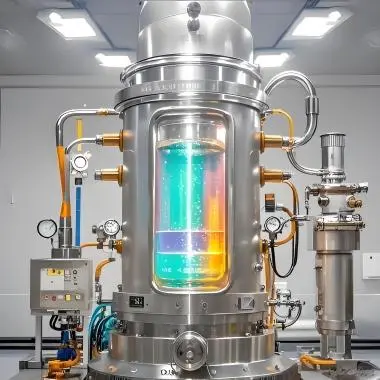
What Is a Supercritical Extraction Machine and How Does It Work?
Definition and Main Function
A supercritical extraction machine uses a fluid that is hotter and under more pressure than it needs to be to extract valuable chemicals from solid materials. Carbon dioxide is frequently utilised since it is non-flammable, can be recovered, and does not make much of a mess when handled properly. CO₂ over 31.1°C and 73.8 bar acts as a gas while passing through a substance and breaks down target chemicals like a liquid. The Asianbios supercritical extraction machine exploits this high solubility and permeability to extract and isolate the active compounds from the sample. It processes plant essential oils, herbal extracts, lipid-soluble components, pigments, and perfumes for enterprises involved in the production of food, health supplements, cosmetics, traditional Chinese medicine, and plant extracts.
Main Components of the System
Several units are coupled to a supercritical CO2 extraction equipment. Each unit controls a distinct element of procedure. Table illustrates pieces of Asianbios supercritical extraction machine and their functions.
| Component | Function |
|---|---|
| CO₂ storage tank | Holds and supplies carbon dioxide |
| Refrigeration system | Controls temperature to maintain extraction conditions |
| High-pressure pump | Builds the pressure needed for the supercritical state |
| Heat exchange system | Controls temperature throughout extraction |
| Extraction vessel | Holds the material during separation |
| Multi-stage separator | Fractionates components for higher purity |
| Circulation recovery system | Recycles CO₂ |
| PLC control panel | Monitors, controls, and logs data |
As a whole, these units keep the pressure steady, regulate the temperature, and recover CO₂. This lets operators run cycles over and over again while keeping track of the data.
Step-by-Step Workflow
Supercritical extraction machines typically contain six steps, which make up a cycle. First, personnel put the pre-treated raw materials into the extraction unit. Secondly, it compresses CO₂ and heats it up until it reaches supercritical levels. Third, the fluid interacts with the substance, degrading the target chemicals selectively. 4. The pressure in the separation vessels decreases and the extract starts to separate. Fifth, workers get the extract and the circulation system sends CO2 to storage. Sixth, the machine is automatically washed and ready for next cycle. Small variations in temperature or pressure can vary what the fluid will dissolve . Because CO2 density is a function of temperature and pressure.
Key Technology Advantages of a Supercritical Extraction Machine
Low Temperature and Component Retention
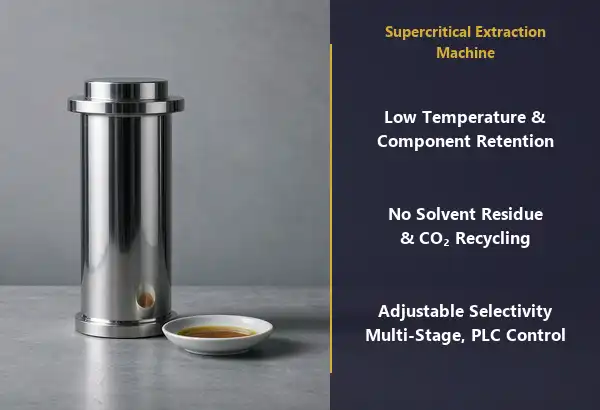
Asianbios supercritical extraction machine uses low extraction temperature to safeguard the active compounds which are readily oxidised and sensitive to heat. Even at 31.1 °C CO₂ is not hot enough to begin reacting and many of the processes that utilise CO₂ operate at temperatures between 35 °C and 65 °C, far lower than what is required for steam distillation. This delicate process helps to preserve the fragrances, colours and lipid-soluble actives that heat might harm. The temperature control is exact to within half a degree centigrade, thus every batch is identical. I do caution customers that residence time is crucial, too, as long cycles with even moderate heat might destroy sensitive compounds. Food, cosmetic and supplement producers may make more from extracts when they retain more of the components.
No Solvent Residue and CO₂ Recycling
As carbon dioxide is gaseous when the pressure is released, the extract is collected with minimal evaporation and no organic solvent residue. The FDA adds that carbon dioxide is typically regarded as safe for use in food, therefore it’s OK to use when preparing food and supplements. “Producers don’t have to buy hexane, store solvents or test for residues associated with solvent residues. A supercritical extraction machine with a circulation recovery system saves CO₂ to reuse it. This cuts down on the gas utilised and supports sustainable production. This closed loop system reduces waste and ongoing solvent costs. These are two items that customers look at closely when they look at operational costs.
Adjustable Selectivity, Multi-Stage Separation, and PLC Control
Operators can alter the temperature, flow rate, pressure and time of extraction to target different groups of compounds since pressure changes the density of CO2. This supercritical extraction machine includes 1-3 steps of separation which divides the extract into multiple portions, making it purer and more full of diverse components. The cycle runs automatically with a PLC control system and touch screen and you can track all the data. It can be withstood pressure of 45Mpa. All the parts contacting with materials are made of SUS316L stainless steel to meet GMP production standards and safety regulations of pressure vessels. Combined, these qualities offer companies the ability to produce plant extracts in a standardised and well-documented method that can be employed for quality checks and feedback from consumers.
Operating Parameters and Comparison With Traditional Methods
Pressure and Temperature Settings
Temperature and pressure are connected. The density and solvating power of CO₂ increases, as does the pressure, so the fluid can break down heavier molecules. Higher temperature = better mass transfer . Higher temperature = lower density . Higher temperature = stress on already weak molecules . But they are at the same pressure . The Asianbios unit can operate up to 45 MPa (450 bar) allowing the operators to vary the density of the solvent. Then it’s the temperature and pressure of the separator that determines which fraction slips out at each stage. Each plant is different and reacts differently to a supercritical extraction machine, so you want to try out your real material before you commit to a recipe.
Raw Material Preparation and Flow Control
If the raw material is ready, a supercritical extraction machine does its work well. Moisture content, particle size and storage history impact how easily CO₂ enters the bed. Too fine a ground material might pack tightly and generate channelling or a significant pressure drop. In contrast, parts that are overly large impede the dissemination. The flow rate must be suitable for the weight of the vessel and the capacity of the bed for water to pass through. Operators frequently employ a static soaking stage and a circulating stage in combination to balance yield, throughput and energy usage. I also think that the calibration, cleaning, inspections and checks of the relief system should be written down, so the plant can continue to run safely and reliably throughout many batches.
Comparison With Traditional Extraction Methods
Because supercritical CO₂ doesn't always beat the other options, I suggest you directly compare a supercritical extraction machine to them. The main differences are shown in the table.
| Factor | Supercritical CO₂ | Organic solvent | Steam distillation |
|---|---|---|---|
| Solvent residue | Minimal when managed | Needs removal and testing | None |
| Thermal exposure | Low | Depends on solvent removal | Higher |
| Selectivity | Adjustable with pressure and temperature | Set by the solvent | Mostly volatile compounds |
| Upfront equipment cost | Higher | Lower | Lower |
I choose the method based on the feedstock, the purity goal, and my budget. For some high-volume feedstocks, traditional solvents may still be the most cost-effective option.
How to Choose the Right Supercritical Extraction Machine
Define Feedstock, Purity, and Capacity
Start with the raw material, the compounds you want to make, how pure they are, how much you expect to make, and when you want to make it. It is important to match the usable vessel capacity, not just the nominal volume, of a supercritical extraction machine to the batch size, bulk density, and cycle time. The rated volume of a vessel does not match the amount of stuff it can hold because the load is limited by the packing density. Check how the separator is set up, how it filters, how easy it is to clean, and whether a co-solvent is needed. Also, think about growth. If you think output will go up, talk about expansion before you buy. We ask for these details first at Asianbios because they let us compare configurations based on real-world throughput.
Materials, Pressure Safety, and Compliance
Check the parts and paperwork of any supercritical extraction machine before you buy it. All parts that come into contact with food must be made of 316L stainless steel for sanitary reasons. The Asianbios system uses SUS316L to meet GMP production standards. When you buy a pressure vessel, the paperwork should match where you live. For example, buyers in the US usually want an ASME Section VIII design, while projects in Europe want CE marking and PED conformity. It is certified by CE, ISO 9001, ISO 14001, ISO 45001, HACCP, FCC, UL, and CSA. Tell us what code your site needs, and we'll let you know which documents we can offer. Check the power, cooling water, any steam heating, ventilation, floor loading, and the way the safety valves are set up.
Price Factors and Procurement Checks
The cost of a supercritical extraction machine changes depending on how it is built. The table shows the main things that change the quote and why they do so.
| Factor | Effect on price |
|---|---|
| Vessel volume and pressure rating | Larger, higher-pressure vessels need more material and testing |
| Number of separators | More stages add vessels and controls |
| Pump and CO₂ recovery capacity | Higher flow needs larger equipment |
| Automation level | Control hardware and data logging scope |
| Materials and sanitary finish | Grade and surface requirements |
A professional quote should include information about the process flow, operating ranges, utilities, safety devices, documentation, testing, delivery, commissioning, warranty, and what the quote doesn't cover. Not only the purchase price, but also the amount of energy used, CO2 released, maintenance, labor, and the expected yield.
Implementation, Common Mistakes, and Supplier Support
Practical Implementation Plan
When you are designing a supercritical extraction machine project, the first thing that comes to mind is the final product, raw materials, quality standards, rules and site constraints. Then test the pressure, temperature, flow, time, separator settings in the lab or small scale and measure yield, selectivity, aroma and active content. You can put down the equipment requirements and compare suppliers according to the results. Prior to operating material during installation, verify utilities, ventilation, pressure testing, calibration, control logic and emergency functions. Once the machine is up and operating, monitor the yield, cycle time, CO2 consumption, energy, downtime and maintenance. Our labs can assist in evaluating the outcomes of tests and providing technical guidance during the trial stage.
Common Mistakes to Avoid
The most common mistake individuals make when choosing or utilising a supercritical extraction machine is to choose one based on nominal vessel volume alone. A more precise estimate of capacity is derived from usable fill volume, material density, cycle duration, yield and recovery efficiency. Another problem is that the parameters are duplicated from another plant, although each feedstock may need its unique pressure, temperature, flow and residence time. But batches can also vary unevenly if no one looks at them, because of seasonal fluctuations, changes in moisture and disparities in particle size. Buyers may not consider ventilation, floor loading, electrical standards and high pressure safety until after they have placed the order. Others just look at the cost of buying the equipment and disregard the expenses of energy, CO2 loss, repairs, labour and downtime that accumulate over time.
Supplier Support, Delivery, and Service
They should do more than just sell you a pressure vessel and pump. For more than 10 years, Asianbios has been using CO2 extraction in production. We also have our own plant extract lines, so we know how a supercritical extraction machine works in real-world production. Our technical team does installation work, operator training, planning for preventive maintenance, supplying spare parts, and giving advice on how to make the process better. Our global service network means that we can help you with technical issues 24 hours a day, seven days a week. Standard equipment ships in 20 days, and custom configurations can take anywhere from 30 to 90 days, depending on the needs.
Conclusion
A machine called a supercritical extraction machine uses CO₂ above 31.1°C and 73.8 bar to break down and separate active compounds at low temperatures. This keeps heat-sensitive parts whole and doesn't leave any organic solvent behind. The pump, extraction vessel, multistage separator, and circulation recovery system are its main parts. They are controlled by a PLC and reuse CO2 between cycles. Yield and selectivity are affected by pressure, temperature, flow, and how the material is prepared, so it's important to do tests on real feedstock. The technology is more expensive at first, but it has more flexible selectivity and is easier to use than solvent extraction and steam distillation. When buyers size a vessel based on its usable capacity, check that it is made of 316L materials and has pressure documentation, and compare lifecycle costs instead of just price, they get the best deal.
FAQ
1. What materials can a supercritical extraction machine process?
It works with natural products like plant essential oils, herbal extracts, lipid-soluble parts, fragrances, colors, and more. It is used to make these things: supplements, cosmetics, traditional Chinese medicine, and food.
2. What are the key specifications of the Asianbios system?
The resistance to pressure goes up to 45 MPa, and the temperature control is accurate to within 0.5°C. There are one to three stages of separation, and the whole process is controlled by a PLC.
3. Is a supercritical extraction machine better than solvent extraction?
It depends on the feedstock, the purity goals, the capacity, the rules, and the cost of running the business. CO₂ lowers the amount of solvent residue and lets you change the selectivity. For some high-volume feedstocks, solvents may still be cheaper.
4. How long does delivery take?
It takes 20 days to ship standard equipment. Depending on the needs, customized configurations can take anywhere from 30 to 90 days.
Request a Supercritical Extraction Machine Quotation From Asianbios
Want to buy a supercritical extraction machine from a company that offers installation, training, and 24/7 remote support? Asianbios has systems that are CE-approved and come with SUS316L contact parts, PLC control, and the ability to withstand pressures up to 45 MPa. Send information about your site, raw material, target extract, batch size, and plant to plantex@asianbios.com. Our team will then suggest a good setup and give you a quote. For more information, go to asianbios.com.
References
1. Brunner, G. "Supercritical fluids: technology and application to food processing." Journal of Food Engineering, 2005.
2. Herrero, M., Cifuentes, A., Ibañez, E. "Sub- and supercritical fluid extraction of functional ingredients from different natural sources: Plants, food-by-products, algae and microalgae – A review." Food Chemistry, 2006.
3. Reverchon, E., De Marco, I. "Supercritical fluid extraction and fractionation of natural matter." The Journal of Supercritical Fluids, 2006.
4. Pereira, C.G., Meireles, M.A.A. "Supercritical Fluid Extraction of Bioactive Compounds: Fundamentals, Applications and Economic Perspectives." Food and Bioprocess Technology, 2010.
5. Knez, Ž., Markočič, E., Leitgeb, M., Primožič, M., Knez Hrnčič, M., Škerget, M. "Industrial applications of supercritical fluids: A review." Energy, 2014.
6. Perrut, M. "Supercritical Fluid Applications: Industrial Developments and Economic Issues." Industrial & Engineering Chemistry Research, 2000.
About the Author

Asianbios
Our purpose is to forge a legacy of stewardship, advancing initiatives that honor and preserve the ecological integrity of our planet.

Send Inquiry

Related Industry Knowledge
- Beauty of Red Bean: Your Secret to Flawless, Refreshed Skin
- Why Tryptophan Production Technology Matters in Animal Feed
- Anti-Wrinkle Peptide vs Retinol: Which Supports Youthful Skin?
- Why choose echinacea extract powder for daily wellness support?
- Elastic Peptide Benefits for Hydrated, Smoother-Looking Skin
- Lifting Peptide for Facial Contours: What to Know
- What Is Bovine Bone Collagen? Benefits, Uses, and How It Boosts Your Skin Health
- Understanding Amylases: The Essential Enzymes Transforming Industries
- How Production Technology Of Ergothioneine Improves Purity
- Benefits of Lysine Production Technology in Feed Industry