How Does Hanging Centrifuge Work? A Step by Step Separation Guide
A hanging centrifuge separates particles from liquid by rotating slurry at high speed within a perforated drum, powered from above. The centrifugal force forces the liquid through the drum wall and filter cloth leaving the solids as a cake. The operator next washes the cake, spins it to a drier condition and discharges it with an automated scraper. This guide takes you through every stage – from the physics to starting tests – so you can weigh up specs, safety and supplier support before you ask for a price. I developed it for engineers and purchasers who seek simple answers.
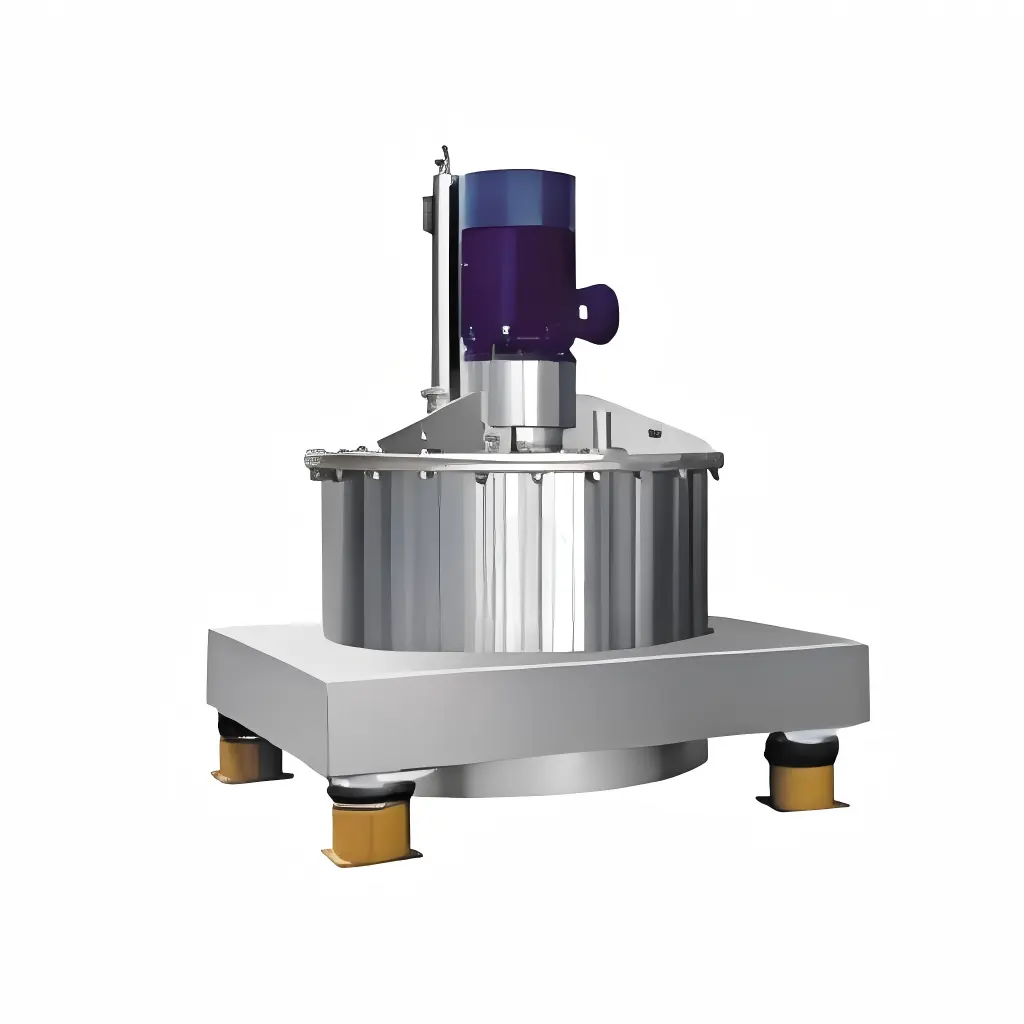
How a Hanging Centrifuge Works: Principle, Metrics, and Parts
The Physics Behind Centrifugal Separation
The force from the rotating drum in a hanging centrifuge is much greater than gravity . Engineers call this the separation factor, or G. It is angular speed multiplied times drum radius divided by gravitational acceleration, thus you double the speed, and G is quadrupled. Liquid passes out via the holes and the fabric of the filter. Solids bigger than cloth holes create a cake against the wall. A machine may filter, settle or clarify, depending on the supply. Suppliers also use the term differently, so before you start comparing bids, establish the precise drum construction and discharge mechanism.
Key Performance Metrics Buyers Should Compare
The nominal drum size does not predict the outcomes of the hanging centrifuge. Here are five things you can do to make comparing quotations fairer.
| Metric | What it tells you |
|---|---|
| Separation factor (G) | Force that drives liquid out of the cake |
| Residual moisture | Dryness of the discharged cake |
| Solid recovery | Share of product kept in the cake |
| Filtrate clarity | Solids lost through the cloth |
| Cycle time and throughput | Batches and tonnage per shift |
Ask every supplier to quote these numbers for your own material, not for water or a generic test feed.
Main Components and Materials
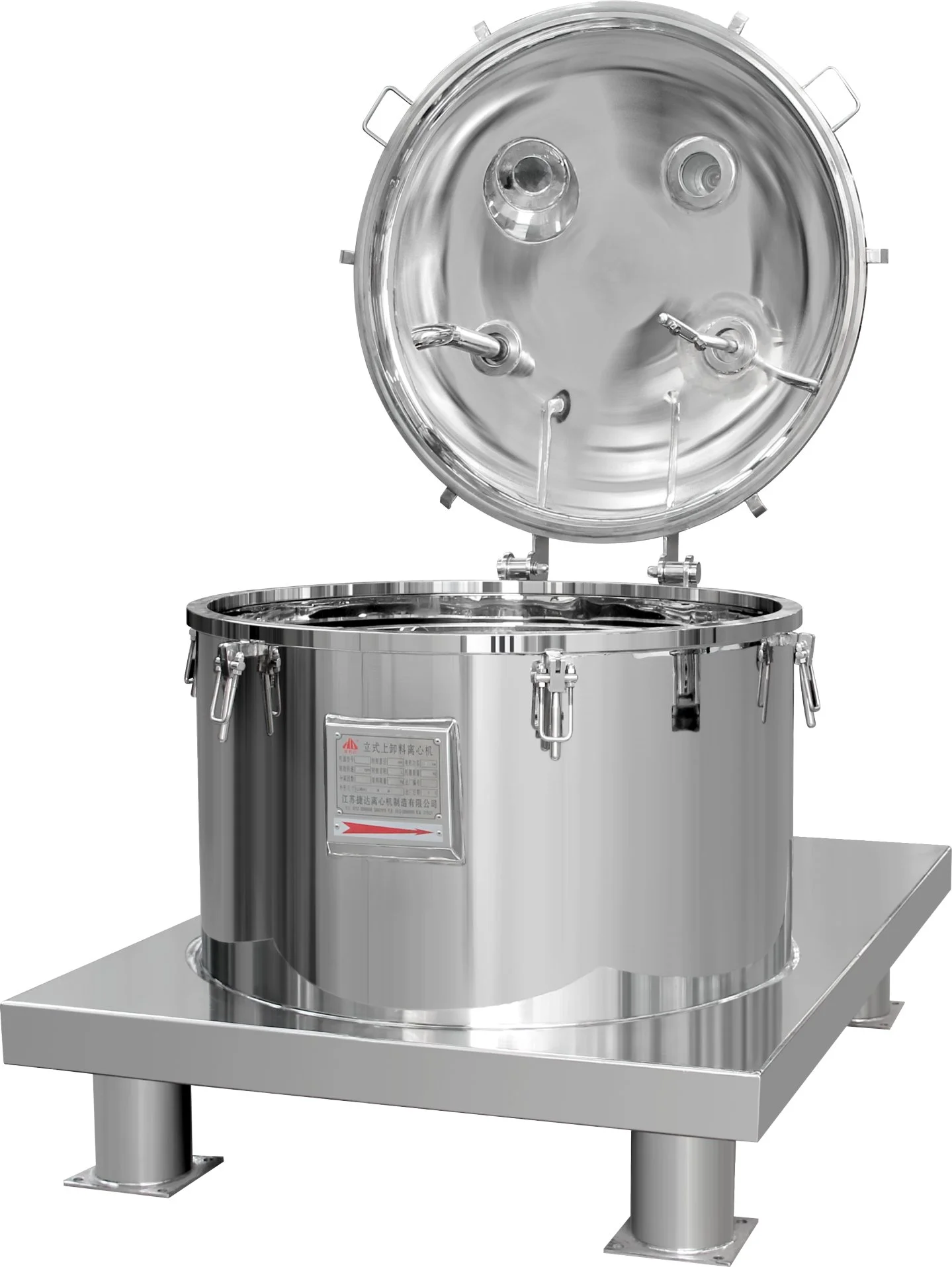
The Asianbios hanging centrifuge is equipped with an overhead mounted motor, drum, casing, transmission system, brake system and automated control system. The arrangement of the motor above the drum separates the driving elements from the process zone. The case provides protection and reduces noise. All of the machine is made of SUS304 or SUS316L stainless steel, providing strength, corrosion resistance and simple cleaning. Cycle is controlled by PLC control, and variable frequency motor provides gentle start and smooth running. Ask for the steel grade suitable for your chemistry for acids, salts or active components.
Step-by-Step Hanging Centrifuge Separation Process
Steps 1 and 2: Pre-Start Checks and Controlled Feeding
Before beginning a hanging centrifuge I check the drum, filter cloth, seals, lid interlock, utilities such as power and wash water etc. I also check that the feed is the same as the formula checked for solids and temperature. Then the feeding mechanism feeds slurry into the spinning drum at a specified rate. Then the slurry spreads uniformly across the wall at a reasonable pace. Uneven loading generally produces vibration, therefore a consistent feed is excellent for the bearing and for the product. Do not exceed the rated nameplate capacity.
Steps 3 to 5: Acceleration, Cake Formation, and Washing
The variable frequency motor cranks up the speed once the hanging centrifuge has its charge. Liquids go through the fabric and solids pack form a cake. If purity is important a spray wash removes the mother liquor left between the particles. A last high speed spin removes the majority of the wash liquid. Cake thickness, wash volume and spin duration all impact moisture and purity thus I set them from lab or pilot data, not assumption. This wash process may be necessary to achieve goal purity for crystal and starch products.
Steps 6 and 7: Discharge, Filtrate Collection, and Cleaning
After the last spin, the brake mechanism securely stops the hanging drum of the centrifuge. The cake is subsequently removed by the automated scraper via the discharge aperture and the filtrate flows out through its own exit. The PLC regulates each step and sets up the next batch. When goods are changed, operators clean the drum and cloth. This is especially important when a factory transitions between food, pharmaceutical and chemical activity. The Asianbios machine may be operated in intermittent or continuous mode, thus the cycle can be adapted to brief campaigns or continuous output.
Performance Factors, Safety, and Maintenance
Feed and Equipment Variables That Change Hanging Centrifuge Results
Formation of cake depends on particle size, density, viscosity, temperature and solids content. Fine sticky particles drain slowly and might blind the cloth. The faster you go, the higher the G. But the higher the energy consumption, vibration and chance of shattering delicate crystals. The choice of cloth combines robust retention against permeability and simplicity of washing. Automation helps, too, since consistent cycle control decreases operator variance, moisture drift and downtime. I usually suggest checking the actual slurry since two meals with the same % of solids might act quite differently.
Safety Precautions for Daily Operation
The spinning drum stores a lot of energy, thus every suspended centrifuge requires stringent safety behaviors. Main concerns include unbalance, overspeed, chemical exposure and sudden movement of cake during cleaning. Our machine has overcurrent, overload, overtemperature and vibration protection. It also has a brake system. In the U.S., this kind of machine maintenance is governed by OSHA’s lockout/tagout regulation, 29 CFR 1910.147. For solvent-based operations, ask the provider to clarify in writing what explosion prevention alternatives are available. Request manuals, certifications of materials and test reports.
Maintenance Routine and Troubleshooting
I listen for noise, monitor for vibration, inspect for leaks, heat and textile damage every day. From time to time I check the bearings, seals, bolts, electrical components and scraper gap. If a hanging centrifuge starts to vibrate, first examine the distribution of the feed and the condition of the fabric. If the cake comes out wet, it is frequently the case that the fabric is blinding, the spin duration is too short or the speed is too low. If the filtrate is cloudy, the cloth is damaged or the holes are too big. Low recovery is typically a sign of small particles passing through the fabric. We designed for little maintenance and regular checkups help keep it there.
Applications and Comparison With Other Centrifuges
Hanging Centrifuge vs. Horizontal and Peeler Units
Vendors utilize overlapping names, so compare structure, not labels. The table displays typical variations.
| Type | Typical operation | Best fit |
|---|---|---|
| Hanging centrifuge | Batch or intermittent cycles, upper-mounted drive | Crystal washing, varied campaigns |
| Horizontal peeler | Batch cycles with a peeling knife | Dedicated products at higher volume |
| Continuous pusher | Continuous feed and discharge | Steady single-product lines |
A hanging centrifuge is suited to flexible batch operations where purity and recovery are more important than peak continuous tonnage.
Industries and Materials the Machine Handles
The Asianbios hanging centrifuge is used for the separation of starch, monosodium glutamate, salt, chemical crystals, herbal extracts and fermentation materials. It is used for food, chemical, pharmaceutical, biological fermentation and agricultural product processing. We also operate our own lines for extraction, separation and purification of plant extracts, thus we are dealing with these slurries in everyday production, not only on drawings. Different fabrics need different cloth, speed and wash settings. That’s why test data is important before you choose a model.
Design Priorities by Sector
Corrosion resistance is often of greater relevance to chemical plants. SUS316L is commonly used for acidic or salt feed. Pharmaceutical users want to know about cleanability, material traceability and validation documents. Food processors should be built from sanitary steel and handle foodstuffs carefully. The main problems for the salt and starch industries are dewatering capacity and wash water control. Each priority is a spec line: material grade, surface polish, degree of automation, documentation. Provide the provider your industry regulations early, (e.g. FDA 21 CFR Part 117 for food in the US) so they can align to them.
Choosing a Hanging Centrifuge and a Manufacturer
Define the Goal, Specs, and Price Drivers
The sizing of a hanging centrifuge starts with the task to be done; dewatering, washing, clarifying or recovery. Define batch size, hours/day and desired wetness. The main requirements are effective volume, speed, G, motor power, material grade, type and utilities of discharge. Price is dependent on size of drum, grade of steel, finish, drive, automation and scope of tests. The cheapest quote may well wind up costing more later if inadequate vibration control, incorrect materials or weak support require more labor and downtime. Request information about guarantyd moisture, filter cloth availability, spare parts, lead time and guarantee.
Verify Performance Before You Pay
Performance You Get There are three methods to reduce risk. First do lab or pilot tests on your real material to assess moisture, recovery, filtrate clarity and cycle time. 2. Perform a factory acceptance test on speed, vibration, interlocks, discharge, dimensions, and materials. Ask for rotor balance records to ISO 1940-1. 3. Test site foundation, electricity, drainage, access and operator training. Record baseline throughput, moisture, recovery, energy use, cloth life and downtime so you can assess the hanging centrifuge against its promises.
Why Asianbios Fits Your Project
Asianbios manufactures this hanging centrifuge according to the parameters shown below. Our personnel and labs can do experimental verification and provide technical support.
| Item | Specification |
|---|---|
| Drum diameter | Φ450–1600 mm |
| Effective volume | 100–1100 L (customizable) |
| Spindle speed | 800–3000 rpm, frequency adjustable |
| Separation factor | 500–1500 G |
| Material | SUS304 / SUS316L stainless steel |
| Discharge | Automatic scraper unloading |
| Control | PLC with variable frequency motor |
We are certified with ISO 9001 and CE for our products. We can provide installation advice, commissioning, operator training, maintenance plans, replacement parts, manuals and remote technical support. For a comprehensive manufacturing line, we may also provide the whole technology to develop it.
Conclusion
A hanging centrifuge separates particles from liquid by the centrifugal force produced by a drum pushed from above. The fabric lets liquid pass through, while solids build up a cake that the operator may wash, spin dry and scrape away. Moisture, recovery and filtrate clarity are a better basis of comparison than drum size as the results are dependent on the separation factor, feed qualities, choice of cloth, cake thickness and cycle management. Safe operation depends on balanced loads , protective mechanisms , lockout practice and periodic maintenance . For food, chemicals and pharmaceuticals the choice depends on the quality of steel, the requirements of the industry, and the paperwork. Factory acceptance and site inspections, including lab testing, ensure a machine fulfills its claimed performance.
FAQ
1. What does a hanging centrifuge do?
It spins a slurry in a perforated drum to extract liquid from particles. Liquid travels through the fabric leaving the solids as a cake which may be cleaned and expelled.
2. Which materials can it process?
The typical diet consists of starch, monosodium glutamate, salt, chemical crystals, herbal extracts, and fermentation materials. Your own slurry will be better since particle size and viscosity will affect the outcome.
3. What stainless steel grades are available?
The Asianbios unit is made of material SUS304 or SUS316L. If your feed contains acids or chlorides, choose 316L, and verify with your process data.
4. What information do I send for a quotation?
Material composition, particle size, solids concentration, throughput, target moisture, temperature, chemical compatibility, discharge preference, electrical standard and site circumstances.
Request Your Hanging Centrifuge Quote From Asianbios
Need a hanging centrifuge manufacturer to test your slurry and help with commissioning? Asianbios provides ISO 9001 and CE approved machinery, application testing, operator training and replacement parts. Send your material data, capacity and moisture goal to plantex@asianbios.com and our staff will offer a setup. For more information visit asianbios.com.
References
1. Perry's Chemical Engineers' Handbook, 2019
2. Coulson and Richardson's Chemical Engineering, Volume 2: Particle Technology and Separation Processes, 2002
3. Solid-Liquid Separation (Svarovsky), 2000
4. Solid/Liquid Separation: Equipment Selection and Process Design (Wakeman and Tarleton), 2007
5. Current Good Manufacturing Practice, Hazard Analysis, and Risk-Based Preventive Controls for Human Food (21 CFR Part 117), 2015
6. ISO 1940-1: Mechanical Vibration – Balance Quality Requirements for Rotors in a Constant (Rigid) State, 2003
About the Author

Asianbios
Our purpose is to forge a legacy of stewardship, advancing initiatives that honor and preserve the ecological integrity of our planet.

Send Inquiry






Related Industry Knowledge
- The Broad Spectrum of L-Glutamine Benefits
- Apple Peel Extract Powder: What is Quercetin and What Are Its Benefits?
- How Does Marigold Extract Protect Eyes? The Synergy Of Lutein & Zeaxanthin
- Elastic Peptide Benefits for Hydrated, Smoother-Looking Skin
- The Potential Benefits of Berberine Hydrochloride Extract You Should Know About
- What Is L-Glutamine? Glutamine Benefits & Why You Should Take It
- Your Guide To Choosing The Best Organic Grape Powder
- Where to Buy Sleep Aid Jelly Online Safely
- What do you do with freeze-dried kale powder?
- Dried Kale Powder for Baking: Add Color and Plant Nutrition