Is powdered kale good for you?
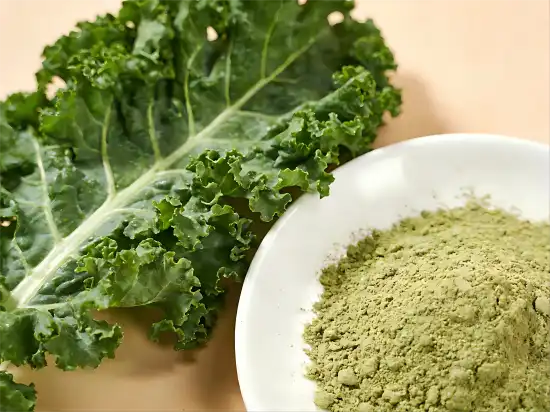
When cooked appropriately and with the right additives, powdered kale can be beneficial. Even after extensive storage, dried kale powder retains the nutritious content of fresh kale. It has the same vital vitamins, minerals, and phytonutrients. Food is freeze-dried to preserve antioxidants like beta-carotene and lutein. Vitamins C and K continue to exist; however, they degrade at high temperatures. This technology has the potential to help businesses incorporate premium green ingredients into functional meals, dietary supplements, and beverages.
Understanding Powdered Kale — Composition and Health Benefits
The Production Process Behind Quality Kale Powder
To make high-quality kale powder, carefully remove the leaves, dry them, and then crush them into little fragments. Freeze-drying technique protects nutrients from temperature-based processes by functioning at extremely low temperatures and under vacuum. Fresh kale leaves lose moisture when they are quickly frozen. The only remaining substance is a vibrant green powder high in nutrients. This allows for the acquisition of vitamins A, C, and K, as well as calcium, iron, and potassium. After processing, the product is easier to store and carry, while retaining the flavor and color of raw kale. During the evaluation of sources, it is critical to analyze their construction. Compared to air- or spray-dried kale powder, freeze-dried kale powder maintains more nutrients. A mild earthy scent, small particle size (80-100 mesh), and dazzling emerald-green color are all indicators of quality. Premium products must also be free of preservatives, additives, and fillers; they are tested using HPLC and strict quality control methods to ensure their purity.
Core Nutritional Components and Their Benefits
Kale powder that has been dried is both healthy and nutritious. Its high vitamin K concentration promotes blood clotting and fortifies bones. Beta-carotene, a provitamin A, improves immune function and eye health. It contains a significant amount of vitamin C due to the freeze-drying process. Vitamin C, a strong antioxidant, protects cells from oxidative harm. Kale powder provides dietary fiber, which helps regulate blood sugar and digestion. The powder improves the nutritional value of plant-based meals by containing readily available minerals like calcium and iron. Antioxidants like lutein and zeaxanthin protect the eyes, while sulfur-containing glucosinolates may have anti-inflammatory and detoxifying qualities.
Addressing Quality Concerns and Safety Considerations
Procurement professionals should address concerns about the safety and purity of kale powder. It is not unusual to discuss thyroid function. Goitrogens found in fresh kale can hinder iodine absorption when present in large doses. However, freeze-drying does not increase the efficacy of these compounds, and only modest amounts can be eaten safely by those with normal thyroid function. Heavy metal contamination removal is an extra quality criteria. To verify that arsenic, lead, cadmium, and mercury levels are much lower than international safety limits, the most reliable providers test each quantity individually. Germ management requires great attention because to the rigorous yeast/mold and total plate count restrictions. Product certifications such as ISO 22000, FSSC 22000, or HACCP demonstrate supply chain quality control.
Powdered Kale vs. Other Forms — Making the Right Choice
Comparing Powder, Flakes, and Juice Concentrates
Purchasing teams will select better products if they are aware of the various varieties of kale and how they satisfy production requirements. Dried kale powder's tiny particle size makes it perfect for incorporating into baked items, beverage mixes, capsules, and tablets without changing their texture. If powders are kept dry and cool, they can maintain their nutritional value for two years. Kale flakes can cause unequal nutritional distribution in automated manufacturing processes because to their uneven size distribution, which makes formulation uniformity challenging. Juice concentrates have a lower shelf life and must be refrigerated despite having a richer flavor. Furthermore, heat-sensitive nutrients are frequently destroyed by pasteurization. Powdered forms preserve nutrients while avoiding these challenges. One cup of fresh kale is equivalent to 10–15 grams of powder, making dosage calculations simple for formulators. Compared to fresh or frozen kale, powdered kale is less expensive to transport and store. Another economical feature of powdered kale.
Selection Criteria for Industrial Applications
Pricing is one of the factors that must be considered when selecting the finest source of kale powder. As the market for clean-label products grows, organic certification is becoming increasingly crucial. Certifications such as USDA Organic, EU Organic, and others ensure that the raw material was produced without the use of artificial fertilizers or pesticides. Sourcing transparency also strengthens the integrity of the supply chain. Reputable vendors provide information about the production sites, harvest dates, and processing facilities of their goods. Manufacturing standards set premium suppliers apart from commodity suppliers. Pharmaceutical-grade quality control is guaranteed by CGMP certification, access to particular markets is granted by HALAL and KOSHER certificates, and consistent quality management systems are confirmed by ISO 9001 accreditation. These certificates demonstrate a supplier's ability to maintain batch-to-batch consistency for recipes with precise nutritional properties.
Procurement Insights — Sourcing and Buying Powdered Kale in Bulk
Evaluating Supplier Reputation and Capabilities
A comprehensive supplier evaluation is the first step in a successful bulk procurement. Beyond basic materials, established firms with specialized R&D labs can offer technological support. The ability to alter moisture content, particle size distribution, and co-process with complementing chemicals is very beneficial to product makers. There is a connection between supply chain dependability and production capacity. Orders can be fulfilled in ten days by suppliers who have at least one ton of dry kale powder. Production delays are avoided as a result. Knowing a supplier's production schedule, lead times for bespoke specifications, and supply interruption tactics helps buyers better manage risk. Good suppliers improve teamwork by providing timely information and proactive problem-solving.
Understanding Pricing Structures and Volume Economics
The cost of dried kale powder at wholesale varies on a number of variables. Factors include seasonal availability, MOQ, and organic certification. Prices decrease with volume; annual contracts may provide additional savings and priority during periods of high demand, while orders exceeding 100 kg typically unlock tiered reductions. Price and quality are related. Although premium freeze-dried powder is more costly than air-dried substitutes, health and wellness companies can justify the expense due to its nutritional profile and processing advantages. When determining the precise cost, yield rates, nutrient density, and formulation efficiency must be taken into account in addition to costs per kilogram. Alternatives affect packaging costs; the best protection is provided by 25-kilogram fiber drums with food-grade LDPE liners. To lower risk, suppliers might test smaller quantities prior to large orders. MOQs, or minimum order quantities, begin at 1 kg.
Logistics and Regulatory Compliance Considerations
Smart procurement can address the logistical issues caused by international sourcing. Collaborations with providers of various modes of transportation could aid in striking a balance between cost and time. These include air freight for medium volumes, sea freight for large cargoes, and quick delivery for small quantities. Market and application-specific criteria for regulatory compliance differ. Compared to pet food or cosmetics, kale powder used in nutritional supplements must adhere to distinct regulations. Certificates of analysis (CoA), allergen statements, GMO-free declarations, and country-specific compliance certificates are provided by knowledgeable suppliers. Product shelf life needs to be managed; freeze-dried kale powder can last up to 24 months if stored properly. To optimize product freshness, suppliers should define temperature, humidity, light exposure, and first-in, first-out (FIFO) inventory rotation.
Practical Applications — How to Use Dried Kale Powder in Your Products
Food and Beverage Formulation Opportunities
With its natural green color and useful nutrition, dried kale powder is a versatile component for food and drink. Vegetable nutrients are added to smoothie and protein drink recipes without dominating flavor thanks to its simple integration with fruits and plant proteins. Although 2–5% by weight is the recommended inclusion rate, some applications may need to adjust for flavor preferences. The powder's solubility and suspension are important to beverage producers. Because to its 80 mesh particle size, the product entirely dissolves in functional drink mixes and does not settle in ready-to-drink products. This chemical's inherent green hue supports clean-label marketing claims by adding visual appeal to health-conscious beverages devoid of artificial coloring. Baked goods and extruded nibbles benefit from the powder's thermal stability. The powder maintains its color and nutritional value in bread, pasta, and nutrition bars even after being heated to a high temperature.
Dietary Supplement Development and Dosage Guidelines
Dried kale powder is used by supplement producers in green blends or as a superfood ingredient. Typically, one to three grams of supplements are taken daily as capsules, pills, or powder sachets. Marketers are able to make health claims based on vitamin K, vitamin A, and antioxidant content due to the nutrient density of powders at minimal threshold levels. Knowledge of bulk density is necessary for encapsulation. When encapsulated, kale powder has a bulk density of 35–50 grams per 100 milliliters. When powder's moisture content is less than 8%, it passes easily through automated machinery, avoiding clumping and guaranteeing a consistent dosage. To create synergistic greens, mix kale with spirulina, chlorella, wheatgrass, or matcha. Combination recipes make use of kale's complementing flavor. Compared to reactive plant compounds, the powder's neutral pH and compatibility with the majority of vitamins and minerals facilitate formulation creation.
Enhancing Product Differentiation and Market Appeal
In competitive markets, strategic ingredient selection helps businesses stand out. High-quality freeze-dried kale powder enables captivating marketing narratives on plant-based diets and whole food nutrition. To draw customers who find it difficult to meet daily vegetable consumption requirements, brands may advertise concentrated vegetable servings per dose. Clean-label stance is enhanced by products having identifiable constituents, such as kale powder, as opposed to artificial vitamins or isolates. According to consumer studies, Gen Z and millennials prefer "real food" ingredients. Brand equity is transmitted through supplier quality certificates. Brands receive organic, non-GMO, and strict safety certifications for their products from suppliers. This increases consumer confidence and streamlines regulatory compliance.
Conclusion
Businesses in the food, beverage, supplement, cosmetic, and pet nutrition industries depend heavily on powdered kale. This is particularly true for powdered kale made with the most recent freeze-drying technique. Procurement experts' challenges in locating reliable, superior botanical ingredients are resolved by this product's highly concentrated nutritional profile, long shelf life, and variety of formulation features. By researching production techniques, contrasting kale styles, and putting strategic sourcing strategies into place, businesses may take advantage of consumers' thirst for plant-based, clean-label nourishment. While offering genuine health benefits to end users, quality assurance procedures like comprehensive testing, supplier certification verification, and open supply chain management preserve brand integrity.
Frequently Asked Questions
1. Does powdered kale provide the same nutrients as fresh kale?
The majority of the nutrients in fresh kale are preserved when it is freeze-dried utilizing contemporary techniques. Freeze-drying saves 90–95% of heat-sensitive vitamins, which is a significant improvement over conventional drying. Throughout the procedure, every fiber and minerals are preserved. Because powdered kale contains less than 8% moisture, its nutrients are nearly ten times more concentrated. About 90% of fresh kale is water. The nutrients in a tiny amount of powder are equivalent to those in a large quantity of raw veggies.
2. What quality checks should I perform when sourcing kale powder?
Check certificates of analysis (CoA) for microbiological contamination, pesticide residues, and heavy metals to guarantee quality. Obtain the results of nutritional tests, moisture, and particle size distribution. A clear green hue devoid of brown oxidation should be visible upon observation. Good manufacture is shown by the premium powder's good dissolution and minimal sedimentation in water. Independent audit reports are required to verify the organic, HACCP, and ISO certifications of your suppliers.
3. Can kale powder be used in cosmetic formulations?
Because of its natural green color and antioxidant content, dried kale powder is utilized in cosmetics. Anti-aging serums, face masks, and cleansers containing vitamins and phytonutrients that shield the skin contain it. Because of its small particle size, the product may be applied smoothly and without grit. Compared to food-grade regulations, cosmetic-grade requirements could call for greater microbiological testing and preservation validation. To guarantee that quality standards are fulfilled, talk to your supplier about the expected application.
Partner with a Trusted Dried Kale Powder Supplier
In our state-of-the-art biotechnology facilities, Asianbios makes premium freeze-dried kale powder that satisfies worldwide standards. As a leading Dried Kale Powder manufacturer, we ensure that our product is 100% pure and HPLC-certified thanks to vacuum freeze-drying, which preserves all of the nutrients. Our CGMP, FSSC 22000, ISO 9001, HALAL, KOSHER, Organic, and HACCP certifications enable us to fulfill the strictest international quality requirements. Our flexible manufacturing allows for OEM/ODM formulations and customized particle sizes, and our large inventory permits delivery within 10 days for typical requirements. One kilogram is the minimum order quantity (MOQ) for product testing, and bulk buying costs are reasonable. Our knowledgeable staff offers application help, product formulation, and supply chain transparency. Get samples of our superior Dried Kale Powder and discuss your product development needs with our experts at plantex@asianbios.com.
References
1. Saini, R.K., et al. "Bioactive compounds, nutritional quality, and functional properties of kale." Journal of Food Composition and Analysis 47 (2016): 80-88.
2. Bhandari, S.R., and Lee, J.G. "Ripening-dependent changes in phytonutrients and antioxidant activity of kale." Scientia Horticulturae 199 (2016): 127-134.
3. Olsen, H., et al. "Comparison of storage stability of freeze-dried vegetable powders under different atmospheric conditions." LWT - Food Science and Technology 45.2 (2012): 304-311.
4. Šamec, D., et al. "Kale as a potential food source: Nutritional composition and health-promoting phytochemicals." Foods 8.11 (2019): 626.
5. Ratti, C. "Hot air and freeze-drying of high-value foods: a review." Journal of Food Engineering 49.4 (2001): 311-319.
6. Podsędek, A. "Natural antioxidants and antioxidant capacity of Brassica vegetables: A review." LWT - Food Science and Technology 40.1 (2007): 1-11.

Send Inquiry
Related Industry Knowledge
- Benefits of Sustainable Valine Production Technology
- Sleep Aid Brewing Powder Guide for Better Sleep Ritual
- Best Tart Cherry Powder: Benefits for Sleep, Inflammation, and Muscle Recovery
- Benefits of Advanced Vitamin C Production Technology
- Sea Buckthorn Freeze-Dried Powder Guide 2026: Skin, Health Benefits & How to Use It
- Top Glutathione Production Technology Methods
- Benefits of Glutathione Production Technology in Industry
- Health Benefits and Uses of Kiwifruit Powder
- Sleep Aid Brewing Powder Uses in Nighttime Routine
- Best Grape Powder for Health: What Makes It So Powerful?