Supercritical Extraction Machine for Advanced Plant Extraction
To get certain compounds out of plants, a supercritical extraction machine pushes carbon dioxide past its critical point. On the plant floor, I have seen procurement teams compare quotes that look the same on paper but are very different in how they act. This guide talks about what the machine does, how each cycle works, what factors affect yield, where technology really shines, and how to check out a supplier before signing. The people who will be reading it are equipment directors, process engineers, and finance teams that are looking at a whole production line.

What Is a Supercritical Extraction Machine?
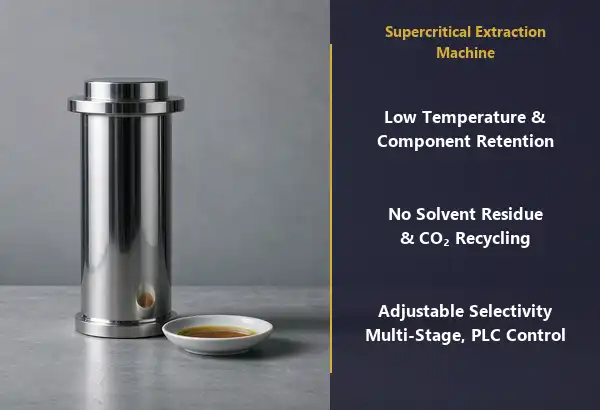
A Definition You Can Put in a Spec Sheet
At 31.1 °C and 73.8 bar, carbon dioxide becomes supercritical. When the fluid is above those lines, it still flows like a gas but can dissolve things like a liquid. The supercritical extraction machine keeps CO₂ at a certain density and pushes it through biomass that has already been prepared. The pressure is then lowered so that the dissolved material settles out into a collection vessel. Since the solvent leaves as a gas, there is no need for a step to remove it from the product stream. This is why buyers in the food, drug, and supplement industries keep this technology in mind, and this is also why changing the pressure, not the solvents, can be used to tune selectivity.
The Six Subsystems That Do the Work
There is a pressure system inside a production unit first, and then there is a process tool. There are six main parts in every supercritical extraction machine. These parts work together to control how the unit acts during a shift.
| Subsystem | Job on the skid |
|---|---|
| Extraction vessel | Holds biomass under pressure; sized by volume and basket design |
| Separator train | Drops pressure in stages so each fraction collects separately |
| High-pressure pump | Pushes CO₂ to working pressure; flow stability sets repeatability |
| Heat exchanger | Holds extraction and separation temperatures at setpoint |
| CO₂ circulation loop | Condenses and returns gas to storage; cuts make-up losses |
| PLC control system | Runs recipes, logs batch data, and handles alarms |
Materials, Pressure Rating, and Cleanability
Where cheap quotes hide are in the details of the build. Before I look at price, I read three lines on a datasheet.
- Wetted parts in 316L. All material-contact surfaces should be SUS316L or an equivalent grade, including vessel internals, piping, and separator bodies. Grade 304 costs less, but it pits faster with acidic botanical loads or chlorinated cleaning water. Pitting inside a pressure boundary is an inspection finding you cannot argue with.
- Pressure rating with real margin. Ask for design pressure, not only working pressure. A skid rated to 45 MPa gives room to run higher-density CO₂ for wax and lipid work; a unit running near its limit has no headroom for the next product you win. Confirm relief valve set pressure and the certificate behind it.
- Cleanable geometry. Drain points, basket removal, polished internal welds, and no dead legs decide how long a changeover takes. Sanitary design matters more than a certificate on the wall when you switch botanicals between campaigns. Ask to see the internal weld map.
A machine that passes these checks is different from one that passes a customer audit.
How a Supercritical CO₂ Extraction Cycle Runs
Charging, Sealing, and Pressurizing
At the start of each cycle, the biomass is prepared and the vessel is cleaned. People put dried, ground material into the basket, leaving room for fluid to move. They then close the head and check for leaks before the pressure builds up. At this point, the pump sets the system's pressure to work, and the heat exchanger keeps the setpoint. Ramp rate is important. When the bed is pressed down quickly, it fills up and channels are made that take yield from the middle of the load. As the pressure reading drops, the supercritical extraction machine with a well-written PLC holds each step until the pressure reading stops rising.
Extraction, Fractionation, and Collection
As supercritical CO2 flows through the bed, it breaks down non-polar compounds. When the full fluid leaves the vessel and goes into the separator train, the pressure drops, which causes the extract to separate from the fluid. There are three separators, and two of them can separate waxes from lighter oils in one run. The collection process doesn't open the pressure boundary, so the batch stays clean and workers stay away from high-pressure fittings. Static soaking works best for dense materials, while continuous flow works best for leafy biomass. Most production schedules do both at the same time, soaking first and then flowing. A recipe is kept for each step.
CO₂ Recovery and Changeover
The gas that comes out of the last separator is still valuable. A closed loop shrinks it, puts it back into storage, and keeps make-up purchases low. This means that recovery rate has the most impact on operating cost of all design choices. Changeover is the second part of the whole thing. A week is determined by how many batches can fit into a vessel, a basket swap, a filter replacement, and a short purge. I have seen plants lose a full shift every week because the changeover wasn't planned well. Any company that sells supercritical extraction machines should be able to give you a real timeline that includes cleaning.
Temperature, Pressure, and Other Process Parameters
Density Is the Real Control Lever
Pressure doesn't tell you much on its own. What dissolves is determined by the CO₂ density, which is a combination of pressure and temperature. Increasing temperature at a constant pressure lowers density but makes diffusion better. Increasing density at a constant temperature pulls heavier compounds together. The main way to tune any supercritical extraction machine is through this trade-off, which is also why published recipes rarely work with different plants.
| Parameter | Raise it | Watch for |
|---|---|---|
| Pressure | Higher density, heavier compounds dissolve | Pump wear, seal life |
| Temperature | Faster diffusion, lower density | Heat damage near the upper range |
| Flow rate | Shorter cycle time | Channeling, incomplete contact |
| Soak time | More complete recovery | Throughput loss |
Biomass Preparation Changes Everything
Often, the setpoint that is argued over in meetings is less important than the moisture, particle size, and packing density. When biomass gets wet, it clumps together, stops flow, and lowers yield. Fine particles cause pressure drop and channeling, while larger particles lock extract inside cell walls. Most work with leaves and seeds works best when the particles are between 0.5 mm and 2 mm and the moisture level is below 8%. Each bed should be packed evenly, leaving some room at the top. These fixes are easy to see and don't cost much. This is because a supercritical extraction machine on a well-prepared bed at moderate pressure usually works better than one on a bad bed at maximum pressure.
Judging Results: Yield, Purity, Repeatability
Three numbers tell you if a set of parameters is ready for production. If the process makes money, the yield per kilogram of biomass tells you. If the next step stays cheap, you can tell by how pure the target compound is. If the quality is the same from one batch to the next, it means that the operator or the equipment is in charge. You should run each possible recipe three times before committing it, and you should keep the chromatograms. A supercritical extraction machine that can keep the temperature and flow steady within ±0.5 °C will accurately copy both good and bad recipes.
Where Supercritical Extraction Machines Earn Their Cost
Botanical Extracts and Herbal Products
I see that herbal work is the main thing that drives demand. Low-temperature processing is good for lipid-soluble parts of traditional herbs, algae high in astaxanthin, ginger, rosemary, and milk thistle, as well as algae. Heat-sensitive markers still work, and the extract doesn't leave behind any solvent residue, which makes it easier to give the customer your specification. By switching baskets and recipes, a supercritical extraction machine also lets one plant run several small campaigns on a single skid. This is useful for contract manufacturers who work with many brands that have small volumes for each one.
Food, Flavor, and Decaffeination
Food processors use the same tools to remove the caffeine from coffee and tea, recover the hop resin and alpha-acid for brewing, and separate the natural flavors and colors. This method takes out the caffeine or improves the smell of the product without changing anything that makes it valuable. When you use organic solvents, you have to remove the solvents and defend a label claim. Steam distillation, on the other hand, damages delicate notes. Documentation for food contact, cleaning validation, and allergen control should be part of the purchase specification, not a conversation with your quality team after the order has been placed.
Cosmetics and Sensitive Actives
People who buy cosmetics want actives that don't leave behind any solvents and a clean label story that they can print on a carton. Both can be delivered by CO₂, and it can also handle thick oleoresins and pastes that get stuck in other systems. Absolutes with the top notes still there are made from jasmine, rose, and other light florals. Because oxygen and heat are not used in the process, astaxanthin from Haematococcus pluvialis is stable. When a brand is making a high-end line, the supercritical extraction machine is often the difference between a marketing claim and a specification that your lab can back up.
Choosing a Supercritical Extraction Machine and Qualifying the Supplier
Matching Vessel Volume to Real Throughput
The number vessel liters is used in this market a lot of wrong ways. Instead of nominal volume, real output is based on bulk density, loading fraction, cycle time, and changeover hours. It takes about 3 to 6 hours for a full cycle to finish in a 100 L vessel that can hold 30 to 50 kg of milled leaf. Figure out how many batches you make each week and how many weeks you're open, then compare that number to your sales forecast. If you size a supercritical extraction machine based on hope instead of a measured cycle, it will either not work at all or work too much, which will hurt the payback case you presented to finance.
Cost, ROI, and the Numbers Behind the Quote
Prices are based on the pressure rating, the number of vessels, the separator stages, automation, and the recovery of CO2. It's not possible to compare two quotes that don't include the recovery rate, the amount of utility used, and the price of spare parts. Figure out how much it costs per kilogram of extract to pay for things like raw materials, utilities, labor, CO2 make-up, repairs, and downtime. Then compare it to a low price to sell it for. When I model buying a supercritical extraction machine, the payback date is moved by recovery rate and uptime more than by the price tag. Both of these depend on how quickly the service team can respond.
Compliance, FAT/SAT, and After-Sales Terms
Compliance with the pressure vessel comes first. The certificate is based on ASME Section VIII in the US, PED 2014/68/EU plus the Machinery Directive in the EU, and TSG 21 in China. After that come electrical safety marks and paperwork about food contact. Include test procedures for both factory and site acceptance in the contract. These tests should include measurements of hold pressure, leak rate, temperature stability, and a test batch using your own biomass. You paid for a supercritical extraction machine that passes FAT on water but fails SAT on leaf. This is now a problem with your schedule.
CO₂, Solvent, and Steam Side by Side
Not by habit, but by total cost and how well it fits the product.
| Method | Strength | Limitation |
|---|---|---|
| Supercritical CO₂ | No residue, low temperature, tunable selectivity | Higher capital cost, batch operation |
| Organic solvent | Low capital, high throughput | Residue testing, solvent handling, worker exposure |
| Steam distillation | Simple, proven for essential oils | Heat damage, narrow compound range |
All three of them lose sometimes. Most of the time, it makes the most business sense to have a line that runs both CO2 for high-value fractions and steam for bulk oil.
Conclusion
A supercritical extraction machine takes a property of carbon dioxide and turns it into a production step that can be done over and over again. What dissolves is determined by pressure and temperature working together. How much of it you can recover is determined by how the biomass is prepared. Without bulk density, cycle time, and changeover hours, vessel liters don't mean much. When heat sensitivity, residue limits, or selectivity make the technology worth the money, it works well. When those conditions aren't present, however, steam or solvents win. There is more value in a high-quality build, pressure certification, and a supplier who will walk you through factory and site acceptance testing than in a low quote. Check a recipe three times before you make it bigger.
FAQ
1. What does a supercritical extraction machine actually extract?
It gets back non-polar and slightly polar compounds from herbs, like flavor molecules, essential oils, oleoresins, lipids, pigments, waxes, and many bioactive markers. In order to make the range bigger, a small amount of ethanol is added as a modifier. Sugars and most proteins stay in the biomass because they are highly polar. This is why the method works best for fats, smells, and colors and not for everything else.
2. How long does one batch take?
The length of the cycle depends on the flow rate, the soak time, and how finely you milled the load. For light seed oils, the cycle lasts about two hours. For dense root material, it lasts eight hours. Plan the plant based on the cycle you find during a test run, not on the big number that a supplier gives you.
3. Which certifications should I require?
Ask for the pressure vessel code that applies in your area, as well as electrical safety marks and material certificates for parts that will be wet. People who buy food and medicines should include GMP-based paperwork, records of the surface finish, and instrument calibration certificates.
Request a Supercritical Extraction Machine Quote from Asianbios
Email plantex@asianbios.com with the type of biomass, the level of moisture, the target compounds, the batch size, and the country where the biomass is going. Asianbios builds each supercritical extraction machine based on your recipe, gives you the process package that goes with it, and ships standard builds within 20 days. Our team responds to technical questions right away, not weeks later. When you buy a supercritical extraction machine from a company that also runs its own extraction lines, the commissioning process goes faster. Talk to people by going to asianbios.com.
References
1. Brunner, G. — Gas Extraction: An Introduction to Fundamentals of Supercritical Fluids and the Application to Separation Processes, Springer (1994).
2. Reverchon, E. & De Marco, I. — Journal of Supercritical Fluids (2006).
3. Lang, Q. & Wai, C.M. — Talanta (2001).
4. de Melo, M.M.R., Silvestre, A.J.D. & Silva, C.M. — Journal of Supercritical Fluids (2014).
5. Herrero, M., Cifuentes, A. & Ibañez, E. — Food Chemistry (2006).
6. Sahena, F., Zaidul, I.S.M., Jinap, S., Karim, A.A., Abbas, K.A., Norulaini, N.A.N. & Omar, A.K.M. — Journal of Food Engineering (2009).
About the Author

Asianbios
Our purpose is to forge a legacy of stewardship, advancing initiatives that honor and preserve the ecological integrity of our planet.

Send Inquiry



Related Industry Knowledge
- Multi-effect eye peptide powder: How It Supports Smoother-Looking Eyes
- How Trehalose Production Technology Works: Industrial Process Guide
- What Are the Health Benefits of Berberine Hydrochloride Extract Powder? A Comprehensive Guide
- Where can I buy high-quality ergothioneine powder online?
- What is Sleep Aid Capsule? Complete Beginner Guide
- Sea Buckthorn Freeze-Dried Powder Guide 2026: Skin, Health Benefits & How to Use It
- Benefits of Sleep Aid Jelly for Better Night Sleep
- Benefits of Threonine Production Technology in Feed Additives
- Why freeze dried strawberry powder is perfect for smoothies and baking?
- Radish Freeze-Dried Powder: Benefits, Uses, and Nutritional Value Explained