Wolfberry Powder: How Polysaccharide Concentration Shapes Product Quality
The amount of polysaccharides in wolfberry powder determines how good it is by determining how much active ingredient each gram gives you and how consistent each batch is. The standardized wolfberry powder that has 98% Lycium barbarum polysaccharides (LBP) by HPLC has a lot more active ingredients per gram than the whole-berry powder that only has 3–5%. A high number doesn't always mean something is good, though. Buyers also need to know the test method, get a batch-specific COA, see data on clean contaminants, and see proof that the ingredient works in drinks, capsules, or tablets. This guide shows you how Asianbios does each of those checks.
What Is Wolfberry Powder and What Does It Contain?
Wolfberry Powder and Goji Berry Powder Share a Plant, Not Always a Product
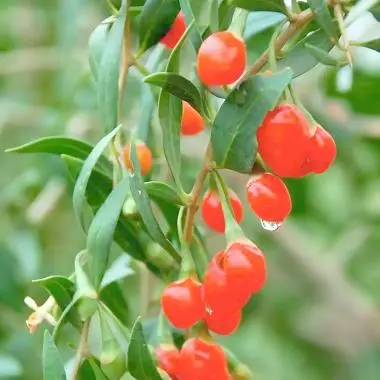
The fruit of Lycium barbarum is called both wolfberry and goji. This means that wolfberry powder and goji berry powder are often used to talk about the same plant. Still, the finished goods are very different. Dried fruit that has been milled may be sold by one company, spray-dried juice with carriers by another, and water extract by a third. The name on the label doesn't tell you which one to buy. Before we describe a lot, we make sure we know the plant species, plant part, where it came from, how it was harvested, and how it was processed in the past. According to our technical data sheet, the plant source is Lycium barbarum L. fruit, which was confirmed by morphological identification. Find out the same thing from all of your suppliers.
Typical Components Buyers Should Expect
Polysaccharides, other carbohydrates, dietary fiber, minerals, betaine, polyphenols, and carotenoids like zeaxanthin are all found in dried goji fruit. A review published in 2011 in Food Research International by Amagase and Farnsworth talks about these compounds and polysaccharides as a main bioactive part. The nutrition facts for a lot rarely match the nutrition facts for a specific cultivar, moisture level, processing method, or analytical method. Instead, rely on the product specs and the batch COA. The whole fruit is not the same as wolfberry powder made from water. In the filtration step, proteins, tannins, and fiber are taken out. This makes the polysaccharide fraction more concentrated.
Whole-Berry Powder, Extract, and Custom Grades Compared
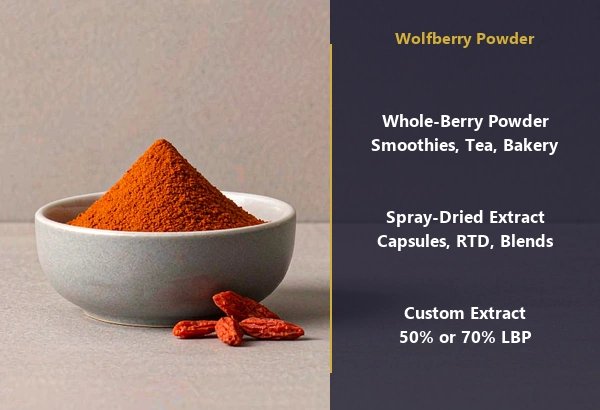
We will compare three common wolfberry powder formats below because the format affects the dose, taste, and how it is handled.
| Format | Typical LBP content | Best fit | Main check |
|---|---|---|---|
| Whole-berry wolfberry powder | 3–5% | Smoothies, tea, bakery | Fiber, texture, dose variability |
| Spray-dried extract | 98% by HPLC | Capsules, tablets, RTD, powder blends | Test method and COA |
| Custom extract | 50% or 70% | Products that need a lower concentration | 200 kg MOQ; 15–20 days development |
The table shows why you should choose the format before the price. A 98% extract and a whole-berry powder each work to fix different issues with the formulation.
Understanding Polysaccharide Concentration in Wolfberry Powder
What Counts as a Polysaccharide and What Does Not
Lycium barbarum polysaccharides are naturally occurring chains made up of carbohydrates. Masci and colleagues wrote a review article in 2018 for Food Chemistry that talks about how they are extracted, cleaned, and structured. Maltodextrin and other added carriers are also carbohydrates, so they can be added to the total in a loose carbohydrate test. In this way, a weak product can look strong on paper. We suggest that you ask each supplier to write down if there is any carrier or processing aid and to name the source of the active ingredient. This one question will weed out a lot of bad offers before you even look at the samples.
Why the Test Method Matters
Different tests don’t all mean the same thing. Analytical Chemistry (1956) published Dubois et al. on the phenol-sulfuric acid technique. This method reacts with a lot of sugars, and if the sample isn't cleaned up first, it will also pick up free sugars. HPLC procedures most often separate and quantify components, usually following hydrolysis to monosaccharides. This means that the same sample can get different results from two distinct labs. The “98% by HPLC” on wolfberry powder is useful only if the COA states the method, reference standard, how the sample was prepared and the moisture basis. “If you don’t have that detail, you can’t compare one supplier to the other.
Reading a COA Line by Line
We begin by looking at these lines on a COA and making sure they all line up.
| COA line | Our specification | What to confirm |
|---|---|---|
| Assay | ≥98.0% by HPLC | Method, reference standard, moisture basis |
| Moisture | ≤5.0% (Karl Fischer) | Dry or as-is reporting |
| Lead / Arsenic | ≤2.0 ppm / ≤1.0 ppm (ICP-MS) | Test date and laboratory |
| Microbiology | Total plate count ≤1,000 cfu/g; yeast and mold ≤100 cfu/g; E. coli and Salmonella negative | Batch number match |
| Particle size | 95% through 80 mesh | Sieve method |
These checks convert a single % into a record that your quality team can audit and file away.
How Polysaccharide Concentration Shapes Product Quality
Dose Consistency in Capsules and Tablets
Eye health and immune support capsules normally include 200 to 500 mg per serving. Wolfberry powder comprises approximately 196 mg polysaccharides per 200 mg serving, 98% LBP. That’s way more than a capsule can hold, around 3.9–6.5 g of whole-berry powder at 3–5% to produce the same amount. Because whole berries are seasonal, a standard test keeps each lot closer to what the label says. So concentration tells you how hard you can squeeze or encapsulate, and it also provides your quality team a number to watch from batch to batch.
Processing Steps That Protect Concentration and Solubility
Checks on the process decide if a wolfberry powder with a high concentration also mixes and flows easily. On our plant's 10:1 scale, water extraction takes place between 60°C and 80°C. Proteins, tannins, and fiber are taken out by ceramic membrane filtration at 0.2 μm. At 50–60°C, the vacuum concentration stops heat damage. With air coming in at 180–200°C and going out at 80–90°C, spray drying turns the liquid into powder in 5–8 seconds. Gharsallaoui and colleagues (Food Research International, 2007) say that droplets stay much cooler than the air coming in because they evaporate quickly. We test each batch with HPLC and add a stronger extract if a lot reads 96–97%.
Why a Higher Number Is Not Always the Better Choice
The concentration should be right for the job. It's easy to dose a 98% extract in milligrams, so it can be put in capsules, tablets, and cold-process RTD drinks. Whole fruit flavor, color, and fiber may be better in baked goods, smoothies, and teas than a concentrated extract. Our wolfberry powder doesn't change when it's heated, pressed, or mixed, and it can handle baking temperatures up to 180°C. Our data sheet says to protect against light, so test the color stability in hot or acidic drinks before going big. We have given 50% and 70% grades when a lower concentration fits better.
Choosing and Sourcing Wolfberry Powder for the U.S. Market
A Five-Step Selection Process
A short process that can be used again and again keeps sourcing decisions fair. The table shows the five steps we think you should take.
| Step | Action | Evidence to request |
|---|---|---|
| 1. Define the application | Pick format, dose, and target market | Written product brief |
| 2. Set a realistic specification | Choose assay range, moisture, particle size | Technical data sheet |
| 3. Verify the COA | Check method and batch match | Batch-specific COA |
| 4. Review compliance | Check certificate scope and contaminant data | cGMP, FSSC22000, ISO9001, HACCP; pesticide and heavy metal reports |
| 5. Pilot test | Test a wolfberry powder sample in your formula | Stability and solubility results |
Before making a lot of something, make sure you like a reference sample, and write down the specifications in your purchase agreement.
Compliance Checks for U.S. Buyers
There may be more regulatory questions about a concentrated wolfberry powder extract than about a whole-fruit ingredient. The 2016 draft guidance from the FDA on new dietary ingredient notifications helps brands decide if a notification is needed, so get your regulatory adviser involved as soon as possible. Claims about structure or function must also include the standard FDA disclaimer and a notice within 30 days of the first marketing. When berries come in, we use GC-MS/MS to check for 247 pesticides and ICP-MS to check for five heavy metals. Our building has cGMP, FSSC22000, ISO9001, HACCP, HALAL, and KOSHER certifications. Organic certification applies to batches of raw materials that are certified as organic. Always check the certificate's validity and scope.
Spotting Whole-Fruit Powder Sold as Extract
There can be dilution in case of huge price disparities. Whole-berry wolfberry powder can’t get to 98% because it only contains 3-5% polysaccharides. A true standardised extract is a fine orange-red powder that is water soluble. But whole fruit powder leaves insoluble fibre behind. Ask for a COA stating the method, and then submit a sample you want to keep to another lab. Compare bids using the price per milligram of LBP, not the price per kilogram. We have had our batches tested by a third-party lab and you can try a 100g sample before committing to a larger purchase.
Cost, Dosage, and Working With Asianbios
Cost Per Effective Dose
There are roughly 980 grams of polysaccharide for every kg of 98% wolfberry powder. Only 40 grams for every kilogram of 4% whole-berry powder. The two varieties differ by a factor of 24, which is in the 20-30x range, which is why the price per kg is inaccurate. To calculate overall cost in usage, add the costs of testing, shipping, packing and MOQ. 600 kg. 4% whole-berry powder contains the same quantity of polysaccharides as a 25 kilogram. drum of 98% powder. This makes it easy to store and deal with. Compare prices to get the greatest price for each effective dosage.
Dosage and Formulation Support
Most manufacturers of tablets and capsules use 200 mg to 500 mg per serving. For inclusion in final food and drinks, we suggest starting at 0.5-5% and checking for stability and good solubility in your application. Water and wolfberry powder combine so there is no need for heat in cold-process RTD shots and quick mixes. Don't include sickness claims in your marketing language. include structural and function statements only. Also, brands should advise customers who are pregnant, taking drugs or have health problems to seek medical advice. We provide the information and your regulatory team stamps off on the final label.
Samples, MOQ, Delivery, and OEM/ODM
Start by picking out 100 g. The price is paid back on the first commercial transaction exceeding 100 kg. Standard stock ships in 10 days following payment. MOQ for tests is 1kg. Express shipping (DHL, FedEx, SF) is 5-7 days for purchases below 50 kg. Air freight is 7-10 days for 50 kg to 500kg and sea freight is 25-35 days for 500kg and above. Standard Packing 25kg Fibre Drum with 2 PE Bags. Also available in bundles of 1, 5 or 10 kg. Store in a dark, damp location below 25 ° C. Shelf life of the product is 24 months. We also provide OEM/ODM along with our pills, capsules, gummies and sachets.
Conclusion
When judging a standardised wolfberry powder, the most informative single number is polysaccharide concentration. But it matters only if the test technique and batch COA and contaminant data support it. Capsules and pills should have 98% uniformity of dosage by HPLC. Whole-berry powder (3–5%) is good in dishes and teas where flavour and fibre are vital. Controlled extraction, filtering and spray drying are industrial procedures that influence solubility and stability. That is why you need to test samples in your own formula. Also, U.S. buyers should examine the NDI questions, claim language and certificate scope. The greatest method to see the value of something is to compare on a cost per milligram of polysaccharide basis instead of cost per kilogram basis.
FAQ
1. Are wolfberry powder and goji berry powder the same?
Both names are used for the dried fruit of Lycium barbarum, but refer to distinct things. One might be whole fruit that has been crushed up and has 3–5% polysaccharides, the other could be a standardised extract. Check the name, portion of plant and species.
2. Is there one ideal polysaccharide concentration?
No, capsules and pills function best with a good quality standardised extract. Whole fruit, however, can add taste and mouthfeel to teas and smoothies. Make sure the specification matches your formulation, dose, and audience.
3. What documents should I request from a supplier?
Request technical data sheet, COA for each lot including test procedure, food safety certificates and data on contaminants. Asianbios includes a COA with every shipment.
4. What is the minimum order, and can I test first?
MOQ is 1kg, you can get samples of 100g. If you are buying more than 100 kg for business you can reclaim your sample cost. Try out your own formula before you give it the OK for large manufacturing.
Request a Wolfberry Powder Specification and Sample from Asianbios
Looking for a company that makes wolfberry powder and can provide 98% LBP by HPLC? Asianbios has a minimum order quantity of 1 kg, enough stock, batch-specific COAs, and support for OEM and ODM. We will send you a technical data sheet with sample information and pricing as soon as we hear about your target polysaccharide range, application, and estimated volume. Please email plantex@asianbios.com. Find out more at asianbios.com, and then test a sample in your own recipe before giving the go-ahead for mass production.
References
1. Food Research International, 2011 – Amagase H., Farnsworth N.R., "A review of botanical characteristics, phytochemistry, clinical relevance in efficacy and safety of Lycium barbarum fruit (Goji)."
2. Food Chemistry, 2018 – Masci A. et al., "Lycium barbarum polysaccharides: Extraction, purification, structural characterisation and evidence about hypoglycaemic and hypolipidaemic effects. A review."
3. Analytical Chemistry, 1956 – Dubois M. et al., "Colorimetric Method for Determination of Sugars and Related Substances."
4. Food Research International, 2007 – Gharsallaoui A. et al., "Applications of spray-drying in microencapsulation of food ingredients: An overview."
5. Planta Medica, 2010 – Potterat O., "Goji (Lycium barbarum and L. chinense): Phytochemistry, pharmacology and safety in the perspective of traditional uses and recent popularity."
6. U.S. Food and Drug Administration, 2016 – "Dietary Supplements: New Dietary Ingredient Notifications and Related Issues, Draft Guidance for Industry."
About the Author

Asianbios
Our purpose is to forge a legacy of stewardship, advancing initiatives that honor and preserve the ecological integrity of our planet.

Send Inquiry
Related Industry Knowledge
- Where can i buy blueberry extract
- Why Use a Compressor-type Low-Temperature Evaporator System?
- Why Human Recombinant Collagen Matters for Next-Gen Biomaterials
- How to Choose a Sleep Aid Brewing Powder Manufacturer
- Glucoamylase Production Technology for Brewing and Alcohol Industry
- anti-inflammatory peptides powder: A Gentle Peptide for Sensitive Skin Care
- Why Choose Eggshell Membrane Over Other Collagen-Rich Products?
- Best Tart Cherry Powder: Benefits for Sleep, Inflammation, and Muscle Recovery
- How to Choose the Best Seabuckthorn Powder - Asianbios
- Uses of Sleep Aid Tablets for Night Insomnia Support