Alkaline vs Acid Protease Enzyme Production: Which Wins?
Each path does not win everyplace but each wins in its own lane. Alkaline proteases are the leading producer of the protease enzyme production used in detergents, leather and textiles due to the fast growth of Bacillus strains and their secretion of the enzyme into the broth. Acid proteases are important in low-pH food, brewing, dairy and feed applications where Aspergillus strains are active. The optimal choice depends on the operating pH, temperature, stability of the enzyme, yield of the fermentation, efficiency of recovery and cost per unit of activity. I prepared this guide to aid plant managers, chief engineers and purchasers to match the enzyme to the process before they invest in a pilot trial or a production line.
Proteases make up around 60% of the commercial market for enzymes, as per a 1998 review in Microbiology and Molecular Biology Reviews that is generally cited. That’s a huge percentage and that’s why buyers always asking me how protease enzyme manufacturing works and which method is ideal for their plant. Below I explore these methods and describe how Asianbios helps projects from pilot trial to consistent output.

What Are Alkaline and Acid Proteases?
Functional Difference Between Alkaline and Acid Proteases
Proteases are enzymes that break the peptide bonds of proteins. Each works better at a different pH level. Many published researches have shown that optimal pH of alkaline proteases, notably the subtilisins from Bacillus, was between 9 and 11. Acid proteases are mainly fungal aspartic proteases and are most active at pH 3 to 4. The neutral proteases fall between these two. Asianbios employs Bacillus subtilis for alkaline protease (pH 6.5-8.5) and Aspergillus niger for acid protease (pH 3.5-5.0). Exact optima differ with strains, formulations and stabilizers and heavy duty detergents may need a higher pH. So I ask for activity curves and stability data from consumers instead than trusting a label.
Typical Industrial Applications
The table covers each kind of enzyme and the processes with which it is most often associated.
| Type | Typical working pH | Common source | Typical uses |
|---|---|---|---|
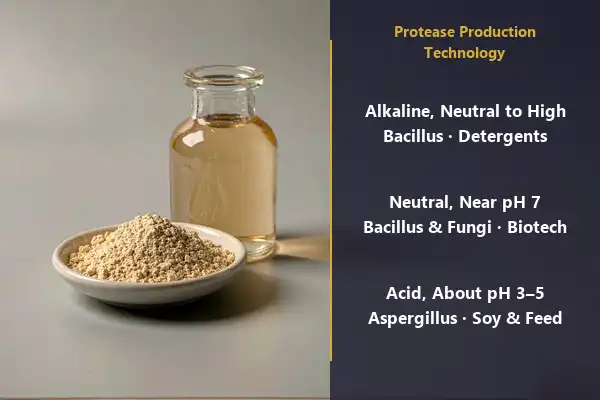
| Alkaline | Neutral to high | Bacillus | Detergent additives, leather processing, textile degumming |
| Neutral | Near 7 | Bacillus, fungi | Specialty protein hydrolysis, biotechnology |
| Acid | About 3 to 5 | Aspergillus | Soy protein hydrolysis, dairy, brewing, feed, digestive preparations |
Feed buyers use acid proteases to promote protein digestion and reduce anti-nutritional effects. Consumers of the detergent use the alkaline kind to remove the stains. Your process should first be matched with the appropriate enzyme type and operating conditions.
Why Application Should Guide Production Decisions
The strain, fermentation conditions, recovery mechanism and format of protease enzyme production are dependent on the desired function. The maker of the detergent should be resistant to surfactants and oxidants. A food company needs clean sensory attributes, food quality documentation and predictable hydrolysis. In the US, food enzymes are usually required to be GRAS or authorized as a food additive by the FDA therefore I would encourage US buyers to check the paper work early on. Decide once and for all whether you need a liquid concentration, powder or granules. A clear brief cuts down on bad samples, speeds up validation, and tightens up quotations.
How Protease Enzyme Production Works
The industrial production of protease enzyme involves three steps: upstream preparation, fermentation and downstream recovery.
Step 1: Selecting a High-Yield Microorganism
Strain selection has an impact on the quantity of protease enzyme production, the efficiency of secretion, the fermentation time and the downstream workload. Bacillus species are good for alkaline proteases because they secrete the enzyme and also ferment well in industrial tanks. Aspergillus and other fungi are ideally suited for acid proteases, especially in food and feed. The sole upside of a high-yield strain is if it is also genetically stable, non-pathogenic and acceptable by authorities in your target market. Asianbios’ upstream covers strain selection, genetic optimization, sterile seed development, media preparation and sterilization and QC of starting material.
Step 2: Preparing Media and Choosing the Fermentation Method
The supply of carbon and nitrogen must be balanced to maintain microbial growth and enzyme secretion. Common examples are glucose, starch, soya bean meal, corn steep liquor and bran. Asianbios utilizes locally available substrates such as soybean meal, corn steep liquor and bran to minimize the cost of raw ingredients. Producers then choose between submerged fermentation, where the cells grow in liquid, and solid state fermentation, where the cells grow on moist solid substrates. In fermentation, we continuously assess temperature, pH and oxygen, add nutrients in batches and measure enzyme activity. The color, the odor and the filtering action vary with the raw material. I am a supporter of specific standards for input content.
Step 3: Recovering and Formulating the Enzyme
Solid-liquid separation and cell removal is the initial stage in recovery. The Asianbios process is a multi-step purification, concentration, drying, final formulation and quality testing by ultrafiltration and chromatography. Commercial proteases are often standardized to a range of activity, rather than purified to laboratory grade and carriers or stabilizers are used to maintain activity during storage. The final cost is often more affected by the losses during filtration, membrane concentration and drying than by the fermentation yield. So when I look at protease enzyme production I look at the recovered activity and protease production technology, not the activity in the broth.
Alkaline and Acid Protease Production Routes
Alkaline Protease Enzyme Production With Bacillus
Bacillus runs are typically one to three days in length and the turnover in the tank remains high. Critical factors include pH, temperature, dissolved oxygen, aeration, agitation, inoculum quality, and nutritional balance. The primary challenges at large volume are foam and oxygen transmission. Controlling contamination is vital because bacteria develop quickly. The broth is clarified downstream by centrifugation or microfiltration, condensed by ultrafiltration and stabilized and spray-dried or standardized as a liquid. Asianbios states that fermentation alkaline protease activity is more than 250,000 U/mL. Even if the test seems strong, oxidants and surfactants may impair activity, so purchasers must still check stability in the final formula.
Acid Protease Enzyme Production With Aspergillus
Fungal cultures develop as filaments and so shape, pellet formation, viscosity and oxygen transport require careful monitoring. Runs take several days, longer than bacterial runs, and filtering might require more work. In response Aspergillus niger generates proteases active at low pH suited for soy protein degradation, dairy, brewing and feed. Asianbios’ acid protease is said to have a fermentation enzyme activity of over 200,000 U/mL. For controlled markets, I would suggest buyers ask for strain identification, non-toxigenic status, genetic stability, contamination controls and consistent findings across numerous commercial batches.
Submerged vs Solid-State Fermentation
Both systems produce protease enzyme, but trade control for water and substrate savings.
| Criterion | Submerged | Solid-state |
|---|---|---|
| Medium | Liquid in a controlled tank | Moist solids such as wheat or rice bran |
| Process control | Strong control of pH, temperature, oxygen | Harder, because moisture and heat vary |
| Water use | Higher | Lower free water |
| Consistency | Easier to standardize | Depends on equipment design |
| Best fit | Bacteria and standardized large output | Selected fungi on farm substrates |
Alkaline vs Acid Protease Enzyme Production: Which Route Performs Better?
Technical Comparison by Performance Criteria
| Criterion | Alkaline protease | Acid protease |
|---|---|---|
| Preferred pH | Neutral to alkaline | Low pH |
| Common host | Bacillus | Aspergillus |
| Usual route | Submerged | Submerged or solid-state |
| Main markets | Detergent, leather, textile | Food, brewing, dairy, feed, digestive |
| Main risk | Foam, oxygen transfer, oxidant stability | Longer cycles, filtration |
| Buyer priority | Activity and chemical compatibility | Acid stability and food or feed documents |
Cost and Yield Considerations
There are additional costs to producing protease enzymes than just fermentation. Cycle duration. Raw materials. Aeration energy. Equipment utilization. Recovery yield. Drying. Packaging. Testing. Freight. It all adds up. Even a cheap fermentation might result in a costly final product if recovery losses or stabilizing costs are excessive. I encourage finance teams to look at cost per unit of confirmed activity and useable dose, not price per kilogram. Alkaline output is generally favored by the fact that bacterial runs are often finished sooner, while fungal runs may employ cheap bran or soybean meal. Before you start budgeting, consider testing, compliance and logistics.
Application Fit and a Practical Decision Rule
If your process is neutral to alkaline pH and requires tolerance to detergents or industrial chemicals, use alkaline protease. Acid protease: When your process operates at low pH and requires continuous acidic activity. If the pH, temperature, substrate or inhibitors fluctuate from stage to stage, request application testing or consider a mix that contains a neutral protease. Give vendors a thorough technical brief before you request prices, so they may propose the appropriate level of activity and structure. Application fit trumps any universal rating.
From Pilot Trial to Stable Protease Enzyme Production With Asianbios
A solid route on paper still requires a strong strategy on the factory floor.
Tuning Strain, Medium, and Fermentation Parameters
Standardize inoculum age, concentration and storage. Uneven seeds = uneven batches. Carbon and nitrogen balance to manufacture the enzyme without over buildup of biomass. Scale up utilizing tank volume but also oxygen-transfer capacity, mixing time and heat removal. Also watch the antifoam dose, too much may interfere with oxygen transfer and filtration. Activity check on each stage, pH and temperature stability, microbiological limits, moisture, heavy metals and shelf-life testing. These methods enable the continuous production of protease enzyme with the growth of volume using protease production technology. Asianbios helps this initiative with formulation, process design, pilot scale to commercial scale testing and parameter optimization.
How to Choose a Protease Enzyme Production Partner
Ask for a technical data sheet, certificate of analysis, safety data sheet, activity description, microbiological findings, heavy metal data, shelf-life data and batch traceability. Check which technique is used to define the activity unit. Watch for red signs like unspecified units, fluctuating specs, little strain information, and costs that don’t include testing, packing or freight. Asianbios has CGMP, FSSC22000, ISO9001, HACCP, HALAL, KOSHER certifications and technicians and labs to offer experimental verification and technical support. Actually check any certificate with the actual goods and plant you are going to purchase from.
Asianbios Technical Services for New Production Lines
When design and execution are in lock step, projects fly. Asianbios' success in producing protease enzymes depends on 30% process and 70% local execution. A good process is important but it' s the people, the commissioning and the day-to-day running that will determine the outcome. So here are the key services that I give to teams developing a line:
-
Research and scale-up of processes: creation of formulae, design of processes, pilot-scale to production-scale trials, tweaking of parameters to increase efficiency and reduce cost and execution of process scale-up and industrialization. Pilot data will show you the recovered activity, energy utilization and batch consistency before you invest your cash in a complete manufacturing line and its equipment.
-
Technical advice. Full range of technical services such as project planning, manufacturing line design and process schemes. I see this step as the place to settle protease type, target activity and batch size on paper, where a change costs nothing, rather than identifying holes during installation or the first production runs.
-
Equipment commissioning, training and after-sale support: commissioning of equipment, operational training and on-site supervision to guarantee steady production, followed by equipment maintenance, troubleshooting and process upgrades. During start-up your operators understand the procedure. Technical help is still accessible to you if settings drift or yields drop.
These services respond to the usual concerns of a new fermentation investment: immature processes, limited yield and unreliable start-up.
Conclusion
Choosing the right protease enzyme production route depends on the target application, operating conditions and production requirements. Alkaline proteases are mostly generated by Bacillus in submerged fermentation. They are ideal for detergents, leather and textiles, with quick cycles and high throughput. Foam, oxygen transfer and oxidant stability must be addressed. Aspergillus acid proteases are excellent for food, dairy, brewing and feed applications at low pH and allow longer runs and more demanding filtration. Submerged fermentation has superior control, whereas solid-state fermentation conserves water and uses agricultural substrates. The recovered activity, testing and delivery requirements determine the cost, rather than the activity of the broth or the price per kilogram. The best choice should be based on pilot data, product type, regulatory paperwork and operating pH. A higher assay can be less valuable than a carefully documented and well-performed system that matches the application.
FAQ
1. What is the main difference between alkaline and acid protease enzyme production?
Alkaline production targets enzymes active at neutral to high pH, often with Bacillus. Aspergillus is commonly used for acid production targeting enzymes that are active at low pH. Media, fermentation conditions and recovery stages are different, verify activity and stability data at your own pH and temperature.
2. Is submerged fermentation better than solid-state fermentation?
Nobody wins everyplace. Better control and easy standardization are provided by submerged fermentation. Solid state fermentation employs agricultural substrates for chosen fungus and saves free water. I advocate a pilot comparison before buying equipment.
3. How do I compare protease prices?
Cost per unit of proven activity and useable dose, not price per kg. Consider shelf life, packaging, testing, paperwork and freight, since a cheap estimate with poor stability might end up costing you more.
4. Can Asianbios support a new protease production line?
Yes. Asianbios offers process research, project planning, manufacturing line design, commissioning, operator training and after-sales services. Email us your intended product and scale.
Start Your Protease Enzyme Production Project With Asianbios
Asianbios provides protease enzyme production projects for protease enzymes from strain and formula creation to pilot trials, commissioning and operator training. Are you searching for a provider of protease enzymes? Send your desired pH, temperature, activity, format and volume by email to plantex@asianbios.com. Our laboratory staff will respond promptly, and we welcome modest trial orders. For certification and technical services, visit asianbios.com.
References
-
Microbiology and Molecular Biology Reviews, 1998 – Molecular and Biotechnological Aspects of Microbial Proteases
-
Applied Microbiology and Biotechnology, 2002 – Bacterial Alkaline Proteases: Molecular Approaches and Industrial Applications
-
Food Technology and Biotechnology, 2006 – Microbiology and Industrial Biotechnology of Food-Grade Proteases: A Perspective
-
Biochemical Engineering Journal, 2003 – Solid-State Fermentation
-
Brazilian Journal of Microbiology, 2015 – A Biotechnology Perspective of Fungal Proteases
-
Frontiers in Bioengineering and Biotechnology, 2019 – Microbial Proteases Applications
About the Author

Asianbios
Our purpose is to forge a legacy of stewardship, advancing initiatives that honor and preserve the ecological integrity of our planet.

Send Inquiry

Related Industry Knowledge
- The Benefits of Rosa roxburghii Tratt Extract
- Pure Saffron Extract Powder for Mood and Focus: How It Works
- How Liquorice Extract Powder Supports Digestive Wellness
- Disc Centrifuge Machine vs. Traditional Separators: Key Differences
- What Makes Bitter Melon Extract Powder a Valuable Botanical Ingredient?
- What is Stevia Extract Powder?
- Uses of Sleep Aid Jelly for Daily Sleep Routine
- Sleep Aid Jelly Guide: How It Supports Relaxation
- Benefits of Lysine Production Technology in Feed Industry
- Best Grape Powder in 2026: Expert Reviews, Health Benefits & Buying Guide