How to Operate a Multiple Effect Evaporator Step by Step
For multiple effect evaporator operation, use the fixed multiple effect evaporator operating procedure. Check equipment and verify utilities. Begin circulation and feed. Drain the steam pipes and let in the steam carefully. Create vacuum from the last effect. Then balance feed, steam, vacuum and level to get concentrate at target. Reduce feed gradually, flush tubes, isolate steam, break vacuum, drain low points and shut down. Keep a log of all your readings. This tutorial breaks down each stage in plain language, supplements with troubleshooting and cleaning methods, and demonstrates how Asianbios constructs its multi-effect evaporator machine for continuous concentration.
This artical is intended for engineers, operators and purchasers in the fields of plant extract, fermentation, food and pharmaceuticals. Written multi-effect evaporator operating procedures ensure all shifts use the same way and protect the heating surfaces. Always defer to the manufacturer’s handbook, approved P&IDs, risk assessments, PPE standards, lockout/tagout processes, over general suggestions.
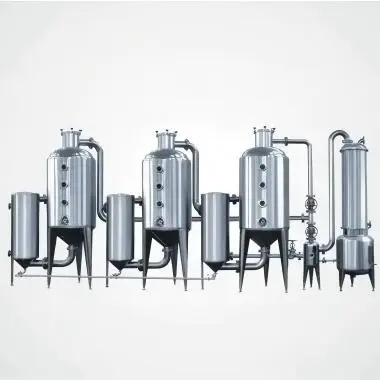
Understand the Multiple Effect Evaporator Process Flow and Main Components
How Vapor and Liquid Move Through the Effects
In a multiple effect evaporator, many evaporation stages are connected in series. The initial effect is heated by live steam. The vapour boiled out there is heating the second effect which operates at lower pressure and lower boiling point. The latter effect is frequently under vacuum. The heat is reused at each stage, thus the plant consumes less steam to evaporate each kilogram of water.
Feed can be forward, reverse, mixed or parallel. Forward feed is best for most heat-stable liquids. The backward feed is useful for thick liquids, since the most concentrated product contacts the warmest surface where the viscosity is least. Every multiple effect evaporator operating process starts with knowing your feed pattern.
Main Components and What Each One Does
Each segment does its own thing. The heating chamber (calandria) transfers heat from steam to the liquid. The evaporation chamber (separator) separates vapour from liquid and a demister grabs droplets. The condenser converts the last vapour back to water. The vacuum system removes air and other non condensable gas.
Feed pumps and a circulation pump move the liquid, and valves, traps and pipelines control flow. The control system reads pressure, temperature, level, flow and density. I make sure each signal reads properly before I begin, as operators rely on those readings to keep the process stable.
Asianbios Multi-effect Evaporator Machine at a Glance
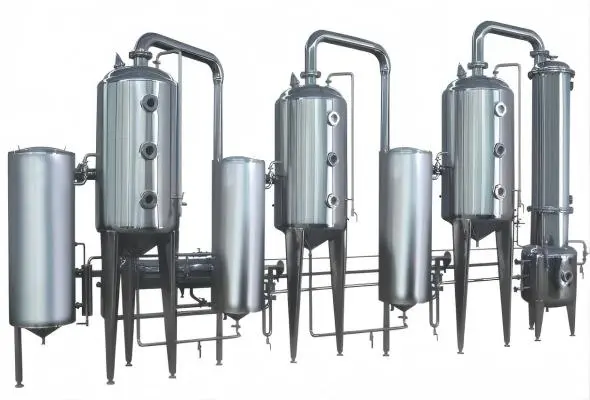
Asianbios multi-effect evaporator machine re-cycles steam heat to concentrate liquids under vacuum constantly. The key specifications are in the table.
| Item | Specification |
|---|---|
| Evaporation capacity | 1000–50000 kg/h |
| Number of effects | 2, 3, 4, or 5 |
| Evaporation temperature | 50–90°C |
| Degree of vacuum | -0.08 to -0.098 MPa |
| Main material | SUS304 / SUS316L |
| Structure | Falling film, rising film, or forced circulation |
| Control | PLC automatic |
| Safety protection | Overheating, overpressure, overload, low level |
| Certification | ISO9001, CE |
These values are useful for plant extract solutions, fermentation liquids, glucose solutions, herbal extracts, syrups and saline waste water. Asianbios claims that steam heat reuse can reduce operational cost by as much as 70% over single-effect systems. Apply these numbers when you alter an operating technique of a multiple effect evaporator to the machine.
Pre-Startup Checks and the Multiple Effect Evaporator Operating Procedure for Startup
Pre-Startup Inspection Checklist
Careful testing before starting prevents heat stress, contamination, leaks and unexpected down time. I walk the queue, inspect valves and pipes, gaskets, pumps, hygienic connections, drains and guards. Then I check to see if we have steam, cooling water, power, compressed air, process water and cleaning chemicals.
The feed must be at the right temperature, viscosity, pH, solids content and levels of filtration. Last but not least, I look at instruments, alarms, PLC or SCADA displays, emergency stop logic and control valve response calibration. If you miss a stage in this multi-effect evaporator operating technique, you will have troubles farther down the run.
Multiple Effect Evaporator Operating Procedure: Startup Step by Step
- Open process, utility, condensate and discharge lines as required, close extraneous bypasses and drains, and confirm that the equipment and utilities are ready for operation.
- Begin feed and circulation at a carefully controlled rate, so that the heating surface is never dry and the pump does not cavitate.
- Begin cooling water to the condenser. Switch on the vacuum system. Create vacuum from the first effect to the last.
- Drain condensate from the steam line and then open steam slowly to prevent water hammer and thermal shock.
- Slowly increase the feed and steam to get consistent levels, temperatures and vacuum. You can observe temperature, pressure, flow and concentration on the Asianbios PLC panel with each modification you make.
Normal Operation and Log Keeping
The objective is to have the unit stable in operation. Feed flow, vacuum, steam pressure, liquid level, circulation, condensate removal, and concentrate discharge must remain balanced. Concentration and vacuum can change suddenly if the feed changes, so change one thing at a time, in modest stages.
Check that the steam pressure and temperature drop across each effect is within allowed limits. This retains the product and reduces fouling. Monitor separator performance, condensate drainage, flow velocity and final concentration, typically measured by density or Brix. Record values, alerts, energy statistics, cleaning and corrective operations each shift. The trends in that log tell you there are problems before they shut down production.”
Shutdown, Troubleshooting, and Cleaning in the Multiple Effect Evaporator Operating Procedure
Multiple Effect Evaporator Shutdown Procedure
Controlled shutdown protects hot surfaces, pumps, seals and downstream equipment. Reduce the input slowly as long as the circulation is enough to flush the product out of the lines and tubes. Then reduce and isolate steam. Break vacuum in a controlled manner and isolate the condenser.
Flush pumps, separators and circulation lines, especially where crystallisation, solidification or corrosion can take place. Drain or recover material from low points. Other emergency and long term shutdown processes include utility isolation, lockout/tagout, draining, cleaning, drying, preservation, alarm records and documented follow up. All changes must be documented. Record shutdown steps for the operating process of the multiple effect evaporator.
Troubleshooting Common Operating Problems
Don’t change a setpoint until you’ve correlated each symptom with its process cause. Table 1 shows common things that can go wrong and what to do initially.
| Symptom | Likely causes | First actions |
|---|---|---|
| Vacuum loss | Air leakage, fouled condenser, vacuum pump fault | Run a leak test, check cooling water, inspect the vacuum system |
| Foaming or entrainment | Excess feed load, foaming feed, weak demister | Lower feed rate temporarily, inspect the demister |
| Scaling or tube blockage | Poor circulation, high concentration, late cleaning | Raise circulation within limits, schedule cleaning |
| Low capacity | Fouled tubes, wrong pressure balance, poor condensate drainage | Compare readings at several points, check traps |
| Condensate problems | Failed traps, blocked drains | Inspect traps and valves |
When problems occur, briefly reduce the load and check the pumps and valves. Take readings at multiple points to identify the cause. Never exceed design pressure or chemical compatibility limits. Add each validated repair to your multi-effect evaporator operating method.
Cleaning, CIP, and Preventive Maintenance
Clean on the facts, not just the date. Cleaning is indicated by reduced capacity, worse heat transfer coefficient, greater pressure drop, product carryover or visible deposits. The normal CIP cycle includes product recovery, pre-rinse, alkaline wash, intermediate rinse, acid wash as required, final rinse, sanitise, inspection and documentation.
Check chemical strength, temperature, circulation time, ventilation, PPE and compatibility of materials. Keep spare parts and inspect tubes, demisters, pumps, seals, valves, traps, sensors, safety devices, condensers and vacuum equipment periodically. Add these cleaning triggers to your operating procedure for the multi-effect evaporator. If you follow them, stainless steel SUS304 or SUS316L surfaces become easy to clean.
Cut Energy Use and Operating Cost with a Sound Multiple Effect Evaporator Operating Procedure
How the Number of Effects Changes Steam Economy
Steam economy is the kg of water evaporated per kg of live steam. It grows with every extra effect. Three- to six-effect systems often are cited in the range of roughly 2.5 to 5.5. Real results rely on input temperature, fouling, increase of boiling point, temperature differential and heat loss.
Extra effects cost more to acquire, and take up more room, but they do cut down on steam usage per unit of water evaporated. Its limit is the boiling point elevation. Dissolved solids increase the boiling temperature and reduce the temperature differential between effects that can be used. A suitable multiple effect evaporator operating method will declare target steam and vacuum values so operators are protecting that differential.
Three-Effect vs. Five-Effect Systems
The table is a general comparison of the two common options.
| Factor | Three effects | Five effects |
|---|---|---|
| Steam consumption | Higher | Lower |
| Capital cost | Lower | Higher |
| Footprint | Smaller | Larger |
| Control complexity | Simpler | More involved |
| Maintenance | Fewer components | More components |
Choose between steam cost and capital cost, comparing both against your projected hours of operation. Asianbios designs 2, 3, 4 or 5 effect configurations so that you can size the multi-effect evaporator machine to your own steam price and production schedule using a multiple effect evaporator operating procedure.
Practical Energy-Saving Measures
Little habits add up. Keep heat transfer surfaces clean, recover heat from condensate, warm feedwater with available heat, and remove air leaks that weaken vacuum. Run the condenser under its designed cooling water conditions and match feed to realistic production demand instead of idling at low load.
Thermal or mechanical vapour recompression can further increase the steam economy for appropriate workloads, thus ask your provider to examine this. Condensate recovery and insulation maintenance are further steam-saving techniques included in U.S. Department of Energy’s steam system advice. A controlled multiple effect evaporator operating process maintains these improvements shift to shift.
Select, Commission, and Improve Your Multiple Effect Evaporator
What to Define Before You Select an Evaporator
Capacity and pricing are not the only considerations in selecting the optimal device. Define feed flow, solids, viscosity, temperature sensitivity, foaming, crystallisation risk, target concentration, operating hours, hygiene level, materials, automation, utilities, site conditions and possible expansion.
These facts are indicative of the configuration. The falling film is ideal for thin heat sensitive liquids. Rising film or forced circulation is suitable for heavier or scaling liquids. Plant extracts and fermentation solutions can froth and thicken easily, therefore test data is useful. Everything has to be in the RFQ. List equipment, installation, utilities, exclusions, delivery, warranty and service charges. For US buyers include also required codes like ASME in the RFQ. These inputs are the basis for all operating processes of multiple effect evaporators.
Factory Acceptance, Site Commissioning, and Performance Acceptance
Acceptance tests indicate the machine complies with the order. Review material, dimensions, welding quality, pressure testing, instruments, pumps, valves, control logic, alarms, interlocks, drawings, manuals and spare parts at the plant. On site inspect plumbing, utilities, drainage, wiring, insulation and alignment. Perform water tests, leak testing, calibration tests and control loop tests.
Always start production commissioning with a safe test medium, e.g. water, before feeding the product. Establish criteria for approval of capacity, final concentration, steam economy, vacuum stability, condensate quality, energy consumption and cleaning performance. A standard installation, including performance testing and full training of the operators, takes about 20 days, says Asianbios. After these tests are completed, you can conclude the operation process for your multiple effect evaporator.
Supplier Support and Long-Term Improvement
Balanced feed, steam, vacuum, circulation, level, condensate drainage and discharge result in stable performance. Adjust slowly, never allow heating surfaces to run dry and use patterns rather than single readings. Use your data to spot repeating alarms, capacity loss, energy growth and quality drift.
Contact the provider for help with unstable vacuum, recurring clogging of tubes, limited capacity, frequent breakdowns of equipment, modifications to feed or increase of production. Asianbios is active in plant extraction and fermentation goods and provides 24/7 technical support with remote monitoring. It also supplies spare parts. Regular training of operators in multiple-effect evaporator operating technique maintains performance standards.
Conclusion
A steady multiple effect evaporator operating technique is based on four habits: understanding the process flow, inspecting before every start, changing settings gradually, and recording every reading. Steam reuse between effects decreases steam consumption. Steam economy increases with each additional effect but capital cost, space and control complexity also increase. Startup builds feed, vacuum and steam in tiny increments. Shutdown flushes and drains the system. Regular CIP and maintenance protects the heat transfer and troubleshooting based on symptoms works best. The multiple effect evaporator operating procedure is performance measurable due to clear feed data, factory and site testing, and stated acceptance criteria.
FAQ
1. What is the correct multiple effect evaporator operating procedure for startup?
The correct startup procedure is to inspect the unit and utilities, establish the required flow paths, start feed and circulation at a controlled rate, begin condenser cooling, create vacuum, drain the steam lines, open steam slowly, and then gradually balance feed, steam, vacuum and liquid level. Operators should always follow the manufacturer’s handbook and approved site procedures.
2. Why does an evaporator lose vacuum?
An evaporator can lose vacuum because of air leaks, a dirty condenser, inadequate cooling water flow, or a vacuum pump problem. The operator should check the condenser and cooling water, inspect the vacuum system, and perform a leak test to identify the cause.
3. Is forced or natural circulation better for viscous liquids?
Forced circulation is normally better for viscous or scaling liquids because the pump keeps the liquid moving rapidly through the tubes. Natural circulation is generally more suitable for thinner liquids with lower viscosity and lower scaling risk.
4. What information does a supplier need for sizing?
A supplier needs information such as feed flow, solids content, viscosity, temperature sensitivity, target concentration, required capacity, available utilities, material requirements, hygiene requirements, automation level and site conditions. These details allow the supplier to select and size the evaporator appropriately.
Request a Multiple Effect Evaporator Operating Procedure Proposal from Asianbios
Looking for multiple effect evaporator operating procedure manufacturer, machine manufacturers? Please send your feed type, solids, target concentration, capacity and utilities to Asianbios at producttech@asianbios.com. We offer 2-5 effects, 1000-50000 kg/h capacity, PLC control, SUS304/SUS316L construction, CE and ISO9001 certification, and 24/7 technical support. Our engineers will put together a preliminary process proposal.
References
-
Perry's Chemical Engineers' Handbook, 9th Edition, 2019
-
Handbook of Evaporation Technology, 1986
-
Unit Operations of Chemical Engineering, 7th Edition, 2005
-
Fundamentals of Food Process Engineering, 3rd Edition, 2007
-
ASME Boiler and Pressure Vessel Code, Section VIII, Division 1, 2023
-
Improving Steam System Performance: A Sourcebook for Industry, 2nd Edition, 2012
About the Author

Asianbios
Our purpose is to forge a legacy of stewardship, advancing initiatives that honor and preserve the ecological integrity of our planet.

Send Inquiry

Related Industry Knowledge
- Elastic Peptides in Skincare: The Future of Ageing Care
- The Power Of Peptides In Anti-Wrinkle Skincare
- Elastic Peptide: How It Supports Skin Elasticity and Firmness
- What Temperature Should a Low-Temperature Evaporator Maintain?
- Best Peptides for Anti-Wrinkle: What the Clinical Evidence Actually Shows
- Peptides for Anti-Wrinkle: What They Are and How They Work
- Brightening peptide powder vs Traditional Peptides in Skin Repair
- Prepare for a Good Night’s Rest with These Sweet Sleep Aid Jelly
- Ergothioneine Benefits for Longevity, Brain and Skin Health
- What is sea buckthorn powder good for?