Best Peptides for Anti-Wrinkle: What the Clinical Evidence Actually Shows
Peptides are fast becoming the hottest beauty care ingredients today, promising to minimise wrinkles, tighten up skin and turn back the clock, all without the agony of injections. But there is a wide set of chemicals behind the marketing that function in many various ways, and have very diverse proof bases and formation tendencies. What peptides do what they claim to accomplish? Which combos have solid clinical proof behind them? And how are brand owners able to get raw ingredients that are sophisticated enough to compete in the current high-end anti-aging market? In this detailed guide, we will explore the science behind the greatest Anti-Wrinkle Peptides, what the actual clinical data indicates, and how Asianbios develops hexapeptide-based complexes that enhance the performance and reliability of cosmetic formulations.

Understanding the Science of Anti-Wrinkle Peptides
Before we compare peptides, it is vital to grasp how biological mechanisms function that make peptides so beneficial in anti-aging skin care. Peptides – biological messengers known as short sequences of amino acids – signal skin cells to produce more collagen, relax muscles or hasten healing. Their compact size and precision targeting capabilities distinguish them from other antioxidant approaches.
The Biological Role of Peptides in Skin Repair
Peptides are signalling molecules that instruct fibroblasts to generate more collagen and elastin. Other peptides affect neurotransmitters to decrease muscle induced expression lines. A good Anti-Wrinkle Peptide complex treats both structural ageing and dynamic wrinkles at the same time since it operates in two ways. This provides cosmetic chemists flexibility to design compositions that perform more than one thing.
Why Molecular Weight Matters
Skin penetration is limited by the size of the molecules. Peptides in the range of 500 to 1,000 Dalton pass through the stratum corneum readily, but larger molecules prefer to sit on top of the skin. Through controlled fermentation we can build an Anti-Wrinkle Peptide complex that tweaks this specific weight range. So it’s around three times simpler for skin to absorb than normal peptide compounds that are in the 1500+ Dalton range.
The Difference Between Signal, Carrier, and Neurotransmitter Peptides
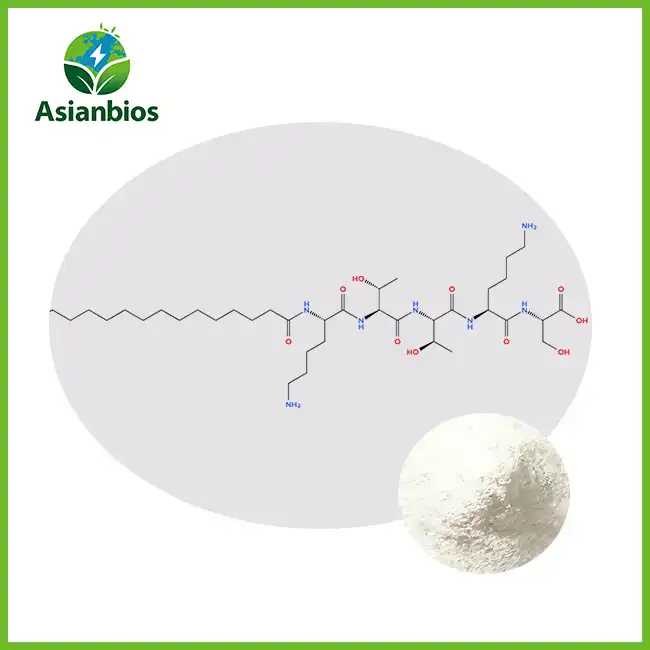
In the realm of peptides, there are three functional groups. Signal peptides, such as Palmitoyl Tripeptide-5, assist in the production of collagen; transporter peptides, such as GHK-Cu, transport trace minerals to aid in tissue healing; and neurotransmitter-inhibiting peptides, such as Acetyl Hexapeptide-8 (Argireline), prevent muscle contraction that leads to expression lines. A real sophisticated Anti-Wrinkle Peptide product combines all 3 groups to get maximum benefits.
| Peptide Family | Example | Primary Mechanism |
|---|---|---|
| Signal | Palmitoyl Tripeptide-5 | Stimulates collagen synthesis |
| Neurotransmitter | Acetyl Hexapeptide-8 (Argireline) | Reduces muscle contraction |
| Carrier | GHK-Cu (Copper Peptide) | Enhances tissue repair |
| Enzyme-inhibitor | Palmitoyl Tetrapeptide-7 | Reduces inflammatory breakdown |
| Structural | Matrixyl 3000 | Targets expression lines |
What the Clinical Evidence Actually Shows
Peptide marketing promises may often outstrip scientific facts, but there is a growing body of real clinical proof for certain of the outstanding compounds. If you are a formulator at the decision-making stage of raw material selection, you should be looking for published and reproducible data on peptides.
Argireline (Acetyl Hexapeptide-8): The Botox-Like Star
Argireline is perhaps the most researched topical wrinkle peptide. Clinical studies have shown a meaningful decrease in wrinkle depth of about 27% following 30 days of continuous twice-daily use at 10% dosage. It is especially good for forehead lines, crow's feet and glabellar wrinkles because it works by controlling the activity of the SNARE protein complex, which reduces contraction of the face muscles. The benefits are synergistically enhanced when Argireline is used as part of a larger Anti-Wrinkle Peptide complex.
Matrixyl 3000: The Collagen Booster
Matrixyl 3000 (Palmitoyl Tripeptide-1 and Palmitoyl Tetrapeptide-7) has been shown to significantly decrease wrinkle depth in controlled experiments. Studies reveal it may improve wrinkle volume by up to 45% after 2 months of regular usage. It combines an Anti-Wrinkle Peptide complex with neurotransmitter-modulating peptides to work on structural and dynamic ageing at the same time – a formulation approach that is increasingly being used by premium brands.
GHK-Cu: The Regenerative Copper Peptide
GHK-Cu copper tripeptide is one of the oldest peptides examined, with over 30 years of study on skin regeneration, elastin formation and wound healing. Recent research has shown that GHK-Cu up regulates the expression of over 4,000 genes involved in skin regeneration and is thus a critical ingredient in any sophisticated Anti-Wrinkle Peptide solution to restore firmness and clarity.
Clinical Data on Multi-Peptide Complexes
Individual peptides work well, however multi-peptide complexes work better than single-peptide formulations. Published results on a six-peptide hexapeptide complex showed a 31% wrinkle depth reduction after 8 weeks of regular treatment, a level no single peptide could achieve alone. This synergy is the best rationale for selecting a well-engineered Anti-Wrinkle Peptide complex over individual actives.
| Peptide/Complex | Clinical Result | Study Duration |
|---|---|---|
| Argireline | 27% wrinkle reduction | 30 days |
| Matrixyl 3000 | 45% wrinkle volume decrease | 2 months |
| GHK-Cu | Enhanced elastin & repair | 12 weeks |
| Multi-peptide hexapeptide complex | 31% wrinkle depth reduction | 8 weeks |
| Eye contour complex | 23% crow's feet reduction | 4 weeks |
Formulation Applications and Best Practices
Even the greatest raw material only works if it is part of a well-thought-out composition. A well-engineered Anti-Wrinkle Peptide complex is versatile and opens the door to several premium product categories.
Anti-Aging Serums and Ampoules
Serums are the best delivery medium for peptides since they have a high water content and a light texture. The Anti-Wrinkle Peptide complex is easy to use at 2–5% in serum bases and is compatible with hyaluronic acid for moisturising anti-aging mixes. There is clinical data to show that when formulated at this concentration level there is a 31% decrease in wrinkle depth after 8 weeks.
Luxury Face Creams and Moisturizers
Peptide complexes are stable in oil-in-water and water-in-oil emulsions which are advantageous for cream forms. Anti-Wrinkle Peptide powders at 3% concentration are stable with retinol, niacinamide and vitamin C, enabling formulators to create complex multi-action therapies without affecting the effectiveness of any one ingredient.
Eye Contour Treatments and Professional Protocols
Peptide-based treatment is particularly good for the sensitive periorbital region. Anti-Wrinkle Peptide complexes diminish the appearance of crow's feet by around 23% in four weeks when used at 2–3% concentration. You’ll typically see percentages in the 5–7% range in professional products like as post-microneedling repair masks or LED-therapy boosters, where the aim is to push skin rejuvenation to its limits following aesthetic procedures.
Men's Grooming and Modern Skincare
Men’s skincare is one of the fastest growing beauty areas and the peptide products match nicely with its performance focused approach. Anti-Wrinkle Peptide complexes work on expression lines and loss of firmness without weighing down – a vital need for men who want light, fast-absorbing textures.
| Application | Suggested Concentration | Key Benefit |
|---|---|---|
| Anti-Aging Serum | 2–5% | Wrinkle depth reduction |
| Luxury Face Cream | 3% | Firmness + elasticity |
| Eye Treatment | 2–3% | Crow's feet reduction |
| Professional Mask | 5–7% | Post-treatment repair |
| Men's Grooming | 2–4% | Expression line control |
Why Asianbios Sets the Standard for Anti-Wrinkle Peptide Supply
Selecting a peptide raw material provider is one of the most important choices a beauty firm can make. Asianbios established a name for itself on the very mix of scientific rigour, manufacturing perfection, and commercial flexibility that luxury cosmetic businesses demand.
Advanced Fermentation and Peptide Engineering
Asianbios employs a controlled fermentation process in bioreactors at pH 6.8 and 37°C to cleave collagen precursors into bioactive peptide chains ideally in the 500-1,000 Dalton range. Three-stage chromatographic purification eliminates endotoxins and molecular contaminants, yielding >98% HPLC-verified purity. The precise engineering provides a hexapeptide based Anti-Wrinkle Peptide complex, with skin absorption 3x quicker than standard peptide constituents.
Uncompromising Quality Certifications
All batches are manufactured in a cGMP certified facility with additional certifications like ISO 9001, FSSC 22000, HACCP, HALAL, KOSHER and Organic. Each batch is tested at 12 points including HPLC fingerprinting, sterility and stability trials and a full Certificate of Analysis is provided with each shipment. This paperwork facilitates global market access, and gives peace of mind to both the regulators and the final customer.
Flexible OEM Support and Reliable Logistics
Minimum order amounts from only 100g for sample, to 1,000kg+ for bulk purchases. Standard specifications are sent within 10 days, customised manufacture is completed within 20 working days, and urgent orders may enjoy 7-10 days green channel service. Partnerships with DHL, FedEx and SF Express enable global logistics that can deliver anywhere in the globe, securely and on time, offering brand owners the agility they need to meet product launch deadlines.

Conclusion
The most effective anti-wrinkle peptides work through complementary pathways — signaling collagen production, modulating muscle contraction, and enhancing dermal repair. Clinical evidence consistently favors multi-peptide complexes over isolated actives, with well-engineered hexapeptide formulations delivering measurable wrinkle reduction within 4 to 12 weeks. Partnering with a supplier like Asianbios — one that combines advanced fermentation technology, cGMP-certified manufacturing, and flexible OEM support — gives brands the raw material sophistication needed to compete in the premium anti-aging market. For beauty brands ready to build the next generation of visibly effective peptide products, the science is clear, and the sourcing choice matters more than ever.
FAQ
Q1: What concentration of Anti-Wrinkle Peptide complex is ideal for a serum?
Most quality serums have 2-5% concentrations. Clinical investigations demonstrate 31% decrease in wrinkle depth at this range with 8 weeks of daily treatment.
Q2: Is Anti-Wrinkle Peptide complex compatible with retinol and vitamin C?
Yes. It is stable in oil-in-water and water-in-oil emulsions and is completely compatible with retinol, niacinamide and vitamin C in the pH range of 5.0 to 7.0.
Q3: What is the minimum order quantity for evaluation?
Asianbios is accepting sample orders from 100g so formulators may evaluate bioactivity, stability and end product performance before committing to bulk manufacturing.
Partner With Asianbios for Premium Anti-Wrinkle Peptide Solutions
Ready to launch a peptide-powered anti-aging product that consumers can visibly see working? Asianbios delivers cosmetic-grade Anti-Wrinkle Peptide complexes with verified 98% HPLC purity, cGMP-certified manufacturing, and flexible OEM support tailored to your brand vision. Whether you're formulating a lightweight anti-aging serum, a luxury face cream, a professional eye treatment, or a men's grooming line, our technical team is ready to provide samples, complete documentation, and formulation guidance every step of the way. Contact us today at plantex@asianbios.com to request samples, pricing, and technical specifications. Let's build anti-wrinkle products that transform how consumers see themselves — beautifully, reliably, and scientifically together.
References
1. Blanes-Mira, C., Clemente, J., Jodas, G., et al. "A synthetic hexapeptide (Argireline) with antiwrinkle activity." International Journal of Cosmetic Science, 2002.
2. Lupo, M. P., & Cole, A. L. "Cosmeceutical peptides." Dermatologic Therapy, 2007.
3. Schagen, S. K. "Topical peptide treatments with effective anti-aging results." Cosmetics, 2017.
4. Pickart, L., & Margolina, A. "Regenerative and protective actions of the GHK-Cu peptide in the light of the new gene data." International Journal of Molecular Sciences, 2018.
5. Fields, K., Falla, T. J., Rodan, K., & Bush, L. "Bioactive peptides: signaling the future of cosmetic anti-aging." Journal of Cosmetic Dermatology, 2009.
6. Reddy, B., Jow, T., & Hantash, B. M. "Bioactive oligopeptides in dermatology: Part II." Experimental Dermatology, 2012.
About the Author

Asianbios
Our purpose is to forge a legacy of stewardship, advancing initiatives that honor and preserve the ecological integrity of our planet.

Send Inquiry


Related Industry Knowledge
- The Best Natural Sleep Aid Brewing Powder to Help You Fall Asleep Faster
- Prepare for a Good Night’s Rest with These Sweet Sleep Aid Jelly
- What are Anti inflammatory Peptides and What do They do for Skin?
- Berberine Hydrochloride Extract Supplements: Health Benefits & Trends
- Hyaluronic Acid Formulations for Skin and Hair Hydration
- Ergothioneine: an antioxidant with high potential
- What Is Production Technology Of Ergothioneine Used For?
- Backpacking Superfoods: Kale Powder
- How Production Technology Of Hyaluronic Acid Controls MW
- Uses of Sleep Aid Tablets for Night Insomnia Support