Trehalose Production Technology for High Purity Food Grade Applications
Trehalose has quietly emerged as one of the most strategically essential functional sugars in contemporary food processing. It is valued for its ability to preserve proteins, stabilise starch, inhibit freezer burn and impart a slight sweetness and great thermal stability and is presently used in frozen dumplings, bread products, drinks, seafood, cosmetics and pharmaceutical formulations globally. But to produce it in high purity and food-grade consistency is quite another matter. This article distils the Trehalose Production Technology down to its practical elements: the two competing industrial routes, the full enzymatic process chain, the quality parameters that define food-grade output, and the real requirements to transfer this technology into a working, profitable production line.
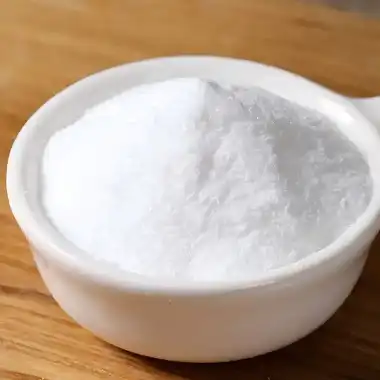
Why Trehalose Production Technology Matters to Food-Grade Manufacturers
The Functional Value Driving Global Demand
Trehalose isn't just another sweetener. It has around 45% the sweetness of sucrose and adds structure and protection, rather than being a dominant flavour. It inhibits starch retrogradation in bread, reduces protein denaturation during freeze-thaw cycles, covers the bitterness of plant-protein products and keeps moisture in cosmetic emulsions. A firm that masters the Trehalose production technology may enter concurrently in many high margin industries instead of the single low margin commodity sweetener business.
What "High Purity, Food Grade" Actually Requires
Food-grade trehalose must offer consistently white, free-flowing crystalline powder with strictly regulated residual maltose, glucose and ash levels, plus microbiological and heavy metal compliance. This is considerably more a downstream refining discipline than a reaction step matter. A well-engineered Trehalose Production Technology package spells out decolorization resin cycles, ion exchange regeneration, crystallisation cooling curves and drying humidity restrictions – the minutiae that distinguish 98%+ purity from off-spec material.
Where the Technology Creates Competitive Advantage
Countries with developed starch deep-processing chains have structural advantages, because to the abundance and low price of maltodextrin feedstock. Adding enzymatic conversion capabilities to existing glucose or starch syrup assets changes a low value commodity stream to a premium ingredient. This is exactly why Trehalose Production Technology is attractive to starch processors, bio-manufacturing facilities and new investment projects looking to vertically integrate and capture better value per ton of raw material.
| Application Sector | Functional Role of Trehalose | Typical Benefit Delivered |
|---|---|---|
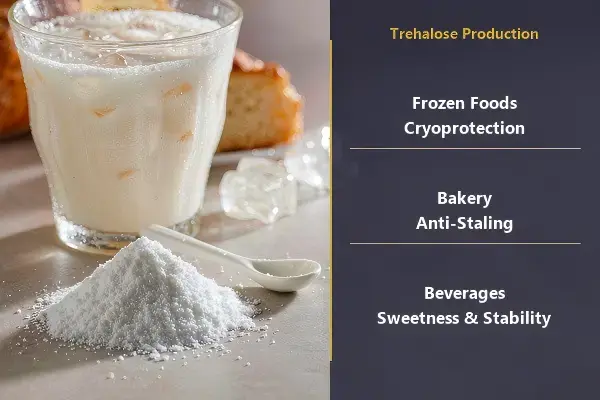
| Frozen foods | Cryoprotection | Prevents ice crystal damage, reduces drip loss |
| Bakery | Anti-staling | Extends softness and shelf life |
| Beverages | Mild sweetness, stability | Balanced flavor, heat resistance |
| Seafood processing | Protein protection | Maintains texture and color |
| Cosmetics | Humectancy | Long-lasting moisture retention |
| Pharmaceuticals | Lyoprotection | Stabilizes proteins and vaccines |
Two Industrial Routes: Fermentation Versus Enzymatic Conversion
The Microbial Fermentation Route
Engineering of bacteria to either accumulate intracellular trehalose or secrete trehalose into the broth is the basis for fermentation. It does not need commercial enzyme preparations and may use simple carbon sources but often yields moderate titers and difficult downstream recovery from complicated broth. For those producers who already have fermentors and who have expertise in strain management and sterile operation, fermentation is appropriate as part of an overall Trehalose Production Technology plan.
The Enzymatic Conversion Route (MTSase + MTHase)
The dominant commercial approach converts maltodextrin using a dual-enzyme system: maltooligosyl trehalose synthase (MTSase) rearranges the reducing-end glucosidic linkage, and maltooligosyl trehalose trehalohydrolase (MTHase) then releases trehalose. Yields are high, the broth is clean, and purification is comparatively straightforward. Most modern Trehalose Production Technology packages are built around this route because it scales predictably and produces superior food-grade clarity.
Selecting the Right Route for Your Plant
Routes should be dictated by the reality of the asset, not trend. If you already have starch liquefaction and saccharification lines the enzymatic approach fits in almost without any problem. If fermentation infrastructure is your strength, you may want to use a hybrid design. A professional Trehalose Production Technology partner will examine existing utilities, effluent capacity and worker abilities before making a recommendation on a design, rather than imposing a conventional blueprint onto an inappropriate location.
| Comparison Factor | Microbial Fermentation | Enzymatic Conversion |
|---|---|---|
| Primary substrate | Sugars / simple carbon sources | Maltodextrin, starch hydrolysate |
| Conversion efficiency | Moderate | High |
| Downstream complexity | High (broth separation) | Moderate |
| Enzyme dependency | Low | High (specialized enzymes) |
| Capital intensity | Higher fermenter load | Integrates with starch lines |
| Best suited to | Fermentation-experienced plants | Starch processing enterprises |
Inside the Enzymatic Process Chain: From Maltodextrin to Crystal
Substrate Preparation and Liquefaction
Substrate quality is the beginning of everything. Starch is liquefied to a regulated dextrose equivalent since the chain-length distribution is strongly related to how well MTSase can work. If it's too short the conversion stops, too long the viscosity makes handling difficult. Trehalose Production Technology has been dependable at commercial scale, based on a not-so-glamorous basis of rigorous DE control, pH correction and filtering of insolubles.
Dual-Enzyme Conversion and Process Control
The conversion stage demands precise temperature, pH and dosing coordination between the two enzymes, along with careful reaction-time management to maximize trehalose while limiting by-product accumulation. Online monitoring and HPLC checkpoints allow operators to terminate the reaction at the optimum window. This control discipline is where experienced Trehalose Production Technology engineering delivers measurably higher yields than trial-and-error operation.
Separation, Purification and Crystallization
Post-conversion liquor passes through filtration, activated carbon or resin decolorization, ion exchange demineralization and evaporation before controlled cooling crystallization. Seeding strategy and cooling rate determine crystal habit, flowability and final purity. Centrifugation, washing and fluid-bed drying complete the sequence, producing the characteristic white, non-hygroscopic powder that food and pharmaceutical customers expect.
Finished Product Specification and Packaging
Output is standardized as white crystalline powder, packed at 25 kg per barrel and shipped by express courier, air freight or sea freight according to volume. Samples from 1 kg are available for application testing before scale-up commitments. If you would like a detailed process flow diagram, mass balance estimate or feasibility assessment tailored to your existing plant, the engineering team can be reached directly at plantex@asianbios.com — most technical enquiries receive a substantive reply within hours.
The 30/70 Rule: Why Localization Determines Success
Thirty Percent Process, Seventy Percent Implementation
Experience across multiple projects points to a consistent truth: successful application of production technology equals roughly 30% process know-how and 70% localization execution. Equipment lists and reaction parameters are the easy part. Adapting them to local water quality, power reliability, raw material variability and labor skill levels is where projects succeed or stall. Genuine Trehalose Production Technology transfer must address both halves.
Compliance, Construction and Supply Chain Readiness
Before commissioning, enterprises must secure environmental permits, food production licences and effluent treatment approval, then lock in stable maltodextrin and enzyme supply. Simultaneously, the sales channel must be developed so that output has a home from day one. A standardized technical package should therefore include documentation supporting audits, HACCP planning and certification preparation, not just engineering drawings.
Team Capability and Continuous Support
Even a perfectly designed line underperforms without trained operators, QC analysts and maintenance staff. Structured on-site training, standard operating procedures, troubleshooting manuals and remote technical consultation dramatically shorten the ramp-up curve. Long-term support arrangements ensure that when substrate quality shifts or yields drift, the plant has expert guidance rather than guesswork.
| Transfer Deliverable | Scope Included | Typical Stage |
|---|---|---|
| Feasibility & process design | Mass balance, equipment list, layout | Pre-investment |
| Engineering documentation | P&ID, utility specs, SOPs | Construction |
| Equipment commissioning | Installation guidance, trial runs | Start-up |
| Operator training | Process, QC, safety, maintenance | Start-up |
| Certification support | HACCP, ISO, FSSC documentation | Post-commissioning |
| Continuous optimization | Yield tuning, remote consultation | Ongoing |
Partnering with Asianbios: Service Scope and Delivery Strength
Customization, MOQ and Sampling Flexibility
Projects rarely begin at full scale, and they shouldn't have to. Trial quantities start from 1 kilogram with samples provided for formulation testing, while OEM and ODM services allow adaptation to different national standards, brand requirements and product formats including powders, tablets, capsules and gummies. This flexibility lets clients validate market response before committing to a full Trehalose Production Technology installation.
Certification and Quality Assurance
Production operates under a full-chain quality control system, supported by CGMP, FSSC 22000, ISO 9001, HACCP, HALAL, KOSHER and Organic certifications, and aligned with CE, FDA and ISO expectations. In-house laboratories perform verification testing, stability studies and application trials, meaning clients receive not only material but documented evidence suitable for their own regulatory submissions and customer audits.
Delivery Speed and Global Logistics
Standard specifications are held in inventory exceeding one ton and dispatch within ten days of payment. Customized production typically completes in around twenty working days, while urgent small batches move through a dedicated green channel in seven to ten days. Shipments travel with DHL, FedEx and SF Express, ensuring dependable door-to-door delivery across international markets.
Conclusion
High-purity, food-grade trehalose is achievable at commercial scale — but only when process science and localized execution advance together. The enzymatic MTSase/MTHase route offers superior yield and purity for starch-integrated producers, provided that purification discipline, compliance planning and team training receive equal attention. With standardized technical packages, certified quality systems, low trial volumes and responsive engineering support, Asianbios helps food ingredient companies, bio-manufacturers and new investors turn Trehalose Production Technology from a blueprint into dependable, profitable, market-ready output.
FAQ
1. What is the minimum quantity available for testing before a full project?
Trial orders start from 1 kilogram, and samples are supplied for application and stability testing so clients can validate performance in their own formulations before committing to scale-up.
2. Which production route is recommended for an existing starch processing plant?
The enzymatic conversion route is usually optimal, since maltodextrin feedstock, liquefaction equipment and utilities already exist, substantially reducing capital expenditure and shortening the commissioning timeline.
3. Does the technical package include support after commissioning?
Yes. Support covers operator training, SOP documentation, certification preparation, yield optimization and ongoing remote consultation, reflecting the principle that implementation accounts for most of a project's success.
Build Your Trehalose Line with Asianbios Today
Whether you are evaluating a new investment project, upgrading an existing starch processing facility or sourcing high-purity food-grade trehalose in bulk, our engineers are ready to help you move from concept to commissioned production. Request a feasibility assessment, process flow proposal, sample or customized quotation by writing to plantex@asianbios.com, and expect a clear, detailed response within hours. Let's turn proven Trehalose Production Technology into a reliable, certified and profitable production line built around your market, your raw materials and your growth plans.
References
1. Elbein, A.D., Pan, Y.T., Pastuszak, I., Carroll, D. "New Insights on Trehalose: A Multifunctional Molecule." Glycobiology, 2003.
2. Maruta, K., Nakada, T., Kubota, M., et al. "Formation of Trehalose from Maltooligosaccharides by a Novel Enzymatic System." Bioscience, Biotechnology, and Biochemistry, 1995.
3. Schiraldi, C., Di Lernia, I., De Rosa, M. "Trehalose Production: Exploiting Novel Approaches." Trends in Biotechnology, 2002.
4. Richards, A.B., Krakowka, S., Dexter, L.B., et al. "Trehalose: A Review of Properties, History of Use and Human Tolerance, and Results of Multiple Safety Studies." Food and Chemical Toxicology, 2002.
5. Ohtake, S., Wang, Y.J. "Trehalose: Current Use and Future Applications." Journal of Pharmaceutical Sciences, 2011.
6. Higashiyama, T. "Novel Functions and Applications of Trehalose." Pure and Applied Chemistry, 2002.
About the Author

Asianbios
Our purpose is to forge a legacy of stewardship, advancing initiatives that honor and preserve the ecological integrity of our planet.

Send Inquiry

Related Industry Knowledge
- Coconut Milk Extract Powder for Creamy Dairy-Free Recipes
- What is liquorice extract and what are its benefits?
- Glucoamylase Production Technology: Complete Step-by-Step Guide
- Compound Amino Acids Supplement: Benefits and Applications Explained
- What Makes Deep lifting peptide powder Essential in Firming Skincare?
- What Are the Health Benefits of Berberine Hydrochloride Extract Powder? A Comprehensive Guide
- How Sour Jujube Seed Can Improve Your Sleep and Health
- What Is Modern Valine Production Technology?
- Benefits of Advanced Vitamin C Production Technology
- Benefits of Threonine Production Technology in Feed Additives