Choosing Threonine Production Technology for Industrial Use
Selecting the right threonine production technology has quietly become one of the most consequential decisions in modern biomanufacturing. L-threonine is the second most important amino acid for pigs and the third most important for chickens. Because of this, it is at the center of all feed preparation strategies that aim to lower total protein without affecting growth performance. Your ability to meet changing demand quickly, your cost per ton, and the amount of damage you do to the environment are all affected by the production route you choose. This guide breaks down the fermentation process, which is now the standard in the industry, the purification train that turns broth into powder that can be sold, and a useful way to look at a technology partner before you give them money.
Why Threonine Production Technology Has Become a Strategic Industrial Priority
The Demand Engine Behind L-Threonine
As cattle farmers try to lower feed costs and cut nitrogen pollution at the same time, the demand for feed-grade amino acids keeps going up. Because L-threonine is the third most important amino acid for chickens and the second most important for pigs, adding it to feed lets formulators lower the amount of crude protein while keeping animal performance and protein utilization the same. If you live in a country where raising animals is a big part of the economy, learning how to make threonine is not just a niche biochemical issue; it's a way to make sure there is enough feed, increase the value of agriculture, and save money on buying amino acids from other countries.
Why Fermentation Outperformed Chemical Synthesis?
Chemical synthesis was first used to try to make amino acids, but it makes a racemic mixture of D- and L-isomers that needs to be sorted, which costs a lot of money. Modern industry has switched completely to 100% direct microbial fermentation, which makes the biologically active L-configuration directly and achieves animal usage rates above 95% without having to remove any D-isomer impurities. Also, threonine that comes from fermentation doesn't leave behind any chemical residue, which is something that downstream buyers who have to follow strict feed safety schemes are becoming more and more interested in. This is the main reason why the technology used to make threonine focused on biology instead of chemistry.
What Commercial-Grade Output Looks Like on Paper?
Before comparing suppliers, buyers should anchor on the physical and regulatory profile that a mature threonine production technology and fermentation process deliver. The table below summarizes the standard output, quality parameters, and operational benchmarks expected from a well-run threonine fermentation facility. It also serves as a practical screening checklist when requesting quotations, evaluating production capabilities, or reviewing samples from prospective partners.
| Attribute | Industry-Standard Specification |
|---|---|
| Production route | 100% direct microbial fermentation |
| Active ingredient | L-threonine (pure L-configuration) |
| Appearance | White to light-yellow crystalline powder |
| Feed-grade purity | ≥ 98.5% |
| Packaging | 25 kg barrel |
| Minimum order quantity | 1 kg, samples available |
| OEM/ODM | Available |
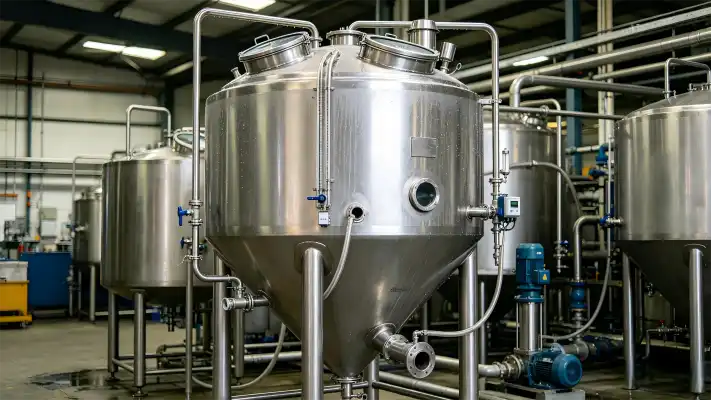
Inside the Fermentation Core: How Modern Threonine Is Actually Made
Building the Medium from Renewable Resources
Every high-yielding fermentation begins with the medium. Leading threonine production technology platforms use hydrolyzed sugars from corn or cassava starch as the carbon source and liquid ammonia as the nitrogen source, with engineered strains supplying key precursors endogenously through metabolic reconstruction. This design matters commercially as much as technically: starch is renewable and widely available, the process avoids cyanide and other high-risk reagents, and wastewater can be reused after biochemical treatment. Producers running this configuration frequently report a carbon footprint reduction of around 65% compared with conventional routes.
Precision Control Across the Fermentation Cycle
Industrial fermentation of threonine runs for roughly 40 to 50 hours under tightly governed conditions. Temperature is held near 37 °C, pH is maintained between 6.8 and 7.2, and dissolved oxygen is kept above 30% saturation throughout the run. Modern plants apply intelligent, whole-process regulation — continuous monitoring of dissolved oxygen, pH, and tail-gas composition — to prevent foam overflow and bacterial contamination, the two classic causes of lost batches. The parameter set below reflects what a competitive fermentation workshop should be able to demonstrate confidently during a technical audit.
| Parameter | Typical Industrial Setpoint |
|---|---|
| Carbon source | Corn or cassava starch hydrolysate |
| Nitrogen source | Liquid ammonia |
| Temperature | 37 °C |
| pH | 6.8 – 7.2 |
| Dissolved oxygen | > 30% saturation |
| Fermentation duration | 40 – 50 hours |
| Process monitoring | Online DO, pH, and tail-gas analysis |
The Strain Strategy That Simplifies Purification
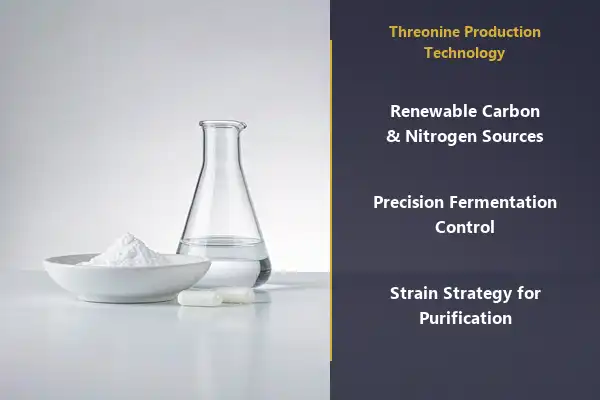
The most distinctive innovation in current threonine production technology is a dual strategy combining controlled nutrient limitation with the release of feedback inhibition inside the producing strain. By starving the culture of a non-essential nutrient and rewiring the bacterium's own regulatory loops, the process pushes metabolism almost exclusively toward threonine, so the final broth contains virtually no other amino acids. Cleaner broth means shorter resin cycles, higher crystallization yields, and lower downstream cost — a quiet but decisive economic advantage that separates high-performing plants from average ones.
Downstream Purification: Where Purity and Profitability Are Decided
Membrane Filtration and Ion-Exchange Capture
When the fermentation process is over, the broth is made up of cells, proteins, salts, and amino acids that have been dissolved. First, membrane filtration gets rid of the biomass and macromolecules, leaving behind a clear liquid that can be used for chromatography. The clear liquid then moves through ion-exchange resin tubes, which only pick up threonine and let the rest of the toxins pass through. The straining method we talked about earlier keeps the soup almost entirely free of rival amino acids. This lets the resin work very well and release a very pure stream of threonine that is ready for the final steps.
Decolorization, Crystallization, and Drying
The eluted stream is decolorized to strip residual pigments, then concentrated under vacuum until threonine reaches supersaturation and crystallizes under a controlled profile that protects crystal size and flowability. Drying completes the transformation into the white to light-yellow crystalline powder that buyers recognize, which is packed into 25 kg barrels for shipment. Each step is standard in isolation; what separates a strong threonine production technology package from a weak one is how reproducibly the entire train holds crystal quality, bulk density, and residual moisture within specification across hundreds of batches.
Quality Benchmarks and Certifications That Open Markets
Heavy metals and microbial signs must be well below strict limits in finished L-threonine in order for it to meet FAMI-QS standards for feed and USP standards for medicinal and nutritional uses. The more experienced producers back up these standards with approved management systems. These include ISO 9001 for quality management, FSSC 22000 and HACCP for food and feed safety, CGMP for production that is close to pharmaceuticals, and HALAL and KOSHER certification for markets based on religion. When checking out a tech company, always ask to see both the certificates and the batch data that they are based on. This is because getting into the market rests on proof of stability, not just promises.
If you are weighing these options for your own facility or product line, you do not need to start from zero. The Asianbios engineering team regularly shares feasibility notes, process schematics, and benchmark data with prospective partners — send your questions to plantex@asianbios.com and you will receive a structured technical reply, usually within a few hours.
Choosing and Vetting a Threonine Technology Partner: A Practical Framework
The 30/70 Rule: Process Know-How Plus Local Execution
Successful industrial implementation of threonine production technology is often described as 30% process and 70% localization — meaning the fermentation recipe alone guarantees nothing unless it is adapted to your local raw materials, utilities, workforce, and regulatory environment. A serious partner therefore offers a complete, standardized technical package plus continuous support: strain handling, medium preparation from locally available starch, commissioning, operator training, and long-term troubleshooting. Ask candidates to describe their localization record in markets similar to yours, and request references from at least one commissioned production line.
OEM/ODM Flexibility and Turnkey Line Construction
A lot of people who buy powder want finished or almost finished goods that they can name themselves. A good partner can handle OEM/ODM production of powders, pills, capsules, and chews, changing the formulas to fit different countries, legal situations, and shelf-life standards that are longer than one year. For investors who want to build capacity instead of buying products, the same company should provide all the technology needed to build a production line, from planning the layout and choosing the right equipment to making sure the whole thing works. They should also provide professional lab support, experimental confirmation, and technical guidance after the line is up and running.
MOQ, Delivery Speed, and Logistics Reliability
Most of the time, business sense chooses between two technically similar deals. Suppliers who are flexible keep their minimum order quantities low. The standard is 1 kg, and samples are always available, so you can check the quality before ordering more. Committed partners hold more than one ton of standard specs in stock so that they can ship within 10 days of payment. Customized production, on the other hand, usually takes 20 working days to finish. Small, urgent batches should be able to use a green route that offers delivery in 7–10 days and is backed by global shipping partners like DHL, FedEx, and SF Express. For your evaluation, the list below condenses these criteria.
| Evaluation Dimension | What to Verify Before Signing |
|---|---|
| Technical package | Complete documentation plus 30% process / 70% localization support |
| Certifications | ISO 9001, FSSC 22000, CGMP, HACCP, HALAL, KOSHER |
| Sample policy | 1 kg MOQ, samples available for independent validation |
| Inventory & lead time | 1+ ton stock in ~10 days; custom ~20 working days; green channel 7–10 days |
| OEM/ODM scope | Powders, tablets, capsules, gummies across target markets |
| Line construction | Turnkey technology with post-start-up technical guidance |
| Logistics | DHL, FedEx, SF Express partnerships; express, air, and sea options |
Conclusion
Threonine production technology has matured into a well-defined industrial discipline: direct microbial fermentation on renewable starch, precision control at 37 °C and pH 6.8–7.2, a strain strategy that yields remarkably clean broth, and a purification train that reliably delivers feed-grade powder above 98.5% purity. For buyers, the decisive question is no longer whether fermentation works — it demonstrably does — but which partner can localize the process, certify the output, and ship at commercial scale with low MOQ and responsive service. Evaluate candidates against the checklists above, verify certificates and batch data, and let samples make the final argument.
FAQ
1. What purity and regulatory standards can threonine production technology achieve?
mature microbial fermentation process delivers feed-grade L-threonine at ≥98.5% purity, with heavy-metal and microbial indicators compliant with FAMI-QS and USP requirements. Because the L-configuration is synthesized directly, there are no D-isomer impurities and no chemical synthesis residues. Certified facilities typically operate under ISO 9001, FSSC 22000, HACCP, CGMP, HALAL, and KOSHER systems, supporting access to feed, food, and pharmaceutical markets.
2. Is the minimum order quantity practical for small brands or first-time buyers?
Yes. The entry point is just 1 kg, and samples are available so buyers can run independent verification before committing to volume. Standard specifications are backed by inventory of more than one ton, shippable within about 10 days after payment; customized orders complete in roughly 20 working days, and urgent small batches can use a green channel with 7–10 day delivery via DHL, FedEx, or SF Express.
3. Can the technology be transferred to build a new production line abroad?
It can. Implementation follows the "30% process + 70% localization" model: a standardized technical package covering strains, media design, fermentation control, and purification, combined with on-site adaptation to local starch resources, utilities, and regulations. Support extends through commissioning, operator training, laboratory verification, and continuous technical guidance after start-up, so partners gain working capability — not just documents.
Take the Next Step: Request Your Threonine Consultation Today
Whether you plan to purchase feed-grade L-threonine, launch a private-label product line, or build a complete production facility, Asianbios can support the entire journey — from threonine production technology consultation and sample validation to OEM/ODM manufacturing and turnkey line construction. Every inquiry receives a structured, transparent response within hours, not weeks. Send your requirements, target market, and projected volumes to plantex@asianbios.com, and our engineering and commercial teams will prepare a tailored solution covering specifications, certifications, delivery timelines, and pricing. One email today can set your threonine project on a faster, safer, and more profitable path.
References
1. Debabov, V. G. (2003). The Threonine Story. Applied Biochemistry and Microbiology, 39(4), 333–340.
2. Gomes, J., & Kumar, D. (2005). Production of L-threonine by bacteria: The current scenario. World Journal of Microbiology and Biotechnology, 21(3), 283–288.
3. Ikeda, M. (2003). Amino Acid Production Processes. Advances in Biochemical Engineering/Biotechnology, 79, 1–35.
4. Lee, K. H., Park, J. H., Kim, T. Y., Kim, H. U., & Lee, S. Y. (2007). Systems metabolic engineering of Escherichia coli for L-threonine production. Molecular Systems Biology, 3, 149.
5. Demain, A. L., & Sanchez, S. (2009). Microbial synthesis of primary metabolites: Current trends and future prospects. Journal of Industrial Microbiology and Biotechnology, 36(3), 319–332.
6. Becker, J., & Wittmann, C. (2012). Bio-based production of chemicals, materials and fuels: Corynebacterium glutamicum as a versatile cell factory. Current Opinion in Biotechnology, 23(4), 631–640.
About the Author

Asianbios
Our purpose is to forge a legacy of stewardship, advancing initiatives that honor and preserve the ecological integrity of our planet.

Send Inquiry

Related Industry Knowledge
- Anti-Wrinkle Peptide vs Retinol: Which Supports Youthful Skin?
- Liquorice Extract Powder: Benefits, Uses, and Function
- Brightening peptide powder for Skin and Tissue Research: Key Applications
- Why Choose Organic American Ginseng Extract Powder for Natural Health Products?
- How Does Glucose Production Technology Improve Yield?
- Benefits of Freeze Dried Kiwi Fruit Powder
- Have you tried Kale Powder? - Realizing Home Recipes
- Is sea buckthorn powder good for you?
- How to Use Chinese Cabbage Freeze-Dried Powder: Benefits and Daily Recipes
- Benefits of Glutathione Production Technology in Industry