Recombinant Collagen: What It Is & Why It Matters
Recombinant collagen is produced by inserting a collagen gene into a host cell, such as yeast or bacteria, then fermenting the organism. It is not derived from the tissue of cows, pigs, fish etc. This process is crucial because it brings a clear order to the brands, improved control of each batch and a raw material that does not come from animal tissue. For the US teams working on skin care and oral beauty, this means greater documentation and fewer surprises on the sourcing side. It informs you how recombinant collagen works, how it compares to other sources of collagen, and what to look for before you buy.
What Is Recombinant Collagen?
Definition and Related Terms
There are more than 28 different forms of collagen, the most prevalent protein found in animals, researchers have identified. Traditional sources of supply have included bone or scales or animal skin. With recombinant collagen, it goes in another direction. Scientists synthesise a gene sequence , put it into a host organism , and that organism makes the protein . The human recombinant collagen is produced from a human gene sequence. Hydrolysed collagen and collagen peptides are also not one and the same. Enzymes break down animal collagen into minuscule fragments of only a few kilodaltons in size. The chemical is generated using a process called “recombinant”. It does not provide the organization, grade or activity by itself.
Sequence, Triple Helix, and Molecular Weight
Native collagen is made up of three chains that are twisted around a glycine-X-Y pattern that repeats itself. A review in the Annual Review of Biochemistry (2009) says that hydroxyproline helps keep that helix stable. The enzyme that adds hydroxyl groups to proline is not found in most bacterial and yeast hosts. This means that producers may co-express that enzyme or use shorter active fragments. Because of this, two recombinant collagen products may have different sequence lengths, helix statuses, molecular weights, and abilities to dissolve in water. Cross-linking is mostly important for scaffolds and hydrogels. Asianbios says that its human recombinant collagen matches the sequence of human amino acids. I recommend that buyers ask any supplier for sequence data and analytical methods.
Common Formats
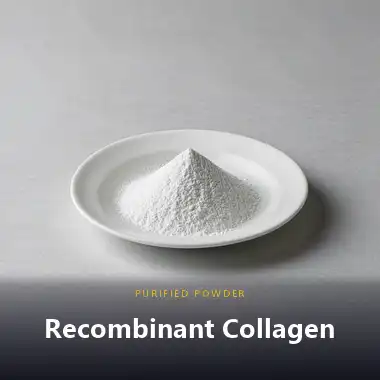
There are different kinds of recombinant collagen on the market. Powders can be mixed dry, put into capsules, or mixed back together. The solutions can be used for research and liquid serums. Cross-linking controls how strong and how quickly they break down in hydrogels and scaffolds that are used for wound care and tissue engineering. Peptide powders are made up of shorter pieces that dissolve easily in water. Asianbios sells a white powder that is spray-dried and dissolves in water. It can be used in cosmetic formulas that start with a dry ingredient. Format changes how it's handled, stored, and how long it lasts, so pick one before you look at prices. A powder that dissolves easily also saves time in the lab when the samples are being tested.
How Recombinant Collagen Is Made
Gene Design and Expression Systems
Gene design is the first step in production. The scientists pick the type of collagen and the order of the amino acids, and then they put the gene into a host cell. There is writing about microbial, yeast, plant, and mammalian systems. It's cheaper and faster for microbial and yeast hosts to grow. Mammalian cells can make changes that are more complicated, but they usually give lower yields and cost more. What you need to know about the structure, the yield, and the regulatory path will help you make the right choice. The confirmed strain is then kept in a master cell bank so that new batches can start from the same genetic source. This step sets the maximum level of consistency for the batch.
Fermentation, Recovery, and Purification
Temperature, pH, dissolved oxygen, nutrient feed, and run time are all things that operators control during fermentation because they all have an effect on yield and protein quality. After it is picked, the process takes the protein away from the cells. Filtration gets rid of dead cells, chromatography separates the protein of interest, and concentration gets it ready to be dried. When something is purified, it gets rid of impurities like host-cell proteins, DNA, and endotoxin. Buyers should ask about these. SDS-PAGE or HPLC are often used by quality teams to check purity. The human recombinant collagen from Asianbios is said to be 98% pure by HPLC, and I always suggest checking that number against the batch certificate of analysis.
Drying, Packaging, and Shipping
Spray drying is how Asianbios makes its powder. This process turns the clean solution into a fine white powder. The powder is sent out in 25 kg fiber drums with an LDPE bag inside. The drum can be kept sealed and out of the sun, water, and strong heat for two years. You can choose between express delivery, air, and sea shipping. The given details are shown in the table below.
| Parameter | Specification |
|---|---|
| Active ingredient | Human recombinant collagen |
| Purity | 98% HPLC |
| Grade and appearance | Cosmetic grade, white powder |
| Solubility | Soluble in water |
| Bulk density | 35–50 g/100 ml |
| Particle size | 100% through 80 mesh |
| Heavy metals | NMT 10 ppm |
| Microbiology | Total plate count <10,000 cfu/g; yeast and mold <1,000 cfu/g |
| Packaging | 25 kg per drum |
| Minimum order | 1 kg, samples available |
These numbers give your formulation scientist a good place to begin. To make sure they are correct for each lot, ask for the batch certificate of analysis.
Benefits, Safety Checks, and Comparison with Traditional Sources
Performance Benefits
Three useful benefits come from controlled production. The material is easier to track down since it comes from a known gene and cell bank instead of mixed animal tissue. Because fermentation conditions can stay stable, which supports stable molecular weight and solubility, reproducibility gets better. Because designers can change a sequence for a target function, customization is possible. It still depends on the route on bioavailability. Oral peptides need to be able to survive digestion, topical ingredients work on the skin's surface, and biomaterials support the structure. Asianbios says that its human recombinant collagen helps skin retain moisture, repair damaged barriers, and keep its shape. Think of these as functions that the supplier told you about, and make sure they work in your own application tests.
Safety and Quality Checks
Purity is the first step to safety. Endotoxin, bioburden, host-cell protein, residual DNA, heavy metals, and allergens are the things I look for in a deal. The Asianbios sheet says that the limits for arsenic are 2 ppm, the limits for lead are 2 ppm, the limits for cadmium are 1 ppm, and the limits for mercury are 0.1 ppm. The plate count is also less than 10,000 cfu/g, and the yeast and mold counts are less than 1,000 cfu/g.
Comparison with Bovine, Marine, and Porcine Collagen
There is no one source that always does well. Animal-derived collagen is still a good choice for products that need to be cheap and work. The table shows how the main choices stack up.
| Source | Starting material | Typical strength | Typical limit |
|---|---|---|---|
| Bovine | Cattle hide or bone | Established supply, lower cost | Batch variation tied to tissue |
| Marine | Fish skin or scales | Suits marine-origin preferences | Source and species variation |
| Porcine | Pig skin | Long history in biomaterials | Animal-origin and religious-diet limits |
| Hydrolyzed peptides | Animal collagen | Common in oral products | Fragments, not intact structure |
| Recombinant | Engineered host cells | Defined sequence, tighter batch control | Higher qualification effort |
When you need a clear composition, less animal-based content, or better batch control, I recommend recombinant collagen. Compare that to the cost, the work needed to qualify, and the regulatory risk.
Key Applications of Recombinant Collagen
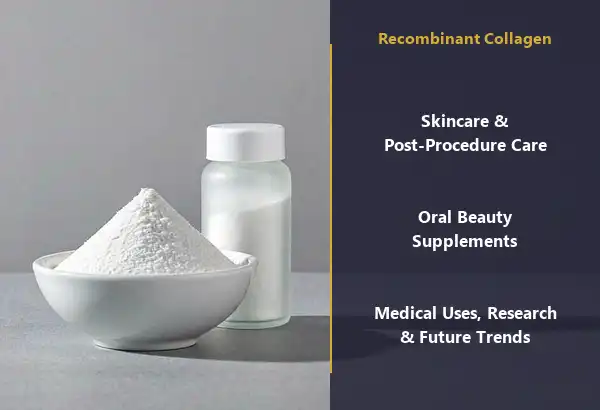
Skincare and Post-Procedure Care
Recombinant collagen cosmetic grade is used mainly in skin care. There’s a list of serums, creams, masks, repair essences and post microneedling and laser treatment care for the skin. Formulators have to check the final product for things like solubility, skin feel, film formation, pH compatibility, preservative systems and ability to stay stable. That's what the Modernisation of Cosmetics Regulation Act of 2022 has to say about cosmetics in the US. It included new obligations including facility registration and product listing. Claims should be on what the drug does for you, not how it works. Test stability and customer perception of the product before writing final label content.
Oral Beauty Supplements
There is a lot of interest in oral collagen. A 2023 systematic review in Nutrients found that oral collagen increased the skin’s capacity to stay moist and stretch. Because most studies used hydrolysed animal collagen, the results cannot be immediately transferred to recombinant collagen. This is vital when you purchase stuff. Asianbios powder is only for cosmetics, so be sure to get proof of its safety for food before you start manufacturing gummies, tablets or capsules. Other new US laws, such as a new dietary ingredient notification or a GRAS review, may also be relevant. Asianbios may produce samples in the shape of gummies, tablets, powder and capsules through OEM and ODM service.
Medical Uses, Research, and Future Trends
For wound dressings, hydrogels, scaffolds, cell culture, and bioprinting, you need stronger proof than for cosmetics. People who are buying things want them to have low endotoxin, be sterile, be biocompatible, have a clear composition, and break down slowly. Biomedical Materials published a review in 2012 that says recombinant proteins can be used as scaffold materials because their make-up can be controlled. I think the market will move toward materials that are made for specific uses, standard tests for structure and purity, and digital tracking. People should also keep being interested in materials that don't come from animals. People who want to use it for these things should first check the grade, since cosmetic grade doesn't cover medical uses.
How to Choose, Qualify, and Buy
Define Your Specification
The application, the audience, and the grade should come first. Choose the right format for your process based on whether you need information about cosmetics, food, research, or medicine. Next, make a list of the technical details, such as the type of collagen, its sequence, its molecular weight, its purity, its moisture content, its pH level, its solubility, its endotoxin content, its bioburden, its residual DNA, and its stability. Before you call suppliers, write the acceptance limits next to each item. This one-page brief speeds up quoting and keeps samples from being mixed up. It also makes it easy for your regulatory colleague to see what you ordered and why.
Evaluate Suppliers and Risks
You should look at the production ownership, the ability to purify, the documentation, the technical support, the minimum order quantity, the lead time, and the logistics of the supplier. Asianbios has CGMP, FSSC22000, ISO9001, HALAL, KOSHER, Organic, and HACCP certifications on its list. It also works with FedEx, DHL, and SF Express. Check the analytical methods, compare certificates of analysis from different batches, and make sure that certificates specific to the facility are correct. Keep in mind that documents for raw materials do not mean that a finished cosmetic, food, or medical product is approved. The regulatory review for the final product is still being done by your team.
From Sample to Bulk Order
Technical and supply risk are lower in a staged process. What I think you should do is shown in the table below.
| Stage | What to do | What to confirm |
|---|---|---|
| Technical brief | Share application, grade, target market | Acceptance criteria |
| Sample test | Request a sample (1 kg minimum order) | Solubility, appearance, stability |
| Multi-batch check | Test more than one batch | Consistency against the certificate of analysis |
| Pilot run | Run a small production trial | Scale-up performance |
| Supply plan | Agree on forecasts and replenishment | Quality agreement, change control |
Asianbios says that customized products will be made in 20 working days, and they have a "Green Channel" for urgent small-batch orders. Every step should be seen as a gate, and you should only move on when the data says to.
Conclusion
Recombinant collagen is produced by fermentation in genetically altered host cells. It is not derived from animal tissue, has greater batch control and the process is in a fixed order. It's not only the word 'recombinant' that tells you how well it functions. Sequence, triple helix status, molecular weight, purity and format all count. When comparing hydrolysed collagen to bovine, marine, porcine, and other sources, you will realise that each one has its place. Which is best depending on cost, documentation and use. There are numerous grades and sorts of proof needed for medical, dental and skin care purposes. Lower technical and supply risk when buyers define specifications, compare batch certifications, test samples in their own process and ensure the end product meets regulatory criteria.
FAQ
1. Is recombinant collagen identical to animal collagen?
Not all the time. Sequence, folding, and modification depend on how the gene was designed and the system it is in.
2. Is recombinant collagen safe?
Safety depends on how pure it is, how it was made, the grade, the dose, and how it is used. Look over the certificate of analysis for information on endotoxin, residual protein, heavy metals, and microbes.
3. How do recombinant collagen and collagen peptides differ?
The process of making the protein is called recombinant collagen. Collagen peptides are short pieces that are usually made by using enzymes to break down collagen from animals.
4. What should a request for quotation include?
Include the use, audience, grade, format, details, packaging, yearly output, delivery schedule, and paperwork that is needed.
Contact Asianbios for Recombinant Collagen Samples and Technical Support
Need a source of recombinant collagen for your next formula? Asianbios has samples, a minimum order size of 1 kg of human recombinant collagen powder, and can help with OEM/ODM for gummies, tablets, powders, and capsules. Use plantex@asianbios.com or go to asianbios.com to send your application along with your target market, grade, and annual volume. Our technical team will get back to you with details and a certificate of analysis. The final approval will depend on testing for your application and regulatory review.
References
1. Advanced Drug Delivery Reviews, 2003. "Recombinant collagen and gelatin for drug delivery."
2. Biomedical Materials, 2012. "Recombinant protein scaffolds for tissue engineering."
3. Annual Review of Biochemistry, 2009. "Collagen structure and stability."
4. International Journal of Dermatology, 2021. "Effects of hydrolyzed collagen supplementation on skin aging: a systematic review and meta-analysis."
5. Nutrients, 2023. "Effects of Oral Collagen for Skin Anti-Aging: A Systematic Review and Meta-Analysis."
6. Biotechnology and Genetic Engineering Reviews, 1996. "Collagen-based biomaterials."
About the Author
Asianbios
Our purpose is to forge a legacy of stewardship, advancing initiatives that honor and preserve the ecological integrity of our planet.

Send Inquiry
Related Industry Knowledge
- How to Lower Hyaluronic Acid Production Plant Cost at Scale
- What is jujube powder used for?
- How to Choose Mimosa Root Bark Extract Powder
- Protease Production Technology: Process Optimization Strategies
- Sleep Aid Brewing Powder Benefits for Modern Sleep Support
- Do Elastic Peptides Help Aging Skin? A Detailed Review
- What Is Production Technology Of Ergothioneine Used For?
- Is powdered kale good for you?
- Sleep Aid Tablets Guide: How They Improve Sleep Quality
- Health Benefits and Uses of Kiwifruit Powder