Why Multi-effect Evaporator Machine Is Used in Pharmaceutical Production
Multi-effect evaporator machines are employed in pharmaceuticals since they may concentrate liquids using much less steam than a single effect unit. The vapor from one step warms the next . So the same energy evaporates water numerous times . When operated under vacuum, boiling temperatures are reduced and heat-sensitive APIs, herbal extracts and fermentation solutions are protected. Stainless steel design, cleanable surfaces and PLC control facilitate GMP focused operations. Lower steam consumption also reduces operational expense and carbon footprint. I prepared this guide for equipment engineers and procurement teams who want to know how the technology works, where it fits and what to check before purchasing.
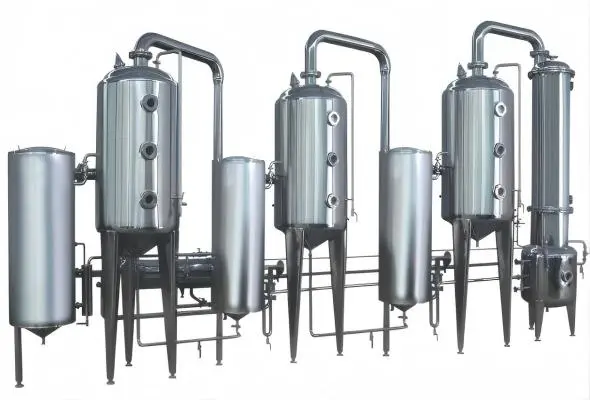
How a Multi-Effect Evaporator Machine Works in a Pharmaceutical Plant
What a Multi-Effect Evaporator Machine Is
Multi-effect evaporator equipment has two or more evaporation stages, termed effects, connected in series. The initial effect is heated by live steam. The vapor boiled out there heats the second effect , which operates at lower pressure , and hence lower boiling point . The pattern repeats at each step. A unit with three or more effects may evaporate many kilos of water per kilogram of live steam, since latent heat is collected rather than vented. Pharmaceutical industries utilize these systems either in batch or continuous mode. The heaters used include falling-film, rising-film or forced-circulation types. Asianbios constructs units with 2 to 5 effects, so the stage count may meet your feed and energy goal.
Core Components and Process Sequence
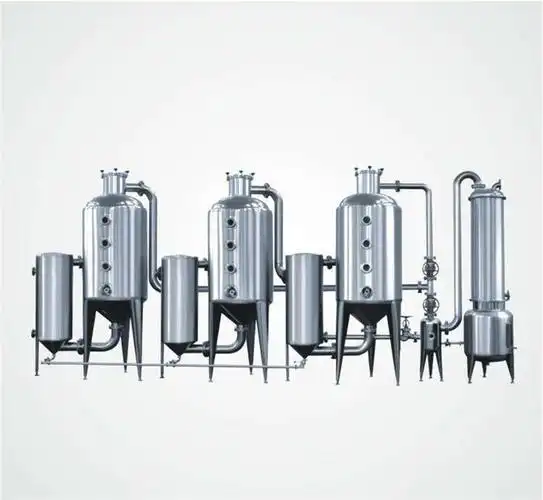
All multi-effect evaporator machines have the same basic components such as the heating chamber, evaporation chamber, condenser, vacuum system, piping and valves, and control system. The method is done in 6 steps:
- The raw liquid is fed into the first-effect heating chamber.
- Steam heating produces vapor and concentrated liquid goes to the separation chamber.
- The secondary vapor from the first effect warms the second effect.
- The cycle is repeated by two to five effects.
- The product is brought to the desired concentration and the vapor is condensed for potential reuse.
- The mechanism automatically discharges finished concentrate while in operation.
With each handoff, the acceptance tests know where to detect temperature, pressure, and flow.
Heat Transfer and Steam Economy in Practice
The heat duty of any multi-effect evaporator machine is Q = U × A × ΔT. Here U = total heat transfer coefficient, A = heating area and ΔT = temperature differential. U is typically between 1000 and over 3000 W/(m2.K) depending on viscosity, boiling point elevation and tube type. Adding effects spreads the available temperature drop across more stages, thus each step has a lower ΔT and requires more space for the same task. That trade-off is the reason steam economy increases with effect count, but not above it. Dissolved solids increase the boiling point , which restricts how many effects remain practical . These computations are described by McCabe, Smith and Harriott in Unit Operations of Chemical Engineering.
Why Pharmaceutical Producers Choose Multi-Effect Evaporation
Lower Steam Consumption Through Vapor Reuse
Steam is generally a major utility expense in a concentration phase. The one-stage evaporation eliminates around 1 kg of water per kg of steam. The multi-effect evaporator machine reuses the secondary vapor and therefore the steam economy increases with every additional effect. We show operational cost savings of up to 70% compared to single-effect systems. The saving realized relies on the operation time, the qualities of the feed and the number of stages. A facility operating 24/7 will have a quicker payback than one that runs just a few batches per week. Reduced steam demand also cuts boiler fuel and associated carbon emissions, which many sites now measure alongside cost.
Gentle Vacuum Operation for Heat-Sensitive Liquids
Many medications in liquid form spoil if they become too hot. In vacuum the boiling point is decreased, such that evaporation may take place at moderate temperatures. Multi-effect evaporator machine is working at 50-90°C, vacuum degree -0.08~-0.098MPa, appropriate for plant extract, fermentation liquid, API solution. But it's not only about maintaining a low temperature for quality. Residence time is just as crucial since the diminishing film heaters lower this, as the liquid runs over the tubes in a thin film. For each product your process engineer should set a temperature limit and confirm the limit by trial runs on representative feed. It is a test of whether activity survives concentration and not a catalog claim.
Hygienic Construction and GMP Alignment
Regulators are concerned about what touches the product. 21 CFR Part 211.65 The surfaces of the equipment should be non-reactive, non-additive and non-absorptive to the medicinal substance. The FDA’s guidance for APIs in the Q7 is similar in its expectations. Grades 304 or 316L stainless steel, smooth surfaces and cleanable design solve these concerns. If there are chlorides or nasty cleaning agents involved then 316L is the standard. All of our devices are manufactured in SUS304 or SUS316L. Small, resistant to corrosion and easy to clean. The PLC system monitors temperature, pressure, flow rate and concentration. The ultimate GMP status will always be up to your own certification procedure.
Pharmaceutical Applications and Evaporator Type Comparison
Liquids and Processes That Suit Multi-Effect Evaporation
These systems are employed in pharmaceutical firms anywhere a dilute liquid needs to be concentrated. Typical feeds include extracts of traditional Chinese medicine, extracts of plants, fermentation liquids, solutions of API, pharmaceutical intermediates, glucose solutions, syrup and salty wastewater. The feeds all behave differently. API solutions need tight control over concentrations and little product loss. Herbal extracts froth and thicken and degrade when heated. Wastewater often includes salts, high COD and suspended solids which foul heating surfaces and hence pre-treatment is typically necessary. Solvent recovery adds the need for an explosion proof and a condenser. Test the actual feed before deciding on a design. Even a little change in particles or viscosity might tip the scales of the right evaporator selection.
Single-Effect Versus Multi-Effect Systems
The table below compares popular alternatives by investment, steam usage and best-fit duty.
| System | Initial cost | Steam use | Typical fit |
|---|---|---|---|
| Single-effect | Lowest | Highest | Small or occasional batches |
| Double- or triple-effect | Moderate | Lower | Mid-size, regular operation |
| Four- or five-effect | Higher | Lowest | Large, continuous plants |
The triple effect units are usually balanced between investment and savings. Five-effect systems pay back largely in continuous plants. A multi-effect evaporator machine is best suited to applications when operation hours are long, steam cost is large, or carbon objectives exist. Boiling point elevation and available steam pressure limits the usable number of impacts. Run the comparison with your actual operation hours.
Falling-Film, Rising-Film, and Forced-Circulation Designs
Falling-Film, Rising-Film and Forced-Circulation Designs "Multi-effect" is the re-use of vapor. The liquid flows through the heater in " falling film " , " rising film " , and " forced circulation " . The two principles may be combined . Falling-film heaters are well suited to low viscosity, heat sensitive liquids because of the short residence period. Rising-film heaters are applicable to feeds of moderate viscosity. Forced-circulation heaters employ a pump to maintain the flow rapid across the tubes, which is helpful with viscous, crystallizing, scaling or solids carrying liquids. We have machines in all three kinds. A design may even rely on forced circulation solely in the last, most concentrated stage when the fouling danger is highest, and falling film in the previous phases.
Asianbios Multi-Effect Evaporator Machine Specifications
Here are the published specifications for our industrial unit.
| Parameter | Specification |
|---|---|
| Evaporation capacity | 1000–50000 kg/h |
| Effects | 2, 3, 4, or 5 (customizable) |
| Evaporation temperature | 50–90°C |
| Degree of vacuum | -0.08 to -0.098 MPa |
| Main material | SUS304 / SUS316L |
| Heating method | Steam |
| Control | PLC automatic |
| Structure | Falling film, rising film, or forced circulation |
| Safety protection | Overheating, overpressure, overload, low level |
| Certification | ISO9001, CE |
These figures let your team check pressure, temperature, and safety needs against your process. US buyers who need ASME code stamping or other local pressure-vessel documentation should raise it during technical exchange, so the scope is agreed before manufacturing starts.
Selecting, Pricing, and Supporting a Multi-Effect Evaporator Machine
Process Data to Prepare Before Requesting a Quote
Selection begins with process data, not a catalog capacity. Below are the elements to collect before you ask for a quotation of a multi-effect evaporator machine.
| Data item | Why it matters |
|---|---|
| Feed and product flow | Sets evaporation duty |
| Start and end concentration | Defines load and effect count |
| Viscosity, foaming, scaling | Selects heater type |
| Temperature limit | Fixes vacuum and stage design |
| Steam, power, cooling water | Confirms utility interfaces |
| Material and documentation | Matches 316L and GMP needs |
This list enables the engineer to estimate the heating area, vacuum range and safety devices without guess work. The most frequent reason an initial quote is subsequently changed is missing data.
Cost and Total Investment
The factors that affect the pricing of multi effect evaporator machine are:
- Capacity
- Effects number
- Surface area of the heating
- Material quality
- Automation level
- Vacuum machines
- Condensers
- Degree of documentation
Don’t judge the machine judge the whole project. Piping, utilities, installation, commissioning, validation assistance, training and replacement parts all contribute to the cost. Equally significant is the life cycle cost including steam, cooling water, electricity, cleaning chemicals, labor and maintenance. To measure payback compare capital input with: Annual operating hours Estimated savings in steam Reduction in wastewater disposal Product recovery Make sure any supplier guaranties performance on established feed parameters. You can't enforce a guarantee that doesn't have particular feed specs.
Installation, Validation, and Maintenance
A multi-effect evaporator machine needs a proper foundation, steam, power and cooling-water connections, drainage, condensate routing and vacuum integration. Usually we install in 20 days and that involves assistance with site planning, equipment assembly, commissioning, training of operators and comprehensive performance testing. In the pharmaceutical business, projects often need drawings, P&IDs, material certificates, FAT, SAT, welding records, and IQ/OQ support, so ensure you verify what your supplier is giving in the contract. Routine maintenance includes fouling of heating surfaces, pumps, mechanical seals, valves, condensers, vacuum equipment and instrument calibration. Fouling or change in feed is usually indicated by falling capacity, foaming or carryover. It is generally corrected by cleaning or changing the method.
How to Evaluate a Multi-Effect Evaporator Machine Supplier
Look for established evaporation experience, process engineering skills, sanitary fabrication and automation. Check traceability documentation for stainless steel, competent welding, polishing, pressure testing and calibration. For cross border orders, please confirm export packaging, remote design review, FAT, commissioning and after sales assistance. Common difficulties include sea freight damage, late commissioning. We provide 24/7 technical support and remote monitoring and have spare parts in stock for quick delivery. Our multi effect evaporator machine is ISO9001 and CE certified. A decent estimate will spell out the performance guaranties, the documentation, the delivery time, the warranty, the local requirements and the replacement parts.
Conclusion
Medicinal liquids are concentrated in multi-effect evaporator machine devices by passing the vapor from one effect to another. This lowers steam usage compared to single effect evaporation. Vacuum operation lowers the boiling temperature and protects heat-sensitive APIs, extracts and fermentation solutions; 304 or 316L stainless steel and cleanable design exceed GMP regulations. Feed choices may range from API solutions to salty wastewater, and the kind of heater – falling film, rising film, or forced circulation – is controlled by viscosity, fouling, and temperature limits. The process data starts the selection. You need to examine the cost throughout the whole lifetime, including utilities, installation, validation and maintenance. Supplier checks on traceability, testing, and documentation and support complete the selection. In the end, the savings are about matching the effect count and heater type to the actual feed and operating hours.
FAQ
1. How many effects should a multi-effect evaporator machine have?
Effect count is a trade off between capital cost and steam savings. Three-effect units are suitable for a wide range of plants. Four- or five-effect systems pay back in continuous, high-volume operation. The usable quantity is limited by boiling point elevation. First, give your feed data.
2. Can a multi-effect evaporator machine handle heat-sensitive products?
Yes, if they are intended for it. Vacuum evaporation at 50-90C with falling-film heater for short residence duration protects many delicate liquids. Check temperature limitations by doing a test with your own feed.
3. What information do you need for a quotation?
Feed type, capacity, start and end concentration, temperature limit, operating mode, steam, power and cooling-water conditions. Material grade and documentation required. Accurate sizing and performance pledges depend on clear data.
Request a Multi-Effect Evaporator Machine Quote from Asianbios
Are you planning a concentration or wastewater-reduction project? Asianbios provides multi-effect evaporator machine with capacity of 1000-50000 kg/h, 2-5 effects, SUS304/SUS316L construction and PLC control. We also offer installation assistance and 24/7 technical service as a producer of multi-effect evaporator machines. Just send us your feed data at plantex@asianbios.com and our engineers will offer a setup. For further information, see the website: asianbios.com.
References
1. Unit Operations of Chemical Engineering, 2005
2. Perry's Chemical Engineers' Handbook, 2018
3. Chemical Process Equipment: Selection and Design, 2012
4. ASME Boiler and Pressure Vessel Code, Section VIII, 2023
5. ASME BPE Bioprocessing Equipment, 2022
6. FDA Guidance for Industry Q7 Good Manufacturing Practice Guidance for Active Pharmaceutical Ingredients, 2016
About the Author

Asianbios
Our purpose is to forge a legacy of stewardship, advancing initiatives that honor and preserve the ecological integrity of our planet.

Send Inquiry


Related Industry Knowledge
- Why Use a Compressor-type Low-Temperature Evaporator System?
- How to Use anti-inflammatory peptides powder in Soothing Skincare
- Elastic Peptides in Skincare: The Future of Ageing Care
- What Is Xiaobai Peptide? A Beginner’s Guide to Its Research
- The Power of Natural Blueberry Extract in Cosmetics
- The Best Natural Sleep Aid Brewing Powder to Help You Fall Asleep Faster
- The Ultimate Guide to Pure Glutathione
- Production Technology of Erythritol and its Applications
- Why Freeze Dried Kiwi Powder Is Trending: Health Benefits and Best Ways to Use It
- What Is Vitamin C Production Technology? Industry Overview