How Does Amylase Production by Fermentation Work?
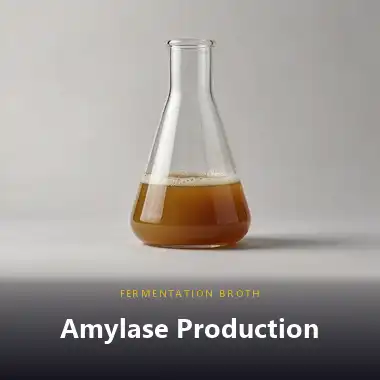
Amylase production by fermentation works by growing a selected microbe, such as Bacillus subtilis or Aspergillus niger, in a controlled tank of nutrient broth. The microbe releases amylase into the liquid as it grows. Operators control temperature, pH, air supply, and time, then harvest the broth at peak activity. Filtration, concentration, and standardization turn that broth into a stable enzyme product, such as a light yellow powder. I wrote this guide for plant managers and chief engineers who plan to build or upgrade an enzyme line. It covers microbes, process steps, quality checks, and supplier selection.
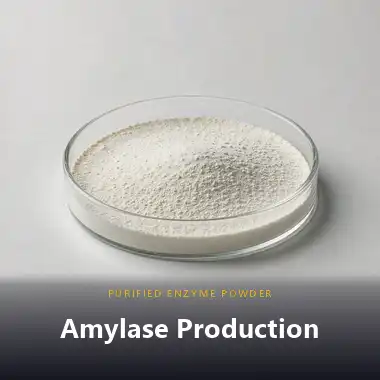
What Is Amylase Production by Fermentation?
How Do Microbes Turn Nutrients into Amylase?
Amylases are enzymes that break starch into smaller sugars. In amylase production by fermentation, a microbe consumes carbon and nitrogen from a prepared medium and secretes the enzyme into the surrounding liquid. Because the enzyme sits outside the cells, the plant can remove the cells and keep the enzyme in the broth. Intracellular enzymes need cell disruption first, which adds steps and cost. Fermentation is only the first stage. Recovery, purification, and formulation come afterward and shape final activity, color, and shelf life. Reviews estimate that amylases hold about a quarter of the global enzyme market, so many factories treat this line as a core product.
Why Does Fermentation Beat Plant or Animal Extraction?
Older amylase sources include malted grain and animal pancreas. Those materials change with harvest, animal source, and storage, so activity swings from lot to lot. Amylase production by fermentation uses a defined strain, a written medium recipe, and recorded process data. That gives a plant steady quality, year-round output, and clear lot traceability for audits. It also lets engineers pick the enzyme type: α-amylase from Bacillus subtilis to thin starch, or glucoamylase from Aspergillus niger to release glucose. The goals stay simple: high activity, stable performance, low side activity, controlled cost, and repeatable batches. Those goals guide every choice in the sections below.
Which Microorganisms Do Manufacturers Use?
Two groups dominate commercial amylase production by fermentation. Bacillus species grow fast, secrete enzyme straight into the broth, and fit submerged tanks. Aspergillus species secrete strongly and also suit solid-state culture. The right pick depends on enzyme type, target pH and temperature, and the platform you already own. Table 1 compares the two groups.
| Factor | Bacillus (e.g., B. subtilis) | Aspergillus (e.g., A. niger) |
|---|---|---|
| Common product | α-amylase | Glucoamylase, fungal amylase |
| Growth | Fast, single cells | Slower, filamentous |
| Platform | Submerged tanks | Submerged or solid-state |
| Watch point | Phage and contamination | Broth viscosity, oxygen transfer |
No single microbe wins every case. Strain stability, regulatory status, and scale-up behavior matter as much as lab titer, so ask for pilot data and strain authorization papers before you sign.
How Does the Amylase Fermentation Process Work?
From Strain Bank to Fermenter
Every amylase production by fermentation campaign starts with a maintained production strain stored in a master cell bank, so each batch begins from the same genetic source. Technicians revive a vial, grow it on a plate, then move it into shake flasks and a small seed tank. Each step raises culture volume until the seed can inoculate the main fermenter. The production medium usually pairs a starch or dextrin carbon source with a nitrogen source such as soybean meal or yeast extract, plus minerals. Operators sterilize the medium and tank, inoculate, and then track temperature, pH, agitation, aeration, dissolved oxygen, and foam. Weak inoculum causes slow starts and raises contamination risk, so seed-train control matters.
Submerged vs. Solid-State Fermentation
Most industrial plants run submerged fermentation, where cells grow in liquid. Solid-state fermentation grows fungi on moist bran or cereal residue. Table 2 shows the trade-offs.
| Factor | Submerged | Solid-state |
|---|---|---|
| pH, temperature, oxygen control | Strong; easy sampling | Harder; heat and moisture vary |
| Water use | Higher | Lower |
| Recovery | Filter or centrifuge broth | Extract enzyme from solids first |
| Automation | Well developed | Less common |
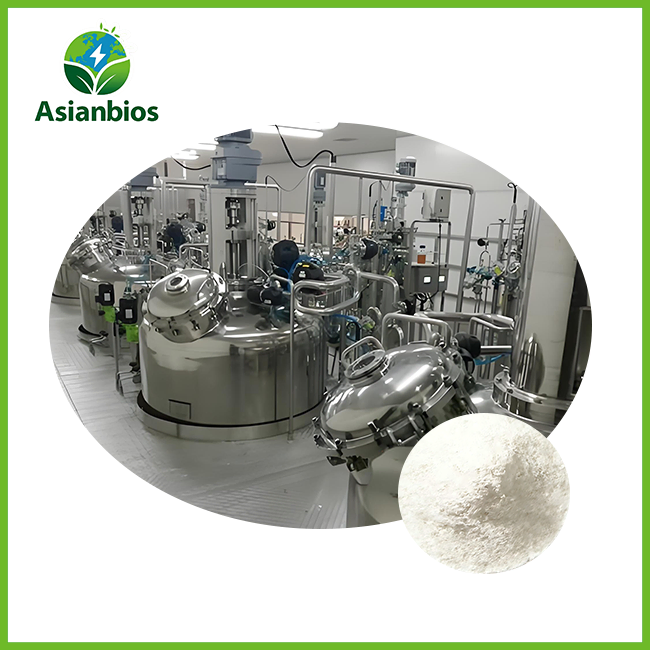
Solid-state systems can save water, yet heat removal and enzyme recovery demand more effort. Compare recovery-adjusted activity, product quality, capital cost, and total cost, not yield alone. Asianbios builds its amylase production by fermentation technology around microbial deep liquid fermentation in controlled tanks.
Recovery, Formulation, and Packaging
After harvest in amylase production by fermentation, filtration or centrifugation removes cells and solids from the broth. Concentration raises enzyme strength, and clarification removes fine particles. Standardization then sets activity to a declared unit using a carrier, so every lot doses the same way. Depending on the product form, plants stabilize the concentrate and dry it into powder or granules. Our amylase product ships as a light yellow powder in 25 kg barrels. Lot records link each barrel to its batch, and storage away from heat and moisture protects activity. Shipping options include express delivery, air freight, and sea freight, chosen by order size.
Which Conditions Control Amylase Production by Fermentation and Scale-Up?
Culture Conditions That Move Activity
In amylase production by fermentation, temperature, pH, and nutrients decide how much enzyme the strain makes. Many Bacillus runs sit near 30 to 40 °C with a near-neutral starting pH, though every strain has its own optimum, and many batches finish in one to three days. The temperature that grows the cells can differ from the temperature where the finished enzyme works best. Carbon and nitrogen balance matters: too much easily used sugar, such as glucose, can trigger catabolite repression and cut amylase output. Dense, viscous cultures can run short of oxygen, so agitation and aeration must hold dissolved oxygen steady. Harvesting at the activity peak prevents enzyme loss and wasted tank time.
How Do Manufacturers Improve Strains and Scale Up?
Manufacturers raise titer through natural strain selection, mutagenesis, or recombinant engineering. Targets include higher expression, better secretion, stronger thermostability, wider pH tolerance, and lower protease side activity. In the lab, structured experiments test medium, pH, temperature, inoculum, aeration, and time, and teams judge results by productivity, recovery, stability, and performance in the real application. Scale-up adds new limits: oxygen transfer, heat removal, mixing time, foam, mycelial morphology, and shear. A pilot run at meaningful volume tests these limits before a plant commits capital, and statistical process control keeps later batches steady. Amylase production by fermentation only pays back when pilot results hold at commercial size.
Common Problems and How to Avoid Them
Strong lab results in amylase production by fermentation do not always become steady commercial value. Batch variation usually traces to inconsistent raw materials, unstable inoculum, pH or temperature drift, oxygen limits, contamination, or a wrong harvest endpoint. Recovery losses and weak storage stability can also erase a high titer. Fix these with written raw-material specifications, a controlled seed train, calibrated sensors, in-process activity tests, and batch trend charts. Handle the concentrate gently downstream to protect activity and shelf life. For a factory owner, these controls protect yield, and yield drives payback, so ask any technology provider how it tracks them during pilot and commissioning.
How Is Fermentation-Derived Amylase Tested and Qualified?
How Do Labs Measure Activity?
Every amylase production by fermentation lot needs a defined assay and a clear unit. Labs commonly use the DNS method, which measures reducing sugars, or the Phadebas test, which uses a dyed starch substrate. Declared units, such as KNU/g or U/g, only mean something when the assay states pH, temperature, and substrate. Ask for specific activity, protein content, moisture, pH profile, thermal performance, and storage stability as well. A high number from one assay does not guarantee lower dosage in your process. If two suppliers report different units, request conversion data before you compare price. Test samples in your own substrate when you can.
What Safety and Purity Checks Apply?
Food-grade amylase usually faces microbial limits, absence of Salmonella and E. coli, heavy-metal limits, and checks for residual processing materials. Buyers also request allergen and GMO declarations and tests for unwanted enzyme activities. When a recombinant host makes the enzyme, specifications often require that the production organism is absent from the final product, which filtration and ultrafiltration support. US buyers also commonly check Food Chemicals Codex (FCC) and JECFA specifications and ask about GRAS status. Confirm current requirements for your product and market, since limits differ by application and region. These checks decide whether amylase production by fermentation output meets a buyer's approval rules.
Which Documents Do Buyers Request?
International procurement usually asks for a paper trail. Table 3 lists the files I suggest requesting before approval.
| Document | What it shows |
|---|---|
| Certificate of Analysis (COA) | Lot activity, moisture, microbial and metal results |
| Technical and safety data sheets | Application range, handling, storage |
| Regulatory statements | FCC, JECFA, GRAS, GMO, and allergen status |
| Traceability and shelf-life records | Batch history and validated storage data |
Store these records with each lot so audits and customer questions get fast answers. A strain authorization letter belongs in the same folder for factories that run their own line. Match each file to your target market, then compare it with the supplier's actual lot data. Missing paperwork can signal weak process control.
How Should You Choose a Supplier for Amylase Production by Fermentation?
Match the Enzyme to Your Application
Requirements differ among starch liquefaction, glucose syrup, brewing, baking, feed, textile desizing, and bio-alcohol. Each use changes how amylase production by fermentation should be tuned. Alpha-amylase thins starch by cutting internal bonds, while glucoamylase releases glucose from the chain ends, so a saccharification line needs a different product than a liquefaction line. A thermostable grade suits high-temperature liquefaction, while a milder grade suits baking. Review operating pH, temperature, thermostability, calcium dependence, dosage, product form, and application data. Our technology supports food-grade and industrial-grade amylase for these uses, and OEM/ODM service is available. Ask for dosage trials in your own substrate instead of relying on catalog values.
How Do You Judge Suppliers Beyond Price?
The lowest unit price may not give the lowest total cost if dosage or batch consistency is poor. Request lot data from recent batches. Check fermentation technology, capacity, quality systems, export experience, technical support, custom formulation, lead time, packaging, and supply continuity. Asianbios lists CGMP, FSSC22000, ISO9001, HALAL, KOSHER, Organic, and HACCP certificates, and you should confirm the scope for your product. We offer a 1 kg minimum order with samples, and our technicians and laboratory can provide experimental verification and technical guidance. Customized products have a production cycle of around 20 working days, and urgent small batches can use our Green Channel service.
The 30/70 Rule for Building Your Own Line
If you plan an in-house line, the amylase production technology is only part of success. Our view is that success equals 30 percent process plus 70 percent localization. Localization means building to local legal norms, forming a supply-chain and sales team, and strengthening team management. Asianbios provides standardized technical packages and continued support, including customized process design, new plant construction, and production-line upgrades. Before signing, request the file list in writing: process flow, P&ID, plant layout, equipment list, energy and consumption data, and training plan. Also confirm strain authorization, pilot data, and the commissioning schedule, since each one affects startup timing and legal safety.
Conclusion
Amylase production by fermentation turns a selected microbe, a controlled medium, and tight process control into a repeatable enzyme product. Bacillus and Aspergillus suit different enzymes and platforms, and submerged tanks give tighter control than solid-state culture. Yield depends on strain, medium, pH, temperature, oxygen, inoculum, and harvest timing, while scale-up adds heat, mixing, and shear limits that pilot runs must test. Recovery and formulation shape final activity, and assay methods, safety data, and documents prove it. Buyers get the best result when they compare suppliers on dosage, batch consistency, certificates, and technical support rather than price alone. For a new line, the 30 percent process and 70 percent localization view shows that legal compliance, staffing, and management decide results as much as the process itself.
FAQ
1. Why do manufacturers use fermentation to make amylase?
Amylase production by fermentation gives controlled, repeatable quality, year-round output, and lot traceability that plant or animal extraction cannot match. A defined strain and recorded process data make audits easier. It also lets engineers choose the enzyme type.
2. Which microbes make industrial amylase?
Bacillus subtilis is a common source of α-amylase, and Aspergillus niger is a common source of glucoamylase. Both grow in controlled tanks. Strain choice should match your target pH, temperature, and platform.
3. What affects amylase yield the most?
Strain choice, medium, pH, temperature, oxygen transfer, inoculum quality, fermentation time, and downstream recovery all change final yield. Weakness in any one can cut output.
4. What should I ask before ordering amylase?
Ask about activity units, assay method, application data, safety documents, shelf life, and certificates. Asianbios supplies a light yellow powder in 25 kg barrels, with a 1 kg minimum order, samples, and OEM/ODM service. Request a sample to test in your process.
Request an Amylase Sample from Asianbios for Amylase Production by Fermentation
Asianbios acts as your amylase production by fermentation supplier for enzyme plants, starch processors, brewers, bakers, and feed producers. Request an amylase sample, product specification, or customized fermentation consultation today. Email your application, pH and temperature range, target activity, order volume, and destination to plantex@asianbios.com. Our technicians and laboratory can verify your trial. We support OEM/ODM, samples from 1 kg, and 25 kg barrels. Visit asianbios.com for details.
References
- Gupta R., Gigras P., Mohapatra H., Goswami V.K., Chauhan B. Microbial α-amylases: a biotechnological perspective. Process Biochemistry, 2003.
- Sundarram A., Murthy T.P.K. α-Amylase production and applications: a review. Journal of Applied & Environmental Microbiology, 2014.
- Pandey A., Nigam P., Soccol C.R., Soccol V.T., Singh D., Mohan R. Advances in microbial amylases. Biotechnology and Applied Biochemistry, 2000.
- de Souza P.M., Magalhães P.O. Application of microbial α-amylase in industry: a review. Brazilian Journal of Microbiology, 2010.
- Singh R., Kumar M., Mittal A., Mehta P.K. Microbial enzymes: industrial progress in 21st century. 3 Biotech, 2016.
- Polaina J., MacCabe A.P. (eds.) Industrial Enzymes: Structure, Function and Applications. Springer, 2007.
About the Author

Asianbios
Our purpose is to forge a legacy of stewardship, advancing initiatives that honor and preserve the ecological integrity of our planet.

Send Inquiry
Related Industry Knowledge
- What is jujube powder used for?
- Amylase Production by Fermentation: A Step-by-Step Process Guide
- Inside Production Technology Of Hyaluronic Acid: Purification
- Angelica Sinensis Extract Powder for Beginners
- Choosing the Right Flash Dryer Device for Your Plant
- Liquorice Extract Powder: Benefits, Uses, and Function
- Best Tryptophan Production Technology for Feed Industry
- Is grape powder good for you?
- What Is Glutathione Production Technology Explained?
- Uses of Sleep Aid Capsule for Insomnia Relief Routine